
Deep inside the limestone canyons that cut across the borderlands of Texas and northern Mexico, ancient murals stretch across cliff walls in sweeping tapestries of color. For decades, archaeologists knew they were old—what they did not know was how old, or how far their cultural influence may have travelled. A new study in Science Advances finally anchors these enigmatic works in time, revealing a painting tradition that endured longer than most civilizations and may have shaped the cosmologies of later Mesoamerican societies.
The study establishes the clearest timeline ever produced for North American rock art. Led by Karen L. Steelman, Carolyn E. Boyd ve J. Phil Dering, the research directly dated 57 individual pictographs and combined them with 25 radiocarbon samples from calcium oxalate crusts that formed naturally above and beneath the paint layers. The outcome is remarkable: the Pecos River style—one of the most intricate and symbolically dense rock art traditions known—emerged between 5,760 and 5,385 years ago and continued in use for more than four millennia.
This places the murals within a timespan far longer than the rise and fall of Egypt’s Old Kingdom, the construction of Stonehenge, or the earliest sedentary settlements in the Andes. The people who painted these walls were mobile hunter-gatherers of the Lower Pecos Canyonlands, a rugged ecological crossroads where three biomes intersect. For at least 12,500 years, these canyons were a cultural home to successive communities—but nothing they left behind is as visually commanding, or as symbolically loaded, as these murals.
A Landscape Turned Into a Living Archive
The Pecos River compositions are often monumental. Some stretch 150 meters in length, their ceilings and walls covered with anthropomorphic, animal, and abstract figures arranged in deliberate, multilayered sequences of red, black, yellow, orange, and white. From small 10-centimeter figures to towering 8-meter silhouettes, the artists relied on scaffolding, coordinated labor, and a consistent symbolic grammar.
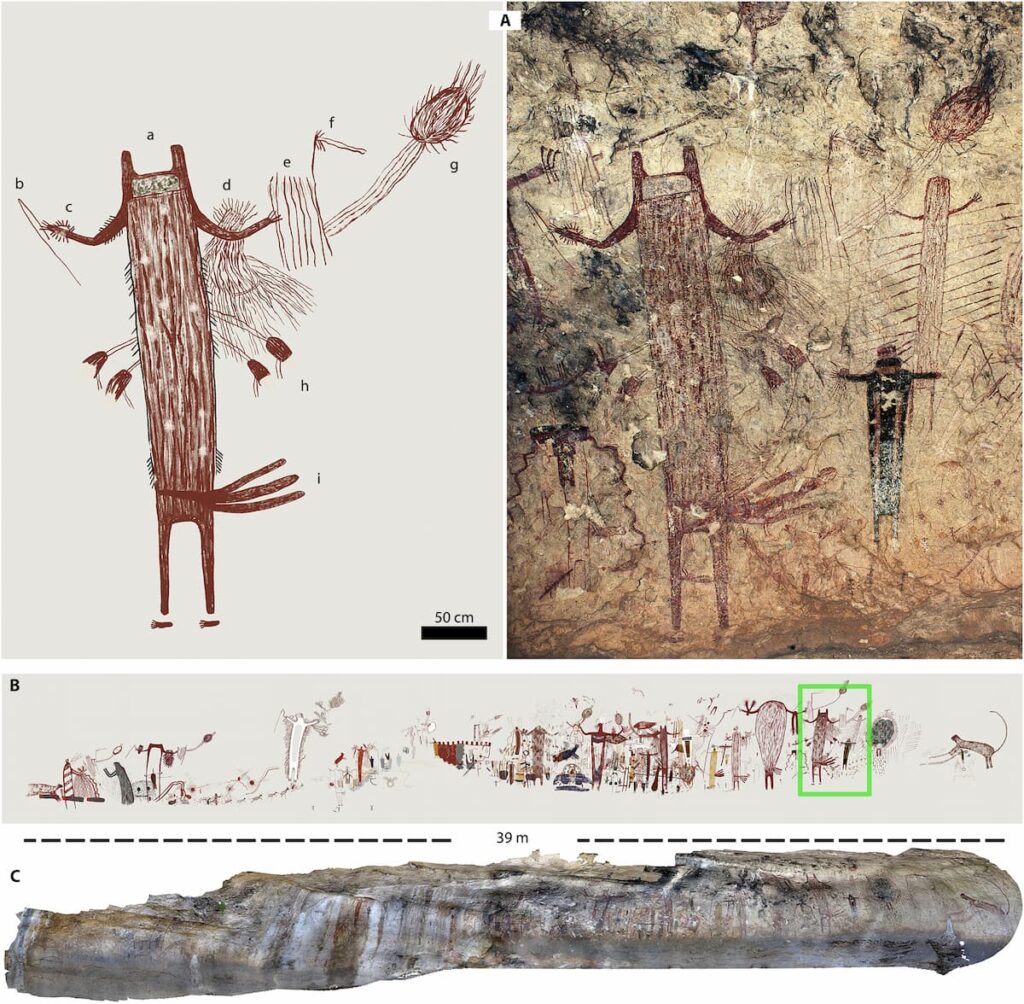
Among the most persistent motifs is the “sacred bundle”—an oval, seedpod-like form extending from the non-dominant arm of a human figure, framed by parallel lines. Other characters wear elaborate headdresses that resemble rabbit ears or antler racks, carry atlatls, or display intricate wrist and elbow adornments. Nothing resembles casual decoration; everything suggests encoded meaning.
A Technical Breakthrough: Dating the Undatable
Rock art is notoriously difficult to date, but this research overcame the barriers through two independent techniques.
The first was direct AMS radiocarbon dating of organic binders mixed into the paint. Pecos River pigments were largely mineral—iron oxides for reds and yellows, manganese for blacks—but the binders appear to have included plant resins and deer bone marrow fat. Using plasma oxidation, researchers extracted minute amounts of carbon while preserving the inorganic pigment and limestone substrate.
The second method dated calcium oxalate crusts formed naturally on the canyon walls. Crusts beneath the paint offer a maximum age; crusts above it provide a minimum age. In site after site, these indirect ages aligned with the direct paint dates, creating an unusually robust chronological framework. Controls taken from unpainted limestone confirmed the absence of contaminating carbon, strengthening the dataset even further.
One Story, Painted Once—Then Left Untouched
Perhaps the study’s most striking revelation is not chronological but conceptual. Through digital microscopy, the team examined 588 paint overlaps across multiple panels. At 535 intersections, the same sequence appeared: black applied first, then red, followed by yellow, and finally white. Only ten exceptions existed.
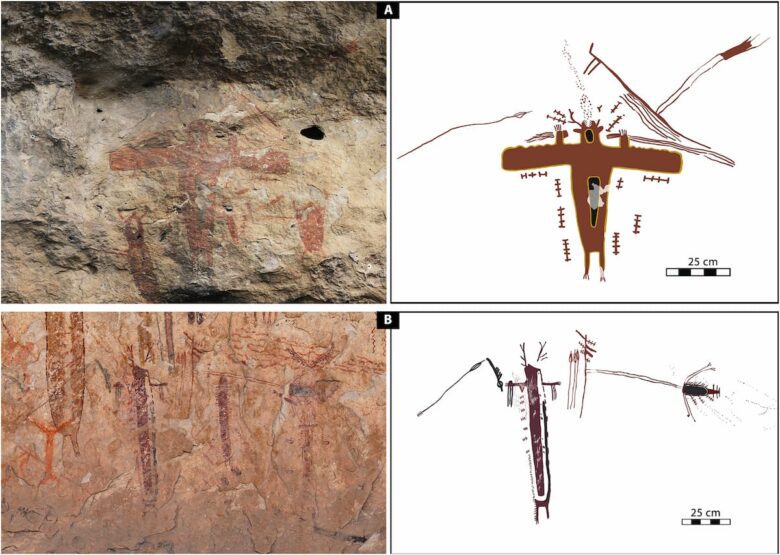
This consistency indicates that the murals were not cumulative palimpsests created over generations. Instead, they were planned compositions, executed in single, coordinated painting episodes. Radiocarbon dates from each layer within a panel were statistically indistinguishable, reinforcing the idea of unified narrative artworks rather than incremental deposits of imagery.
A Tradition That Survived 175 Generations
By modeling the dates through Bayesian analysis, the researchers reconstructed a tradition spanning 4,095 to 4,780 years, roughly 175 generations. Through dramatic environmental shifts—extended droughts, wetter intervals, changes in bison populations, technological transitions such as the introduction of the bow and arrow—the core visual system remained stable.
That degree of continuity is almost unparalleled in world prehistory.
A Cosmology With Deep American Roots
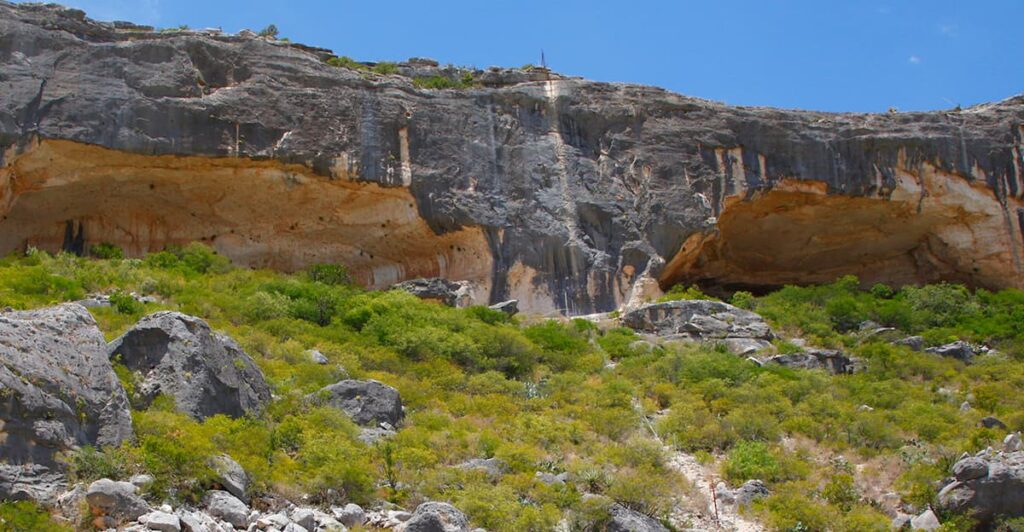
Why did nomadic communities return to these shelters for millennia to produce artworks of such scale and precision? The authors argue that the canyons themselves were perceived as charged cultural landscapes—places where the boundaries between the physical and spiritual worlds thinned. In many Indigenous perspectives today, the murals are still understood as living entities, active transmitters of ancestral knowledge.
This interpretation aligns with broader theoretical work by scholars such as López Austin, who proposed that Mesoamerican civilizations inherited a deeply rooted cosmological “hard core”—a conceptual foundation resistant to change. The motifs in the Pecos River murals, and their astonishing temporal longevity, appear to fit squarely within that framework.
Some symbols echo later Aztec (Nahua) narratives; others resonate with spiritual concepts among the Huichol (Wixárika). The new chronological evidence finally makes such connections plausible. The Pecos River murals may represent the earliest surviving visual expression of a pan-American worldview, one that took shape thousands of years before the rise of agriculture or urban societies in Mesoamerica.
In other words, these canyon walls may preserve the oldest coherent cosmological tradition ever identified in the Americas—a sacred story painted long before the first Maya hieroglyph, long before the Olmec heads, and over a span of time longer than the distance between us and the builders of the Egyptian pyramids.
Cover Image: Antropomorfo de 41VV83 con muchos de los atributos característicos del estilo del río Pecos. Crédito: Carolyn E. Boyd / K.L. Steelman et al. 2025
Karen L. Steelman et al., Mapping the chronology of an ancient cosmovision: 4000 years of continuity in Pecos River style mural painting and symbolism. Sci. Adv. 11, eadx7205(2025). DOI:10.1126/sciadv.adx7205