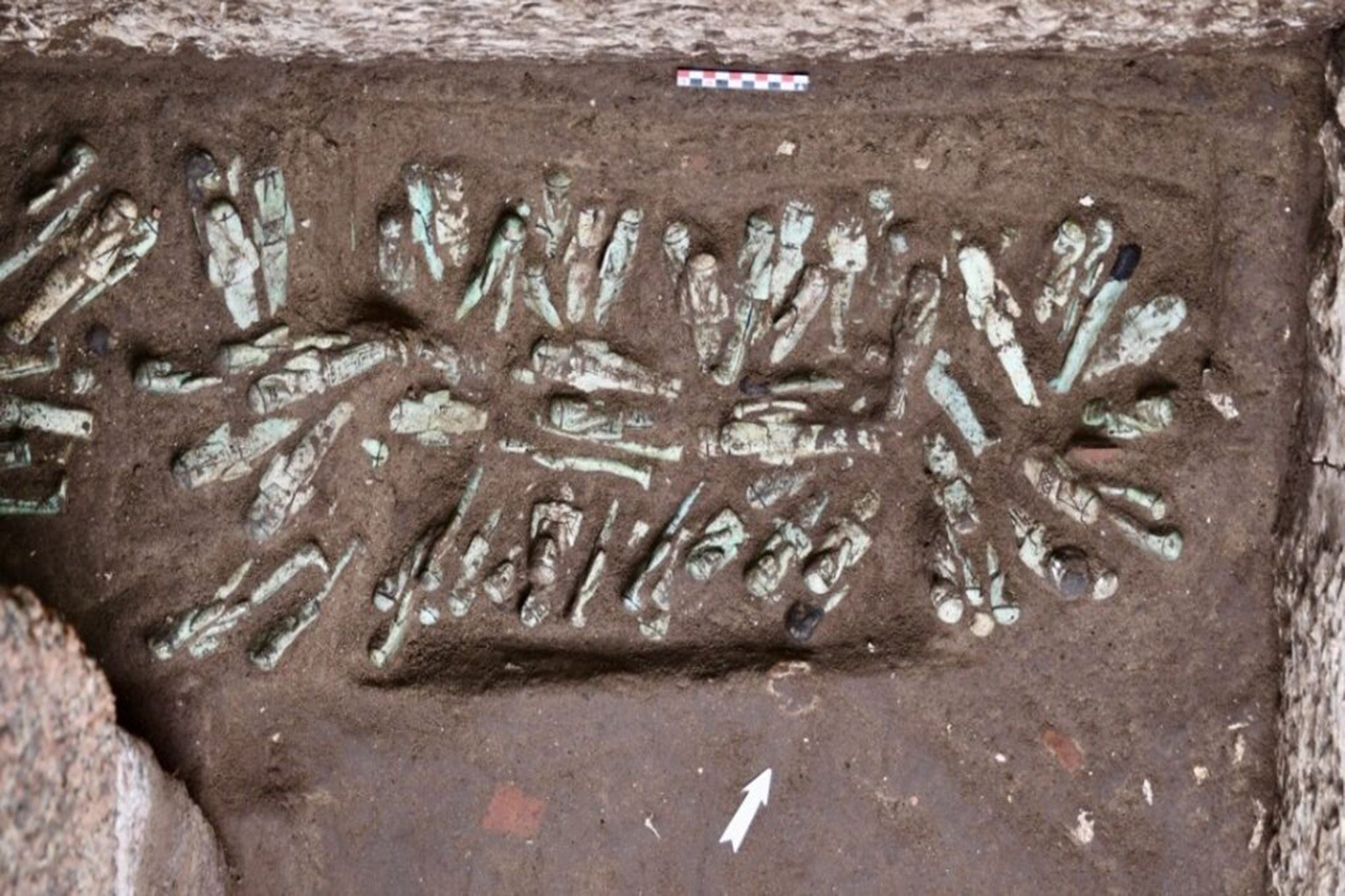
A mystery in the royal necropolis of northern Egypt has taken an unexpected turn after 225 ushabti figurines—inscribed for Pharaoh Shoshenq III—were found inside the tomb of his predecessor, Osorkon II.
A new round of conservation work in the ancient city of Tanis has revealed one of the most intriguing reversals of identity in Egypt’s Third Intermediate Period. A French archaeological mission cleaning the interior of Osorkon II’s 22nd Dynasty tomb uncovered hundreds of faience ushabtis lying exactly where they had been placed more than 2,700 years ago—yet none of them belonged to the pharaoh whose burial chamber they were found in.
Instead, their hieroglyphic inscriptions identify them as funerary servants of Shoshenq III, who ruled several decades after Osorkon II. The figurines were still neatly grouped near an uninscribed granite sarcophagus, a detail that has now become central to understanding a long-standing puzzle in Tanis’ royal burials.
A Tomb Rediscovered—and a Royal Lineage in Disarray
The limestone tomb complex was first brought to light in 1939 by French Egyptologist Pierre Montet, just beside the Temple of Amun. Even then, it was clear that the burial had suffered extensive looting in antiquity. Yet among the debris Montet identified the granite sarcophagus of Osorkon II, along with his canopic jars and the burials of both his father and his son.
One chamber, however, contained an enigma: a fourth sarcophagus, massive, uninscribed, and empty.
For decades, Egyptologists debated whom this anonymous coffin was meant for. Now, the renewed fieldwork—part of a project to protect the monument from environmental threats—has provided the missing clue. As conservators removed layers of compacted silt from the northern chamber, the clustered ushabtis of Shoshenq III emerged exactly where they had originally been placed.
The find suggests the uninscribed sarcophagus was not anonymous at all—it was the hidden resting place of Shoshenq III himself.
Why Was Shoshenq III Buried in Someone Else’s Tomb?
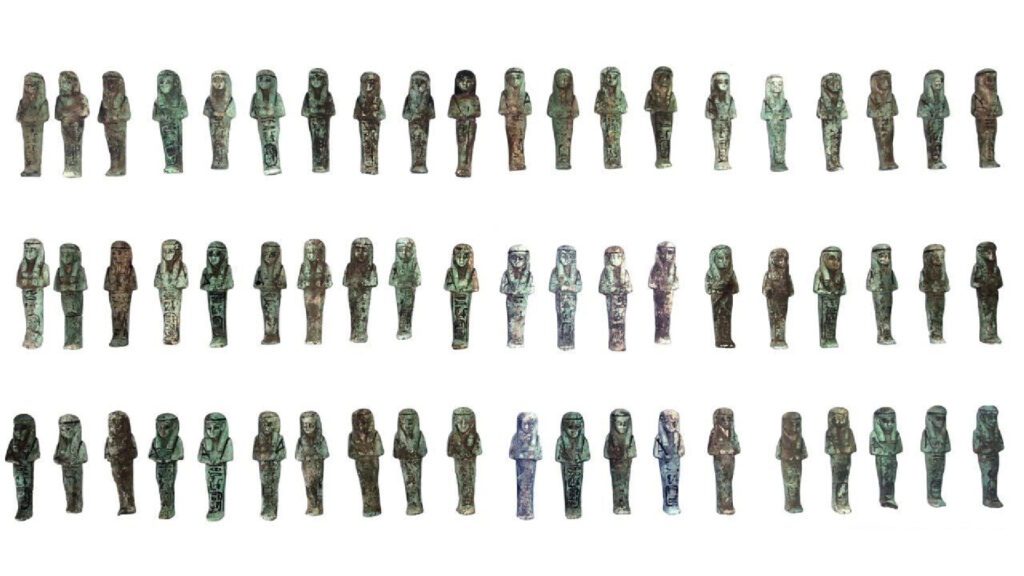
The newly discovered ushabtis are not the only link. Freshly recorded wall inscriptions within the chamber also mention Shoshenq III, reinforcing the possibility that he was intentionally placed in an unmarked coffin inside Osorkon II’s tomb.
Such a move would have been unusual but not impossible during a politically fragmented era. Burying a pharaoh discreetly inside the tomb of a predecessor may have been a security measure meant to protect his body from pillagers—a fear with deep roots in Egyptian mortuary culture.
Curiously, the tomb traditionally attributed to Shoshenq III contains artifacts bearing the name of Shoshenq IV. This raises the possibility that Shoshenq IV seized that burial and relocated Shoshenq III to Osorkon II’s complex, leaving behind a confusing overlap of names, objects, and displaced remains.
With the new evidence in hand, archaeologists now see the ushabtis as the decisive key to unravelling this royal reshuffling.