
The first time researchers blew into the ancient Charonia shells, the lab filled with a low, resonant tone — the kind of sound that could roll across valleys, reach distant settlements, and mark the presence of a community long gone. According to a new study in Antiquity, these shells were not simple curiosities. They were precision-modified instruments used by Neolithic groups in Catalonia to signal, gather, and perhaps even perform music nearly 6,000 years ago.
A Multidisciplinary Team Reconstructs the Voices of Prehistoric Iberia
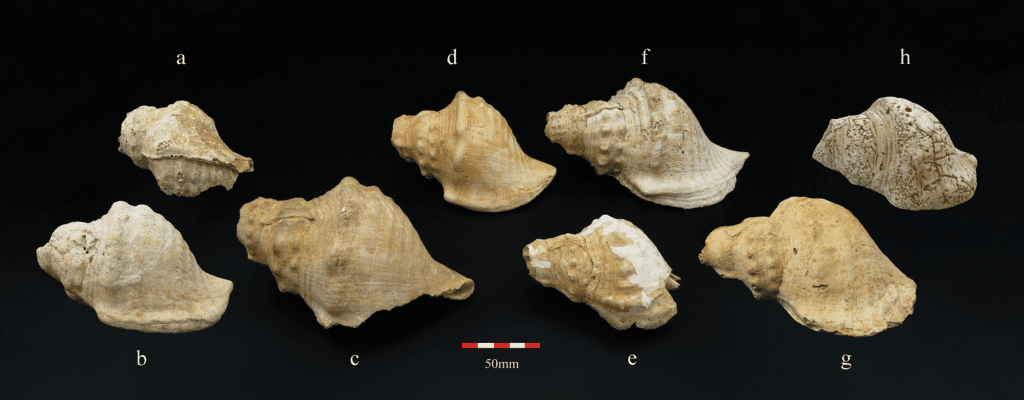
The research, led by Dr. Víctor Manuel López-Montalvo (Université de Toulouse / ICAC) and supported by a team including Dr. Rafael Micó (Universitat Autònoma de Barcelona), Dr. María Gutiérrez (Universidad de Alcalá), and specialists in acoustics and experimental archaeology, combines technological analysis, residue studies, 3D microscopy and experimental sound testing to reinterpret 12 shell trumpets recovered from Neolithic and Chalcolithic sites across Catalonia.
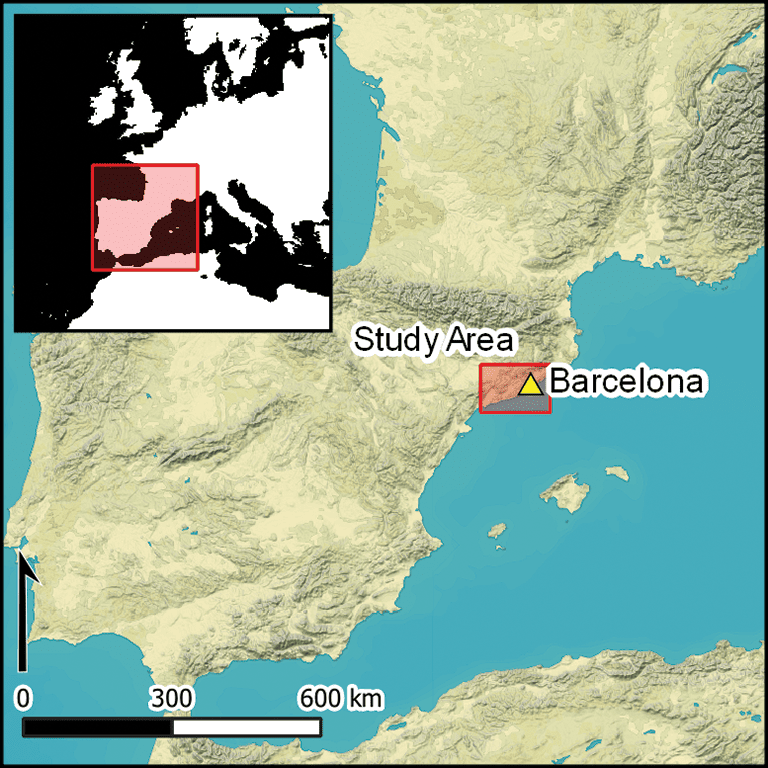
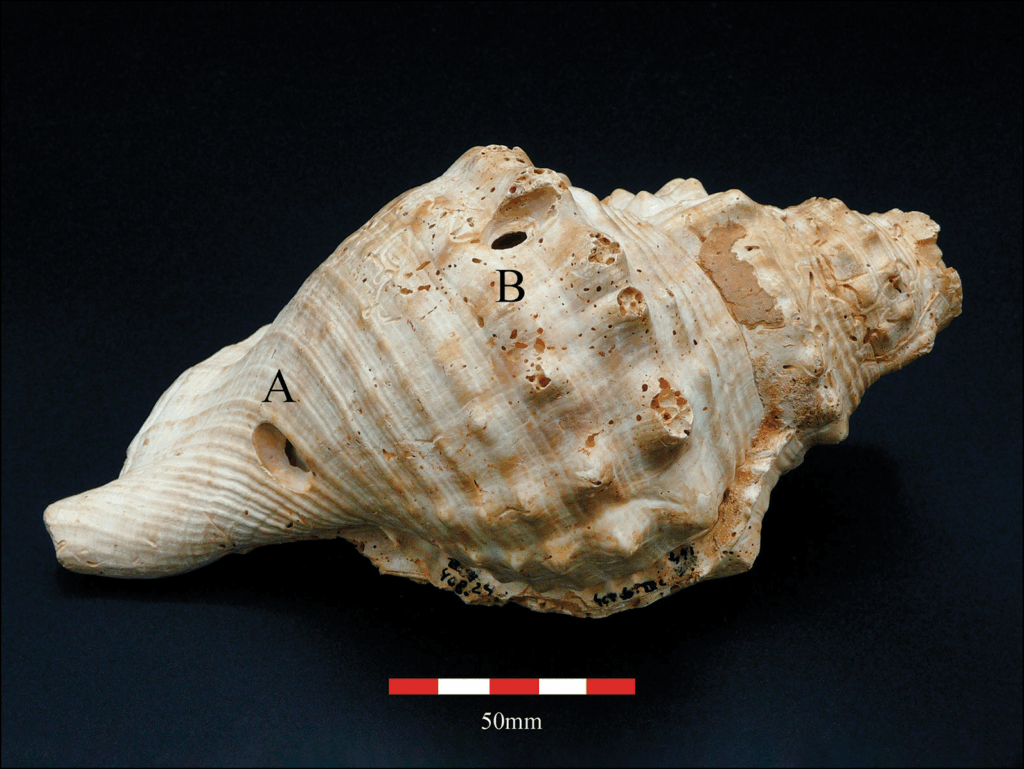
The team demonstrates that many of these shells — primarily of the species Charonia lampas and Charonia nodifera — were intentionally perforated, reshaped, and fitted with organic mouthpieces that are now preserved as microscopic residues. Their findings overturn earlier assumptions that these objects were symbolic or decorative. Instead, the shells form one of the oldest documented acoustic communication systems in Europe.
What the Study Reveals
The researchers identified:
- Deliberate modifications to the apex of the shells, allowing airflow to produce stable tones.
- Use-polish and organic residues indicating mouthpiece fittings made of bone or plant materials.
- Acoustic tests showing that at least eight shells can still be played today, producing consistent low-frequency notes between 255–315 Hz, strong enough to travel long distances across open landscapes.
- Contextual patterns suggesting the instruments were used in ceremonial spaces, settlement peripheries, and elevated outdoor sites, consistent with communal signalling or ritual performance.
A Neolithic Soundscape Comes into Focus
Archaeoacoustic experiments show that these shells can serve dual purposes:
They can broadcast sharp calls used for long-distance signalling, yet they can also produce modulated tones when combined with rhythmic blowing, suggesting a clear musical potential.
The authors argue that the instruments likely structured social gatherings, coordinated collective labour, marked boundaries, and forged communal identity — a social technology that would have been as meaningful as architecture, pottery or figurines.
A Rare Glimpse into Prehistoric Social Coordination
By demonstrating that these shells functioned as both tools of communication and musical instruments, the study positions Neolithic Catalonia as one of the earliest regions in Europe with a recognizable sound-based social network.
According to López-Montalvo, these instruments “expanded the sensory landscape of Neolithic communities,” enabling early societies to organize their world not only through built structures but also through the powerful medium of sound.
DOI: https://doi.org/10.15184/aqy.2025.10220
Cover Image: Details of the apical cut from the shell trumpets 355-1-51 from Mas d’en Boixos (left) and 408-24 from Gavà Mines (right) (figure by authors).