
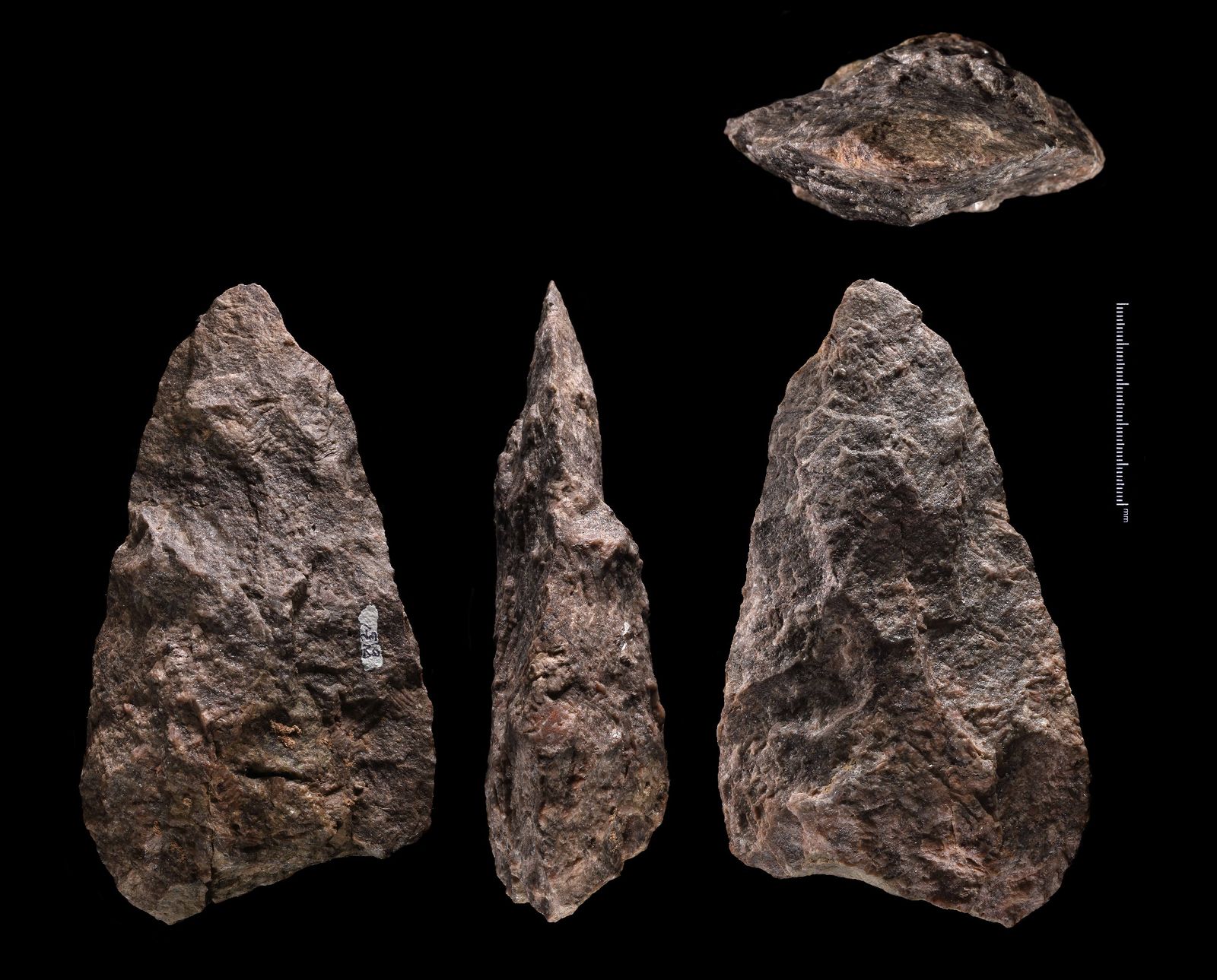
A dry river valley in Botswana’s Kalahari Desert has yielded nearly 100 prehistoric stone handaxes, some discovered alongside debris left by the people who made them. The tools belong to the Acheulean tradition, which began more than 1.7 million years ago. More importantly, archaeologists have identified several layers of ancient human activity separated by river and lake deposits, raising the possibility that early populations repeatedly visited this landscape over long periods.
An international team led by Professor Mirosław Masojć, director of the Institute of Archaeology at the University of Wrocław in Poland, documented approximately 40 handaxes at one site during the 2026 field season. The discoveries bring the total recovered from the research area to nearly 100, although scientists have yet to establish their precise age.
An Ancient River System in the Kalahari
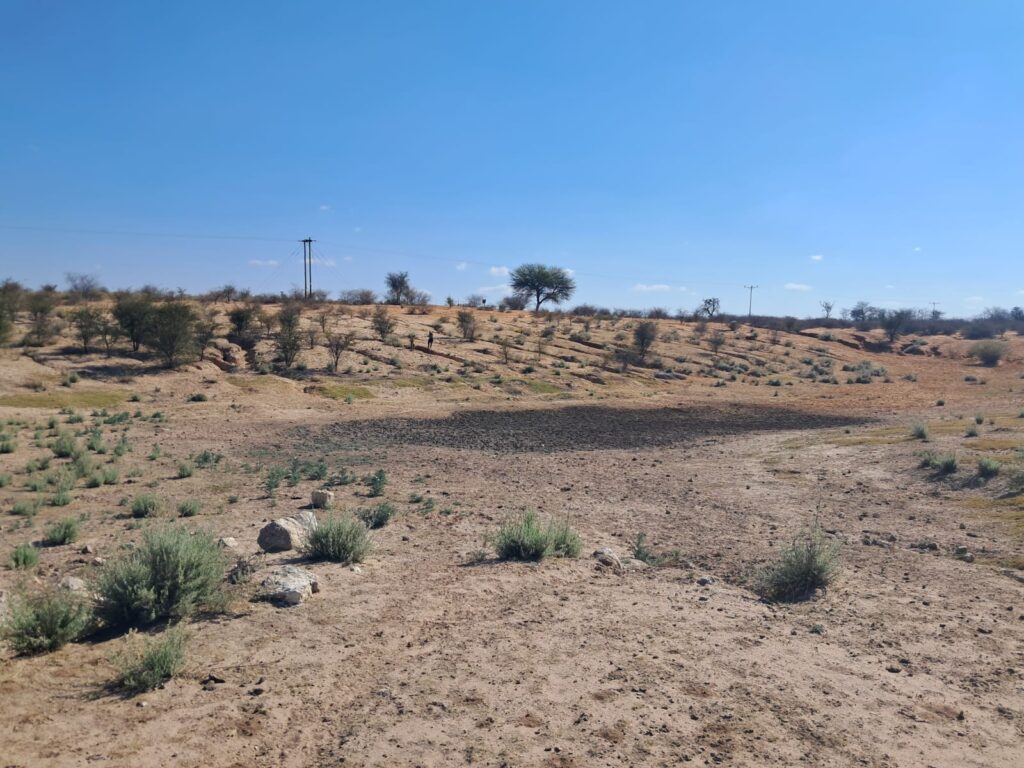
The discoveries come from the Okwa Valley, which extends from the Botswana–Namibia border toward the prehistoric Makgadikgadi lake system in central Botswana. Today, much of the valley lies dry beneath dense, thorny vegetation. During the Pleistocene, however, rivers and lakes shaped a landscape very different from the one researchers encounter now.
The ancient waterways may have provided important resources for early human populations moving through southern Africa. Understanding when these water sources existed, and whether people occupied their surroundings at different times, is a central objective of the project.
According to a University of Wrocław field report, researchers identified several Acheulean archaeological horizons separated by sediments deposited during successive phases of river and lake activity. Some of these deposits contain calcite-cemented layers that have helped preserve their stratigraphic context.
This geological sequence could prove particularly valuable. Rather than treating the stone tools as an isolated collection, archaeologists can examine their relationship to individual sediment layers and investigate whether they represent separate episodes of human activity.
Handaxes and Evidence of Stone Tool Production
The handaxes belong to the Acheulean technological tradition, one of the most enduring developments in prehistoric stoneworking. Early toolmakers typically shaped these implements by removing flakes from both sides of a stone, producing cutting edges suitable for processing a variety of materials.
The Smithsonian Institution’s Human Origins Program dates the emergence of Acheulean handaxes to approximately 1.76 million years ago in Africa. The technology subsequently spread across large parts of Africa and Eurasia, remaining in use for hundreds of thousands of years.
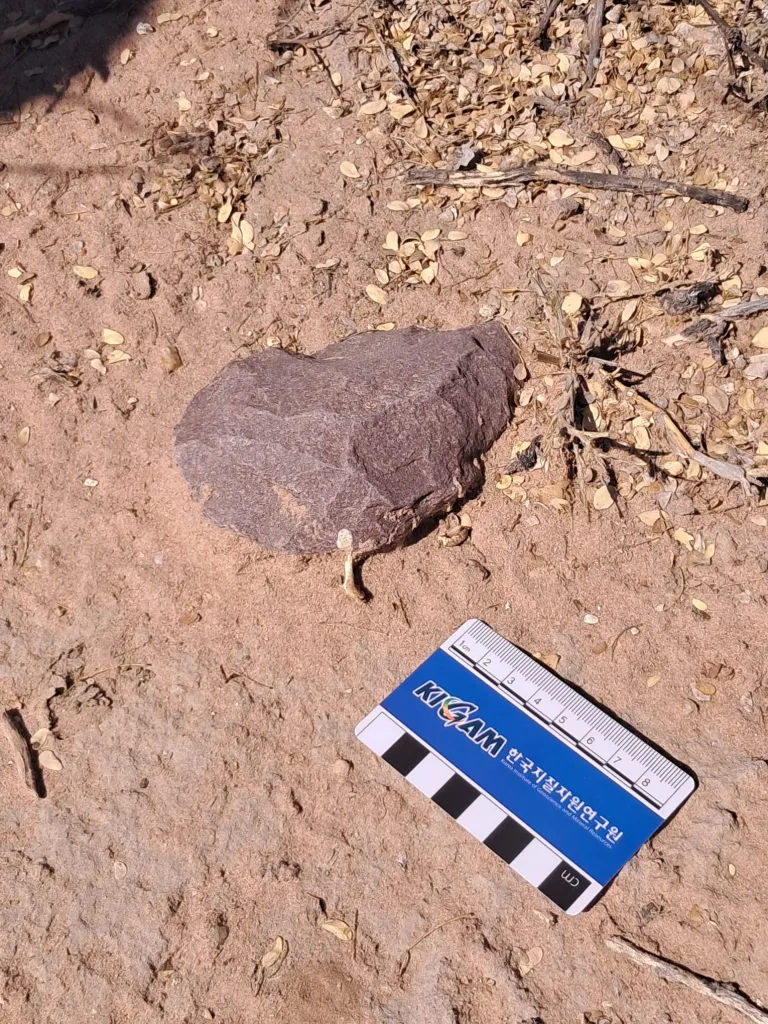
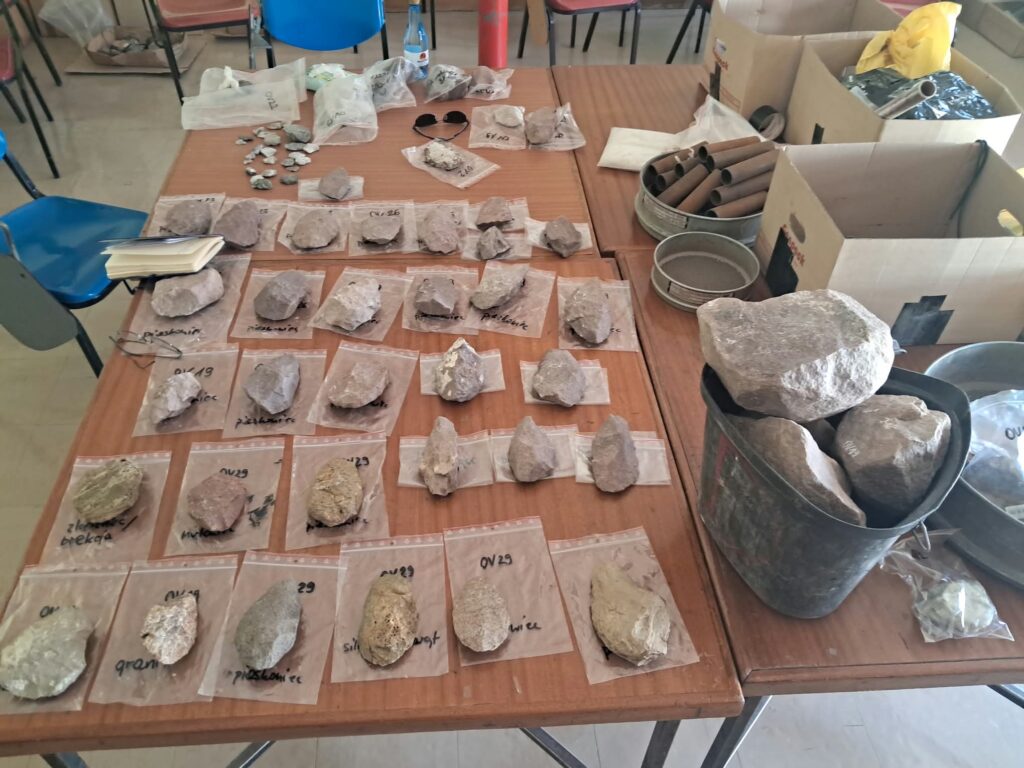
Alongside the handaxes, Masojć’s team recovered flakes and other debris generated during tool production. These materials provide clues about how prehistoric craftspeople selected raw materials, shaped stone cores, and manufactured finished implements.
Researchers plan to compare the Kalahari artifacts with Acheulean assemblages from regions north of the desert and from South Africa. The tools have been transferred to AGH University of Krakow for detailed technological analysis, which may help identify similarities and differences between regional stoneworking traditions.
Road Quarries Expose Prehistoric Deposits
Investigating the Okwa Valley presents unusual practical difficulties. Dense vegetation restricts access to large areas, and the valley’s remote location makes conventional archaeological surveys challenging.
The team found a useful alternative in local quarries where workers extract calcrete, a natural material formed when calcium carbonate binds sediments together. Widely used in road construction in Botswana, these deposits provide geological exposures that allow researchers to examine layers normally concealed beneath the surface.
The quarry sections revealed evidence of Pleistocene rivers and an ancient lake. Archaeologists also found handaxes near the former lakeshore, establishing a potentially important relationship between stone tool distributions and the valley’s prehistoric water system.
The researchers must still determine how the artifacts came to rest in these locations. Water movement, erosion, and later sediment deposition can alter archaeological contexts, making geological analysis essential before reconstructing ancient human activities.
To establish a chronology, the team plans to use optically stimulated luminescence (OSL), radiocarbon dating, uranium-thorium analysis, and cosmogenic beryllium-10 measurements. These methods can date different geological materials or processes within their applicable ranges, helping researchers build a chronological framework for the valley’s archaeological deposits.
Early Human Activity in a Changing Landscape
The discovery forms part of a wider effort to understand how prehistoric populations inhabited the Kalahari Basin before the development of its present landscape.
A 2024 study published in Quaternary Science Reviews examined the region’s sedimentary history and archaeological record. The researchers found that the Kalahari underwent substantial geological changes, including extensive erosion and the development of its widespread sand cover during the past one to two million years.
The study also documented evidence of significant early human activity around the basin, particularly along its southern margins during the Acheulean period. Its findings underline the importance of environmental history when interpreting archaeological sites, since changing landscapes can preserve, bury, or remove traces of past occupation.
The Okwa Valley investigation may add new evidence to this regional picture. By combining technological analysis with sediment studies and geological dating, the team hopes to determine when prehistoric groups occupied the valley and how their activities related to changing water resources.
The project brings together researchers from the University of Wrocław, the University of Botswana, the Korea Institute of Geoscience and Mineral Resources, and the Polish Geological Institute. Archaeologists plan to return to Botswana in 2027 for excavations following the 2026 geoarchaeological surveys.
For now, the handaxes cannot be assigned to a specific human species or dated precisely. The next stage of research will test whether the separate Acheulean horizons represent repeated visits to the valley and how those episodes relate to the region’s changing environmental conditions.
Cover Image: An Acheulean handaxe from the Kalahari Desert, photographed from multiple angles to document its shape and worked surfaces. Credit: Prof. Mirosław Masojć.