
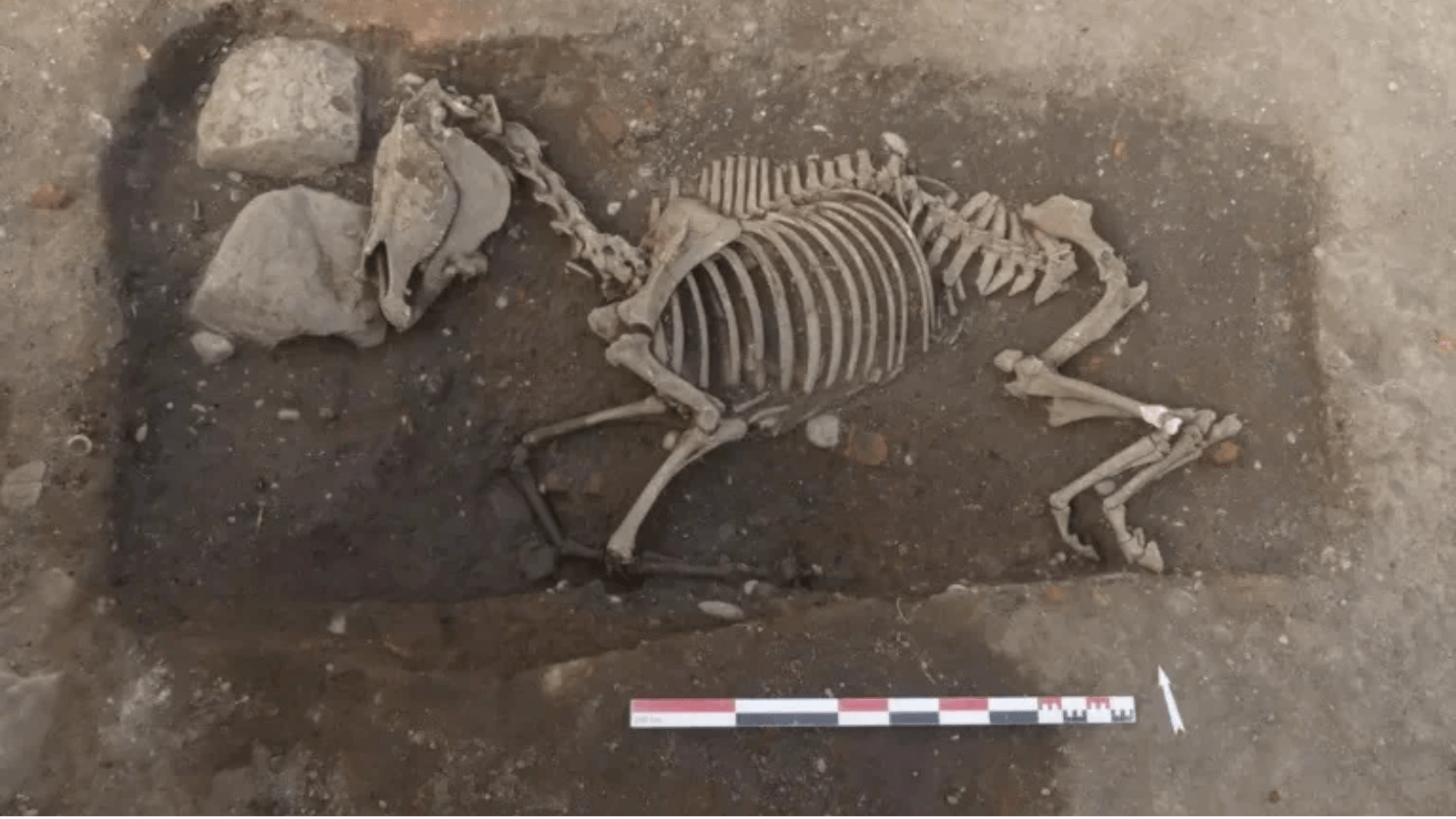
Archaeologists have discovered a 1,500-year-old cemetery containing 14 human graves and two horse burials in a former Roman residential quarter at Horbourg-Wihr, northeastern France. Richly furnished graves, decorated weapons, and skeletal injuries reveal striking social differences and evidence of violence during the decline of Roman authority along the Rhine.
The French National Institute for Preventive Archaeological Research (INRAP) discovered the cemetery during excavations ahead of housing construction at Horbourg-Wihr, near Colmar in the Alsace region. The burials date to the second half of the fifth century AD, a poorly documented period between the decline of Roman rule and the emergence of early medieval kingdoms.
A Roman Neighborhood Reused for Burials
Horbourg-Wihr developed near the Rhine, which marked a major frontier of the Roman Empire for centuries. Between the first and third centuries AD, the settlement supported a busy residential district with buildings, streets, wells, hearths, and areas devoted to everyday activities.
By the fourth century, activity in the excavated neighborhood had declined considerably. Archaeologists have not established exactly why this area fell out of regular use, but its purpose changed again during the second half of the fifth century, when people began digging graves among the remains of the Roman buildings.
Earlier investigations by Archéologie Alsace documented Roman houses, roads, and two burials provisionally attributed to the Late Roman period in another part of Horbourg-Wihr. Those findings provide a broader picture of the settlement’s changing use, although researchers have not established a direct connection between the earlier graves and the newly discovered cemetery.
Weapons, Jewelry, and High-Status Burials
The cemetery contains 11 graves belonging to adults or older adolescents and three belonging to children. Two male burials stand out for their elaborate military equipment, including swords, shields, single-edged blades known as scramasaxes, and angons, a type of javelin used in early medieval warfare.
One sword retained part of its wooden scabbard, while gold, silver, and red garnets decorated elements of the weapons and clothing. Such costly objects suggest that the individuals occupied prominent positions within their community, although their exact roles remain uncertain.
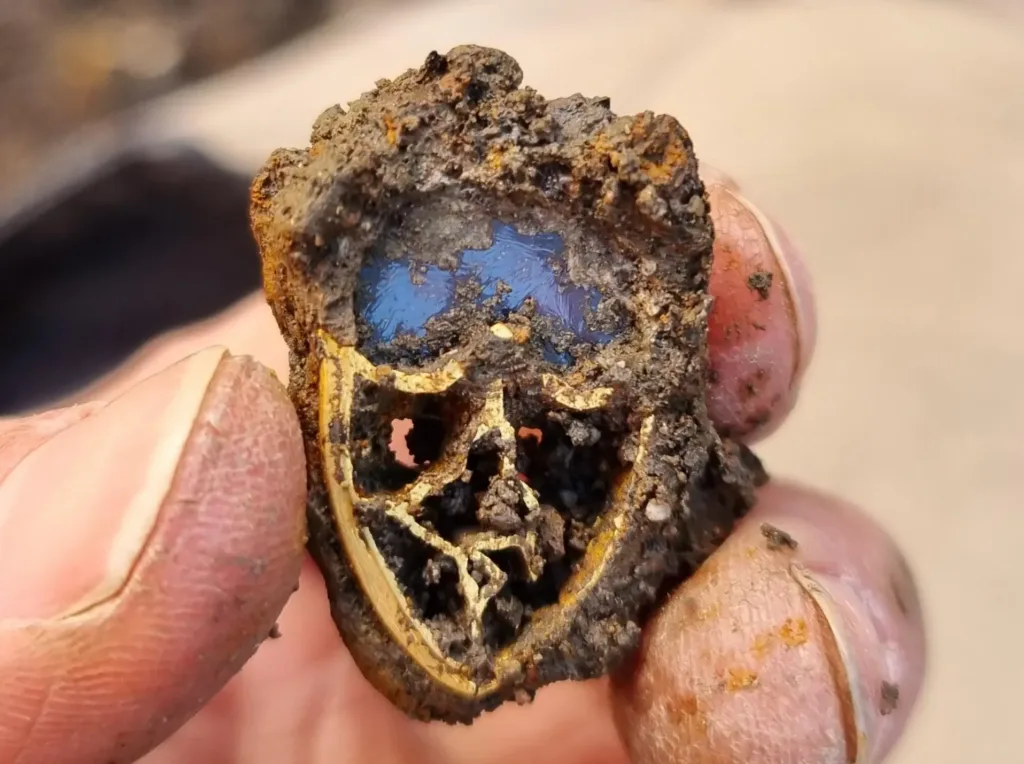
Two other graves contained objects traditionally associated with female burials, including gilded silver brooches, bird-shaped ornaments, glass bead necklaces, belt fittings, and a bone comb. These finds reveal another expression of wealth within the cemetery, but the objects alone cannot establish the biological sex or personal identity of those buried with them.
Archaeologists also uncovered two horses buried with elements of their harnesses. Their presence suggests that horses held an important place in the funerary traditions of this community, potentially reflecting the status or military connections of some of its members.
Injuries Reveal a More Troubled Past
The human remains provide evidence that goes beyond the wealth displayed in the graves. Archaeologists identified possible sharp-weapon injuries on at least two individuals, including a wound to the back of a shinbone that showed no signs of healing. This raises the possibility that the injury occurred shortly before death.
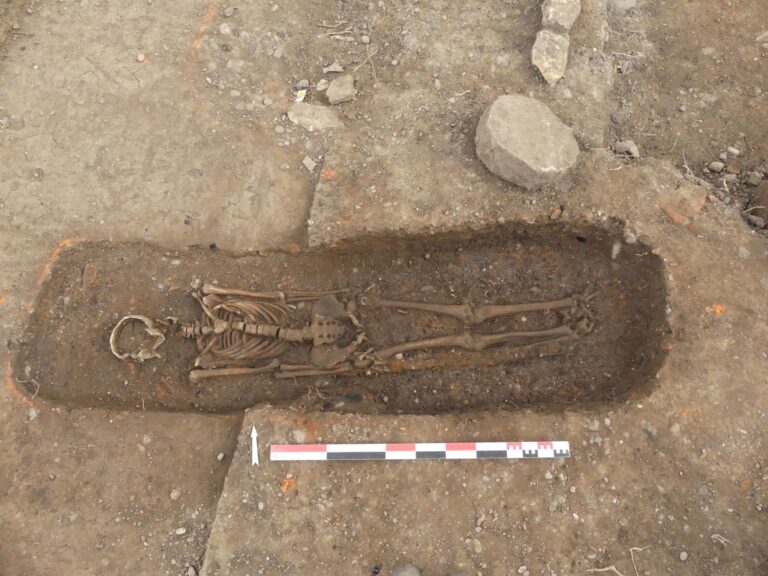
Other skeletons displayed poorly healed fractures and serious joint damage, including a fused knee that would have severely restricted movement. These observations suggest that some individuals experienced significant physical hardship, although researchers have yet to determine the full medical histories of the deceased.
The injuries make the weapons found in the graves particularly interesting, since some may have belonged to people familiar with violence rather than serving exclusively as symbols of rank. However, the evidence does not establish that these individuals died in battle or connect their deaths to a particular historical conflict.
Between the Roman Empire and the Early Middle Ages
The cemetery belongs to a period when political and military authority was changing across the Rhine frontier. Germanic groups had long maintained complex relationships with Rome, sometimes fighting imperial armies and sometimes serving within them.
INRAP researchers note that the weapon-rich graves resemble those associated with leaders of Germanic origin or foederati, allied troops who served in the Roman military. Both possibilities fit the broader historical setting, but neither has been established for the people buried at Horbourg-Wihr.
Burial customs and weapon styles can reveal cultural connections without necessarily identifying a person’s ethnicity or political allegiance. The distinction matters in fifth-century Europe, where Roman military traditions and practices associated with Germanic communities often overlapped.
While Late Roman graves elsewhere in France offer evidence of earlier burial customs, archaeologists have documented relatively few fifth-century burial sites of this kind in Alsace. The combination of weapons, personal ornaments, horse burials, and skeletal injuries provides evidence of social differences and funerary customs during a poorly understood period.
The excavations do not establish whether those buried here descended from the Roman neighborhood’s earlier inhabitants. They do, however, reveal how part of a long-established settlement acquired a new purpose, preserving traces of the communities that lived through the transition from Roman to early medieval Europe.
Cover Image: A horse burial discovered in the fifth-century cemetery at Horbourg-Wihr, northeastern France. The cemetery was established within a former Roman residential quarter. Photo: H. Cicutta / Inrap.