
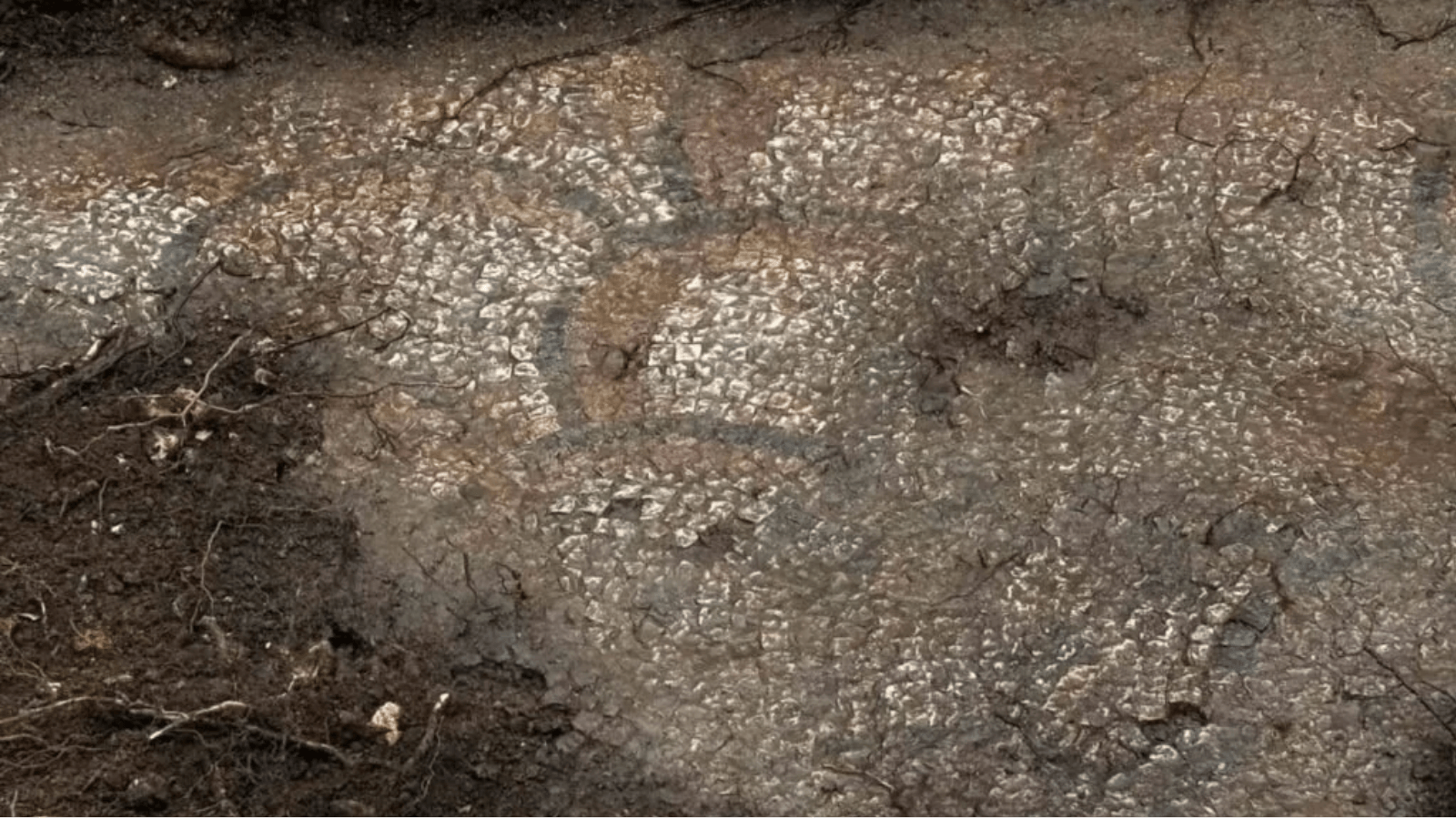
Archaeologists in North Macedonia have uncovered a Late Antique mosaic at a fortified complex that may once have served as the residence of a wealthy Roman landowner. The discovery at Pelenica, near the capital Skopje, has renewed interest in a site containing an early Christian church and an unusual circular building. Although researchers have identified the mosaic floor, its connection to these structures remains uncertain.
The National Archaeological Museum began excavations on October 28, 2026, under the direction of senior curator Radomir Ivanović. The team wanted to investigate records from the 1930s describing a mosaic floor within a circular room. Their work has now confirmed the presence of mosaic decoration, alongside pottery fragments and a coin dating to Late Antiquity.
A Multicolored Mosaic from Late Antiquity
The mosaic features a polychrome design created using the opus tessellatum technique, a method widely used throughout the Roman world. Craftspeople arranged small pieces of stone or other materials, known as tesserae, to form decorative patterns and images.
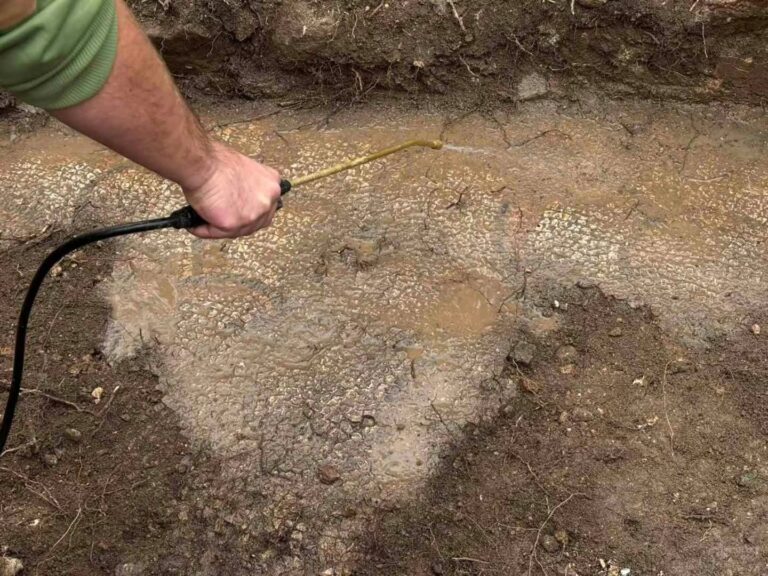
According to the National Archaeological Museum, archaeologists have exposed the mosaic only along the edges of the excavation area. They have yet to establish its complete dimensions, decorative composition, or the function of the building it once adorned. These questions are particularly relevant because Pelenica contains several structures whose original purposes remain disputed.
A Fortified Complex with a Complicated History
Pelenica lies near Dračevo, south of Skopje, on a plateau overlooking the surrounding landscape. Earlier investigations documented a fortified area measuring approximately 130 by 100 meters, with several buildings enclosed by defensive walls.
The site’s archaeological history stretches back to excavations conducted in 1936 and 1937 under the supervision of R. Grujić, then director of the Skopje Museum. Researchers recorded the remains of an early Christian church, a basilica-like building, and a circular structure approximately 11 meters in diameter.
A detailed account appears in Eight Millennia: Life, Culture, Creativity, published by the Faculty of Philosophy in Skopje in 2019. The volume discusses the earlier excavations and subsequent interpretations of the complex, including the work of archaeologist Ivan Mikulčić.
One historical record refers to a mosaic surface measuring approximately 200 square meters. However, the academic publication questions the reliability of that figure. Archaeologists cannot yet determine whether the newly exposed pavement corresponds to the area described in the original documentation.
The Possible Residence of a Wealthy Roman Landowner
The most distinctive building at Pelenica is a circular structure in the northwestern corner of the fortified complex. With a diameter of roughly 11 meters and walls approximately 1.6 meters thick, it attracted particular attention during earlier archaeological investigations.
Ivan Mikulčić interpreted the remains as part of a substantial rural residence, possibly belonging to a wealthy landowner. He compared the circular hall with similar architectural features at Roman-period complexes on Brijuni and Mljet along the Adriatic coast. His interpretation placed the complex between the third and fifth centuries AD and identified it as a possible villa rustica.
The presence of an early Christian church within the same fortified area adds another dimension to the site’s history. The surviving architecture suggests that different buildings may have served residential and religious purposes, although their chronological relationships require further investigation.
The newly discovered mosaic could contribute to this discussion, but its architectural context has not yet been established. Researchers must determine whether it belonged to the circular building described in the 1930s or another structure within the complex before drawing conclusions about its original function.
Further Excavations and Conservation Plans
The Municipality of Kisela Voda finances the current project, which brings together specialists from the National Archaeological Museum, the Skopje Conservation Center, and the Institute of Old Slavic Culture in Prilep. The archaeological team also receives support from the Church of St. Spas in Dračevo.
Researchers plan to carry out geophysical surveys in the courtyard of the present-day monastery complex to identify additional archaeological remains without extensive excavation. The Skopje Conservation Center also plans to begin conservation work in 2027 to protect the mosaic and associated structures.
The discovery confirms that the mosaic mentioned in historical records was more than an uncertain entry in an old excavation report. Determining its full extent and relationship to Pelenica’s buildings may help archaeologists establish how this fortified complex functioned during Late Antiquity.
Cover Image: A section of the Late Antique polychrome mosaic discovered at Pelenica, near Skopje, North Macedonia. Credit: National Archaeological Museum of North Macedonia.