
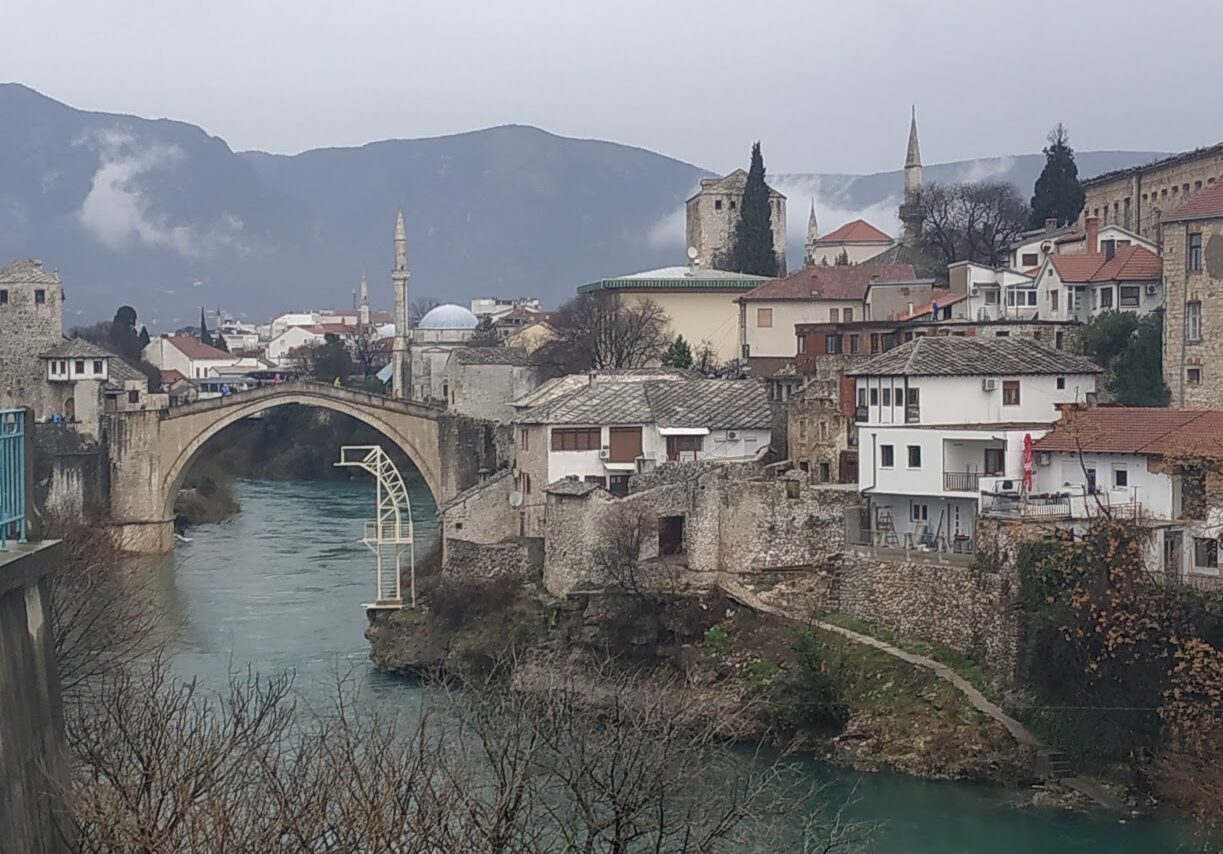
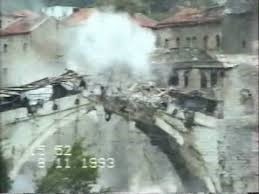
For more than four centuries, people in Mostar crossed the Neretva River on the same stone arch. On November 9, 1993, that familiar passage collapsed into the water after sustained tank fire during the Bosnian War. The bridge had stood for 427 years, connecting the two sides of a city that the fighting had already divided.
Known as Stari Most, or the Old Bridge, the monument was one of the Ottoman Empire’s most remarkable engineering achievements. Its destruction severed an important crossing for civilians and soldiers alike, while the loss of a landmark so closely tied to Mostar’s identity left a lasting mark on the city.
An Ottoman Bridge with Medieval Roots
Located in southern Bosnia and Herzegovina, Mostar developed around a crossing of the Neretva River long before the famous stone bridge existed. The city’s name derives from mostari, meaning bridge keepers, a reminder of how important the crossing was to the settlement’s early development.
Commissioned by Sultan Suleiman the Magnificent, the Ottoman bridge was completed in 1566 by Mimar Hayruddin, a pupil of the celebrated architect Mimar Sinan. Its elegant limestone arch crossed the river with an opening of approximately 27 metres. The structure measured about 30 metres in length and four metres in width, while the Halebija and Tara towers guarded the approaches on either bank.
For generations, the bridge connected markets, homes and neighbourhoods in a city shaped by Muslim, Catholic, Orthodox Christian and Jewish communities. Merchants and travellers crossed it alongside local residents going about their daily lives. Over time, the stone arch became inseparable from Mostar’s historic landscape.
The Destruction of Mostar Bridge in November 1993
The Bosnian War began in 1992, bringing widespread violence and destruction to Bosnia and Herzegovina. Fighting in Mostar intensified the following year between the Croatian Defence Council (HVO), a Bosnian Croat military force, and the Army of the Republic of Bosnia and Herzegovina (ABiH). As HVO forces besieged East Mostar, the remaining crossings over the Neretva became increasingly important.
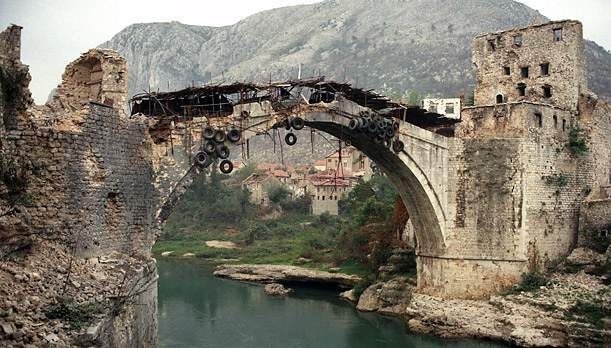
According to the International Criminal Tribunal for the former Yugoslavia (ICTY), an HVO tank repeatedly fired at the Old Bridge throughout November 8, 1993. By evening, the structure was close to collapse. The shelling resumed the following morning, and the stone arch finally fell into the Neretva on November 9.
The bridge served as a supply route for the ABiH, making it militarily significant. However, civilians also depended on the crossing, and its destruction left some residents virtually isolated. The tribunal documented the profound psychological impact that the loss of the bridge had on Mostar’s Bosniak population.
The attack later became part of international war crimes proceedings. In 2013, the ICTY Trial Chamber concluded that the destruction had caused disproportionate harm to civilians compared with the expected military advantage. The Appeals Chamber overturned the bridge-specific findings of wanton destruction, persecution and unlawful terror in 2017, ruling that the bridge had been a military target and that the legal requirements for those crimes had not been established in relation to its destruction.
The appeal decision did not change the documented fact that HVO forces had shelled the bridge. It distinguished the circumstances of the attack from the legal grounds for criminal responsibility.
Archaeological Excavations Reveal Earlier Bridges
After the war, plans to reconstruct Mostar Bridge prompted detailed investigations of the historic crossing. Archaeologists examined the foundations, towers and surrounding ground, uncovering evidence that the location had supported bridges centuries before the Ottoman stone structure.
According to UNESCO’s World Heritage nomination documentation, excavations conducted between 2000 and 2003 identified remains of earlier wooden bridges dating to the pre-Ottoman period. Researchers also investigated the streets approaching the bridge, documenting older pavement layers, a wooden water pipe and late medieval artefacts.
These discoveries established that the famous Ottoman arch belonged to a much longer history of crossing the Neretva, a pattern also documented at an ancient Roman bridge site in Switzerland. The archaeological evidence revealed successive phases of construction and occupation, extending the history of the bridge complex into the late medieval period.
The findings also influenced the conservation project. Specialists incorporated the newly documented remains into their understanding of the site, ensuring that the reconstruction would acknowledge its earlier history rather than focus exclusively on the 16th-century monument.
Rebuilding the Bridge After the War
The reconstruction became an international undertaking involving UNESCO, the World Bank and the City of Mostar. Croatia, France, Italy, the Netherlands and Türkiye were among the countries supporting the project. Specialists studied historical photographs, architectural drawings and surviving stone fragments to reproduce the original bridge as faithfully as possible.
The builders obtained limestone from the same local quarry used in the 16th century and followed traditional construction methods where possible. They also preserved surviving material from the original bridge and archaeological remains from the medieval crossing, making them accessible as part of the site’s history.
On July 23, 2004, almost 11 years after its destruction, Mostar Bridge reopened. In 2005, UNESCO added the Old Bridge Area of the Old City of Mostar to the World Heritage List, recognizing the site’s cultural significance and the international cooperation behind its restoration.
Thirty-three years after the original bridge fell into the Neretva, people once again cross the river along the historic route. The stone arch standing there today is a reconstruction, not the monument that survived from 1566 until 1993. Its history now encompasses both the loss of a centuries-old landmark and the effort to preserve what remained of it.
Cover Image: The reconstructed Mostar Bridge spans the Neretva River in Bosnia and Herzegovina, surrounded by the historic buildings of the old town. Photo: Oğuz Büyükyıldırım.