
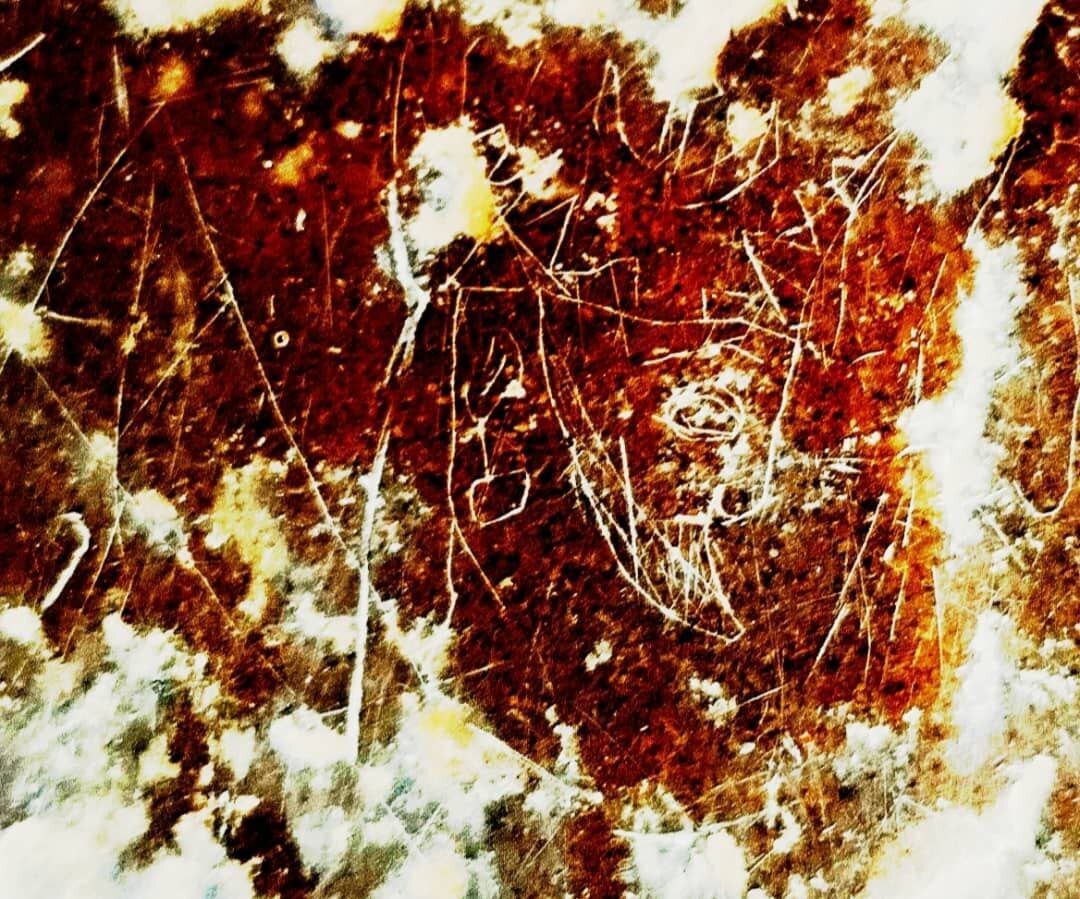
A finely incised, needle-carved image believed to represent a Sasanian king has been identified on the cliffs overlooking the ancient city of Istakhr in southern Iran, according to archaeologist Abolhassan Atabaki. The carving, faint yet deliberate, depicts a crowned ruler accompanied by a crescent moon, a star, and a crenellated diadem — motifs strongly associated with late Sasanian royal iconography.
A Royal Image Echoing Late Sasanian Art
Atabaki notes that the crown’s form and the accompanying astral symbols closely resemble elements seen on official Sasanian rock reliefs, luxury metalwork, and mint-issued coinage. These parallels, he argues, place the carving firmly within recognisable artistic traditions of the later Sasanian period.
Historian Najmeh Ebrahimi adds that the find resonates with the dynasty’s long-standing practice of monumental and miniature royal portraiture. She references a 10th-century report by Al-Masudi, who described an illuminated manuscript discovered in Istakhr featuring Sasanian kings — a reminder that the city once held a significant archive of royal imagery. According to Ebrahimi, the newly recorded portrait carries stylistic traits comparable to early Sasanian needle engravings documented around Persepolis.
She also underscored the concentration of similar works in the region: an estimated 90% of known Sasanian royal-style rock reliefs have been located in the Marvdasht Plain, the political and ceremonial heartland of the dynasty. Many more carved surfaces, she notes, remain unstudied.
Istakhr: Birthplace of a Dynasty
Located just a short distance from Persepolis, Istakhr rose to prominence after Ardashir I overthrew the last Parthian king, Artabanus IV, in 224 CE. The victorious ruler adopted Istakhr as one of his main residences, using the site to anchor the new Sasanian dynasty to the prestige of Achaemenid Persia.

Architectural evidence supports this ideological strategy: builders at Istakhr frequently reused stonework from Persepolis, consciously connecting the dynasty to a past imperial tradition. The monumental Achaemenid tombs of Naqsh-e Rostam also lie nearby, reinforcing the site’s symbolic value.
A Regional Landscape Dense With Sasanian Power
Istakhr once hosted palaces, temples, administrative complexes, and military installations. As described by the 10th-century geographer Istakhri—whose name notably echoes that of the city—residential structures ranged from clay and wood to more elaborate stone and plaster, reflecting the social hierarchy of the time.
The discovery of the needle-carved image adds yet another piece to this dense archaeological landscape. It also highlights the region’s potential: despite its significance, large areas around Istakhr and Persepolis remain unsurveyed, and numerous Sasanian-period features have yet to undergo scientific documentation.
A Small Carving, a Big Clue
Though modest in scale, the new carving reinforces what scholars have long argued — Marvdasht was not only the political cradle of the early Sasanian Empire but also a key center of royal artistic production. Each newly identified portrait strengthens the map of how Sasanian kings projected authority across their ancestral homeland.
Cover Image: Weathered needle-carved depiction of a Sasanian king on the rock surface at Istakhr, showing faint crown and facial features despite heavy erosion.