
For more than two centuries, scholars have admired the technical brilliance of Roman diatreta — the famous “cage cups” with their delicate open-work walls. Yet one small detail on some of these vessels has gone largely unnoticed: a set of abstract symbols carved into the inscription band. A new study now argues that these marks are not decorative fillers but deliberate makers’ marks left by late Roman glass-workers.
The argument is presented by Hallie G. Meredith in her article titled “Looking for—and Finding?—Workshop Makers’ Marks on Late Roman Diatreta,” published in the 2025 volume of the Journal of Glass Studies.
From “stop-marks” to a visual script
Several inscribed diatreta carry tiny abstract signs placed at the edges of their Latin or Greek toasts. Older scholarship described them briefly as “stop-marks,” a kind of ornamental punctuation with no deeper significance.
Meredith challenges this assumption. She describes the signs as a kind of “imagistic script” — purposeful, non-alphabetic symbols with communicative value. Her central claim is simple but consequential: these marks act as makers’ signatures, tied to the workshops and craft groups that produced the vessels.
According to Meredith, these symbols were not added casually: they were carved during the earliest stages of cold-working. In her words, they are “designed into the vessel,” which means they mattered to the people who made them.
Three cage cups, one symbol
The study focuses on three closely related diatreta:
- A small cup in a private collection, currently on loan to a major museum in New York.
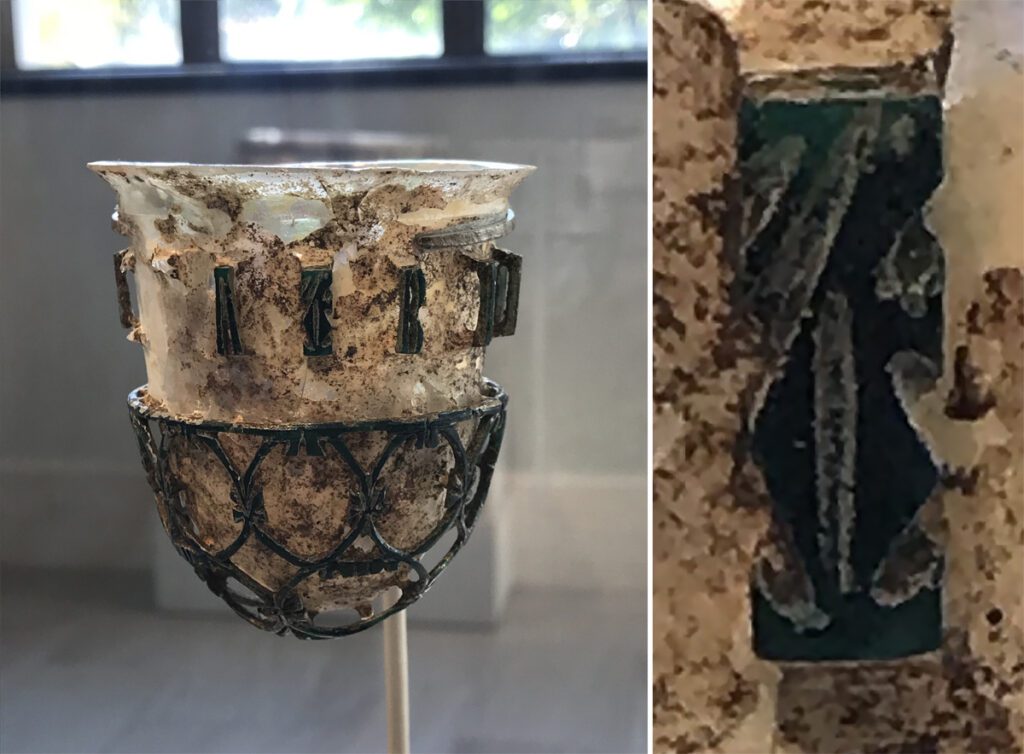
- A larger excavated example from Cologne.
- A second Cologne cup bearing a Greek inscription.
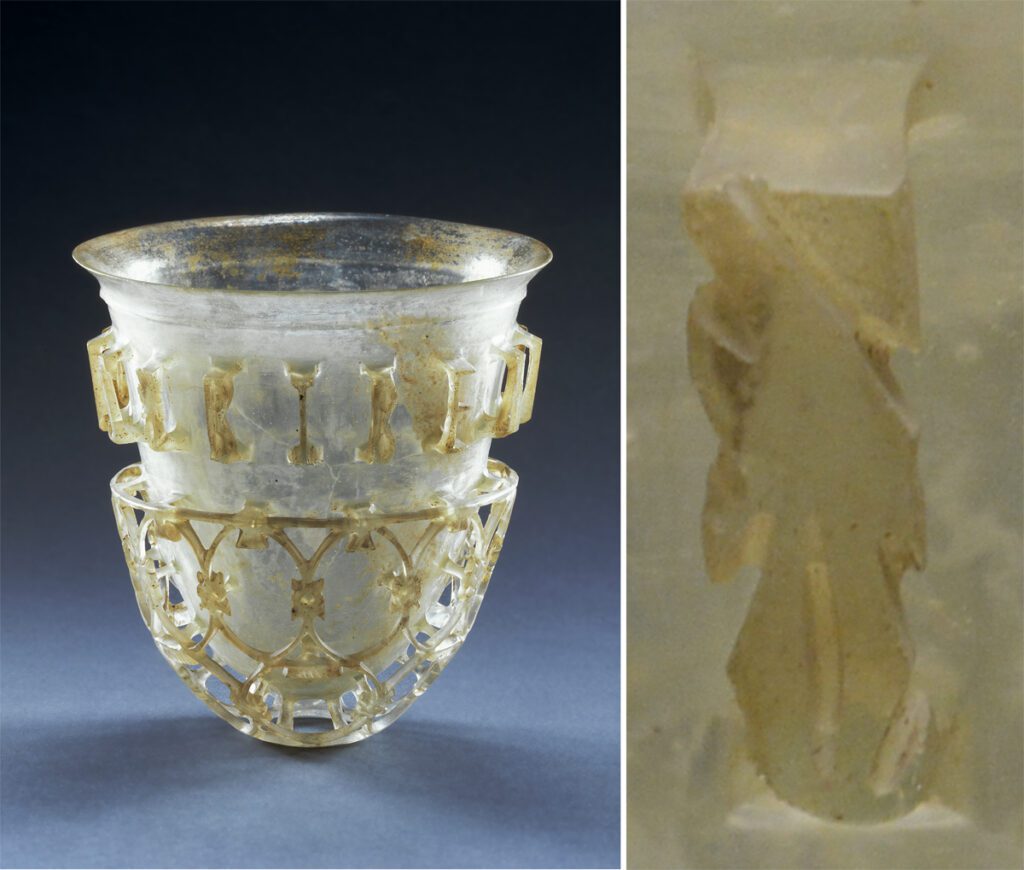
All three share near-identical features:
- similar Latin/Greek drinking formulas,
- comparable geometric cage structures,
- and a matching abstract symbol carved in almost the same way.
For Meredith, this trio forms a strong cluster: the symbol appears to function as a workshop identifier, linking these cups not to a single master, but to a coordinated production group.
Seven symbol-bearing vessels across Europe
Meredith identifies approximately 100 known open-worked vessels, around 30 with inscriptions, and at least seven with identifiable abstract symbols.
These pieces come from a wide geographic range:
- France
- Germany
- Hungary
- North Macedonia
- Montenegro
- and an unprovenanced example now in New York
The symbols vary — leaf-shaped, cornucopia-like, staurogram-like — but their patterned appearance, especially when paired with personal names in the inscription, strengthens the case that these are not owner’s marks but producer marks.
Notably, five of the seven symbol-bearing vessels also include a personal name in the inscription. This separation between “named individual” and “symbol” makes the workshop-mark interpretation more plausible.
A quiet system of branding?
The symbols’ placement during early cold-working, their regional clustering, and their recurrence across multiple pieces point to a collective identity system used by workshops.
The implication is significant: late Roman luxury glass may not have been as anonymous as long assumed. Some diatreta appear to have been quietly branded, their makers leaving a non-verbal signature system centuries before formal trademarks existed.
What happens next
Meredith stresses that the study is preliminary. The number of symbol-bearing diatreta is small, and many pieces have uncertain archaeological context.
However, she has already initiated archaeometric analysis comparing the chemical composition of cups bearing the same symbols. If their glass recipes match, the workshop-mark hypothesis will gain substantial support.
As she notes, these marks were “hidden in plain sight” for decades. Taking them seriously not only reframes how these rare vessels were made, but also brings the identities of late Roman craftworkers a little closer to the surface.
Cover Image: Glass openwork vessel with inscription and symbol. Excavated at Cologne. 300–350 CE. Inscription: ΠΙΕ ΖΗCΑΙC ΚΑΛWC ΑΕΙ (Drink, may you live well always!). H. 12.1 cm, Diam. (rim) 10.1 cm, letter height and wall thickness not specified. Römisch-Germanisches Museum, Cologne, 60.1. (Photo: Hallie G. Meredith)