
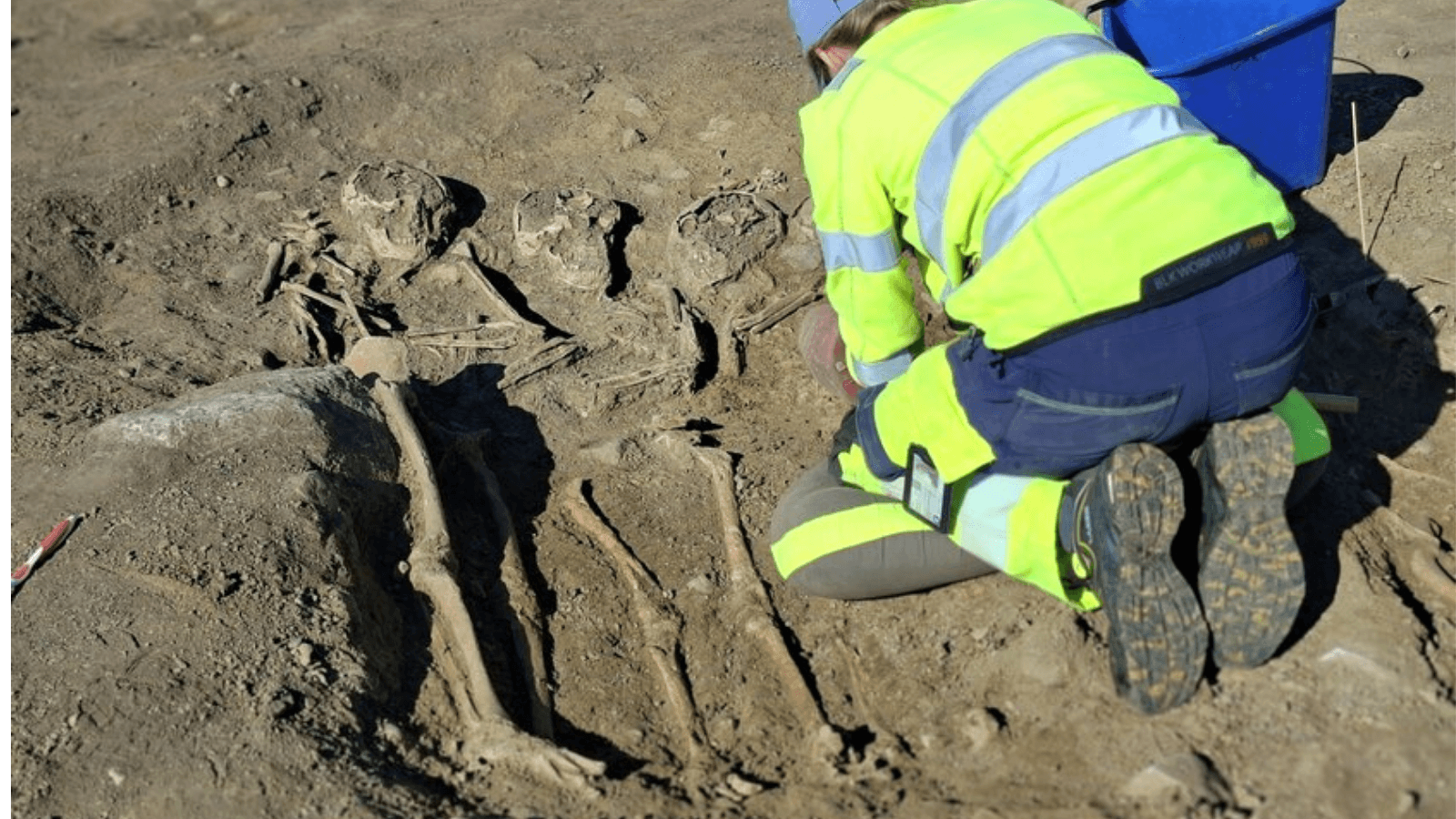
Archaeologists investigating a 1,000-year-old Christian cemetery in Norway have uncovered 15 skeletons, including adults and children. Several of the graves contain two or more people, making the burial ground at Valum unusual for an early medieval rural community.
One grave at Valum, near Hamar, held four individuals placed closely together, while others contained three or two bodies. Archaeologists are now trying to determine whether disease, seasonal burial practices or another event caused several members of the community to be buried at the same time.
The excavation is being led by the Norwegian Institute for Cultural Heritage Research (NIKU) in cooperation with Innlandet County Municipality. The number of skeletons is considerably higher than preliminary investigations had suggested.
A cemetery from Norway’s Christian transition
Radiocarbon dating of a rib and a finger bone recovered during earlier fieldwork placed the burials between AD 994 and 1190. The range covers the transition from the final Viking Age to the Early Middle Ages, when Christianity was reshaping burial customs across Norway.
The graves follow a clearly Christian pattern. The bodies were laid on an east–west axis, with their heads toward the west and their feet toward the east. This position allowed the dead, according to Christian belief, to rise facing the sunrise at the resurrection.
Archaeologists have found no grave goods, unlike many Viking Age burials in which weapons, jewelry, tools or other possessions accompanied the deceased. There is also no evidence of cremation, another practice that declined with the spread of Christianity.
The cemetery is especially important in Innlandet, a region associated in historical accounts with resistance to the new religion. Traditions surrounding the eleventh-century king Saint Olaf describe forceful efforts to Christianize parts of Norway’s interior. The graves at Valum show that Christian burial customs had reached the Hamar area during this early phase.
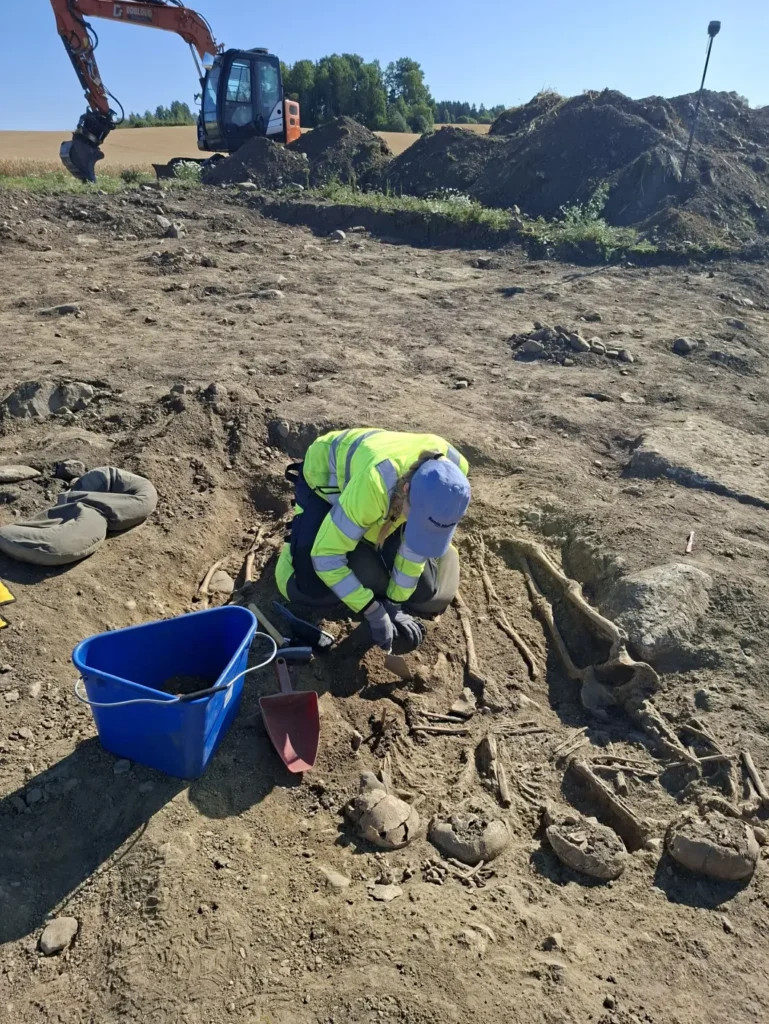
Four people placed in a single grave
Preliminary observations indicate that the cemetery contains three multiple graves. These include double and triple burials as well as the grave containing four individuals, one of whom was a child.
The four appear to have been buried together. Their bodies were positioned closely, with their hands gathered over their chests, giving archaeologists the impression that they had been laid to rest carefully.
The reason for the multiple burials is unknown. An outbreak of disease may have caused several deaths within a short period. Another possibility is that people who died during winter were kept until the frozen ground had thawed and then buried together.
Neither explanation has been confirmed. Shared graves were not limited to relatives in the Middle Ages, so the arrangement alone cannot show whether the individuals belonged to the same family.
DNA testing could help establish biological relationships between them. Examination of the bones may also provide evidence of disease, injuries and possible causes of death.
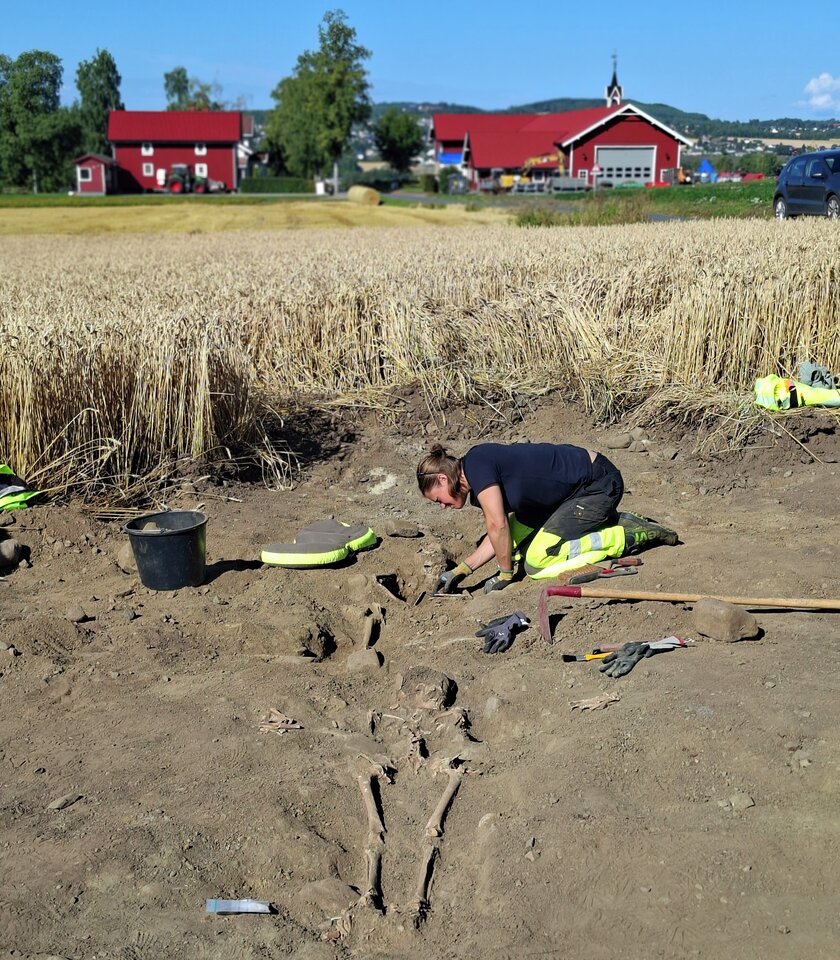
Photo: Nina Hildre, Innlandet County Municipality.
A badly healed leg fracture
One skeleton already preserves evidence of a serious injury. The individual had suffered a fracture of the lower leg, which later healed at the wrong angle.
The injury left one leg shorter than the other, meaning the person likely walked with a pronounced limp for the rest of their life. Because the fracture had healed, the individual survived the original trauma, although the bones cannot show what assistance they may have received during recovery.
This person was buried alongside another individual. Archaeologists have considered whether the shared grave reflects a close relationship, but further analysis will be needed before any connection can be established.
No remains of coffins have been identified. The dead may have been placed directly in the ground, though the shallowness of the graves and centuries of agricultural activity mean that traces of wooden coffins could have disappeared.
The cemetery was nearly destroyed
Historical records indicated that a church and cemetery once stood at Valum, but their exact location had been lost.
Valum was known as a farm during the Middle Ages. It was purchased by the neighboring Sælid property in 1832, and its buildings were demolished later in the nineteenth century. The former farmyard was subsequently turned into agricultural land.
The cemetery was relocated in 2020 after a metal detectorist noticed human bones in the field. Archaeological investigations conducted the following year confirmed that graves survived immediately below the topsoil.
Some of the shallowest remains were already fragmented and damaged by farming. Archaeologists warned that further ploughing could have destroyed the cemetery entirely, prompting the current rescue excavation.
The church at Valum is known to have fallen out of use by 1590. No visible cemetery boundary survives, although the burial ground may once have been enclosed by a stone wall or another type of barrier.
The 15 skeletons will be catalogued by NIKU before being transferred to the Museum of Cultural History in Oslo. Osteological, isotope and DNA analyses may eventually establish the individuals’ ages, sex, diet, geographical origins and possible family relationships. Until those studies are completed, the reason for Valum’s unusual number of multiple burials cannot be determined.
Cover Image: Four individuals were found buried closely together in a single grave, their hands positioned across their chests. Credit: Nina Hildre, Innlandet County Municipality.