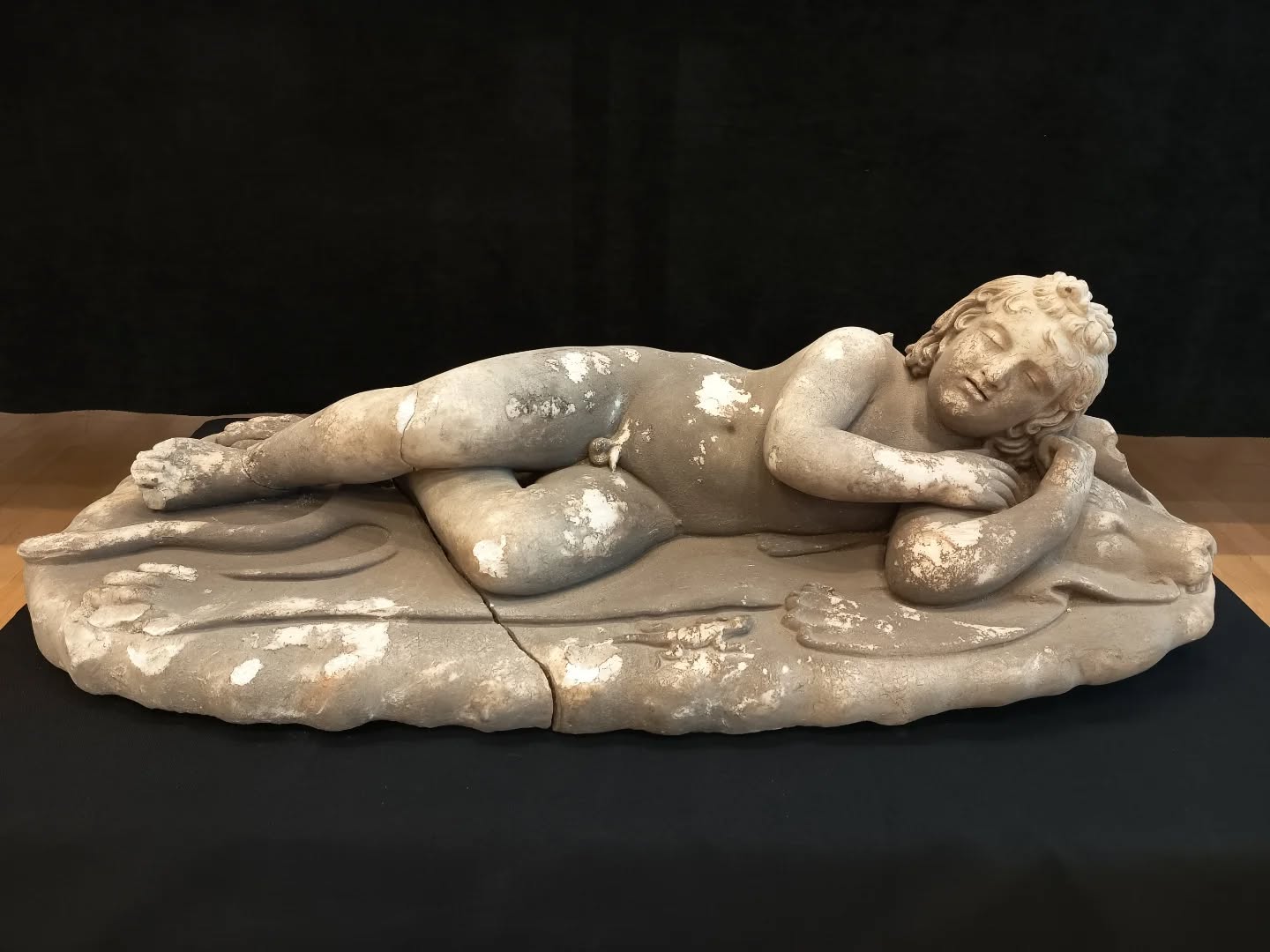
A remarkable discovery has once again placed Pula in the archaeological spotlight. Beneath the streets of the Croatian port city, archaeologists have uncovered a finely carved marble statue of a Sleeping Cupid, dating to the 2nd century CE. Experts describe the find as one of the most exquisite examples of ancient Roman sculpture ever found in Istria — a testament to the wealth and artistic sophistication of Roman-era Pula.
A Two-Thousand-Year Slumber Awakened
The statue, measuring nearly one meter in length, was discovered in two pieces beneath Castropola Street at a depth of about three meters. The excavation, directed by archaeologist Aleksandra Paić, was part of research into a Roman domus — a luxurious family residence — on a property owned by Kaštel Centar, where a boutique hotel was planned.
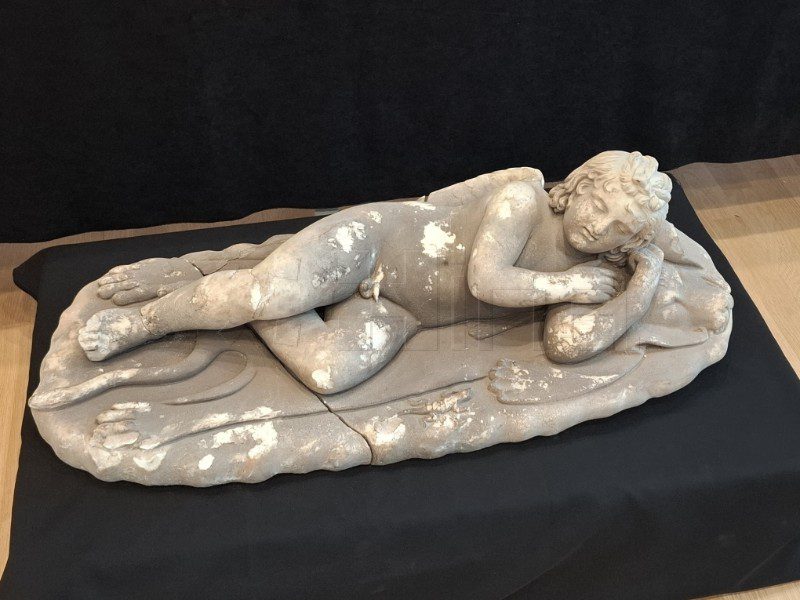
Those plans are now on hold. “We literally woke him from his two-thousand-year sleep,” Paić said, recalling the moment the figure of Eros, the god of love, emerged from the soil. The sculpture depicts the youthful deity lying serenely on a lion’s skin, with a small lizard beside him — a rare motif known from only a handful of European examples.
The Symbolism of a Sleeping God
In Roman and Hellenistic iconography, a Sleeping Cupid symbolized more than rest; it reflected the delicate boundary between love, sleep, and death. To ancient Romans, the image of a slumbering Eros suggested the eternal nature of love and the renewal of life after death. Such figures were often placed in children’s tombs or within elegant villas, evoking both innocence and divine protection.
According to Silvana Petešić, curator at the Archaeological Museum of Istria, the statue was sculpted from fine-grained white marble of still-unknown origin, executed with striking precision.
“Our Eros lies on a lion’s skin, his head resting on the lion’s head, rendered with breathtaking delicacy,” Petešić explained. “Only a few comparable examples in Europe remain so complete.”
Glimpses of Roman Pula’s Elite Life
The excavation area, covering roughly 1,200 square meters between Cvečićev and Glavinićev Uphill, lies within the ancient urban core of Pola, a flourishing Roman colony on the Adriatic coast. Early findings reveal that the domus was lavishly decorated with mosaics, marble cladding, and frescoes, evidence that the residence once belonged to an elite family during Pula’s golden age in the 2nd century CE.
“This is an extraordinary find that testifies to the wealth and culture of ancient Pula,” said Darko Komšo, Director of the Archaeological Museum of Istria. “It reinforces Pula’s status as one of the Mediterranean’s great archaeological treasure troves.”
From Excavation to Museum Display
Conservation specialists have begun the delicate process of rejoining the marble fragments and preparing the sculpture for laser cleaning, which will remove centuries of sediment without damaging the stone’s surface. Once restored, the Sleeping Cupid will join the permanent collection of the Archaeological Museum of Istria, where it will be exhibited alongside other masterpieces of Roman Pula.
Komšo added, “The ‘Sleeping Cupid’ is not only a masterpiece of Roman art but also a bridge between the ancient and modern city. It reminds us that beneath every stone of Pula lies another story waiting to be rediscovered.”
Pula’s Enduring Legacy
With a history spanning over 2,300 years, Pula has remained continuously inhabited from prehistoric times through Roman, Venetian, and Austro-Hungarian periods. Once home to grand temples, villas, and a monumental amphitheater, the city continues to reveal its ancient layers — proof that the Adriatic still guards secrets of its Roman past.
For archaeologists and art historians alike, the Sleeping Cupid of Pula represents more than an artistic marvel. It tells a story of love, craftsmanship, and cultural memory — a god of love who slept beneath the city, waiting to be found once more.
Archaeological Museum of Istria
Cover Image Credit: Archaeological Museum of Istria, via Facebook