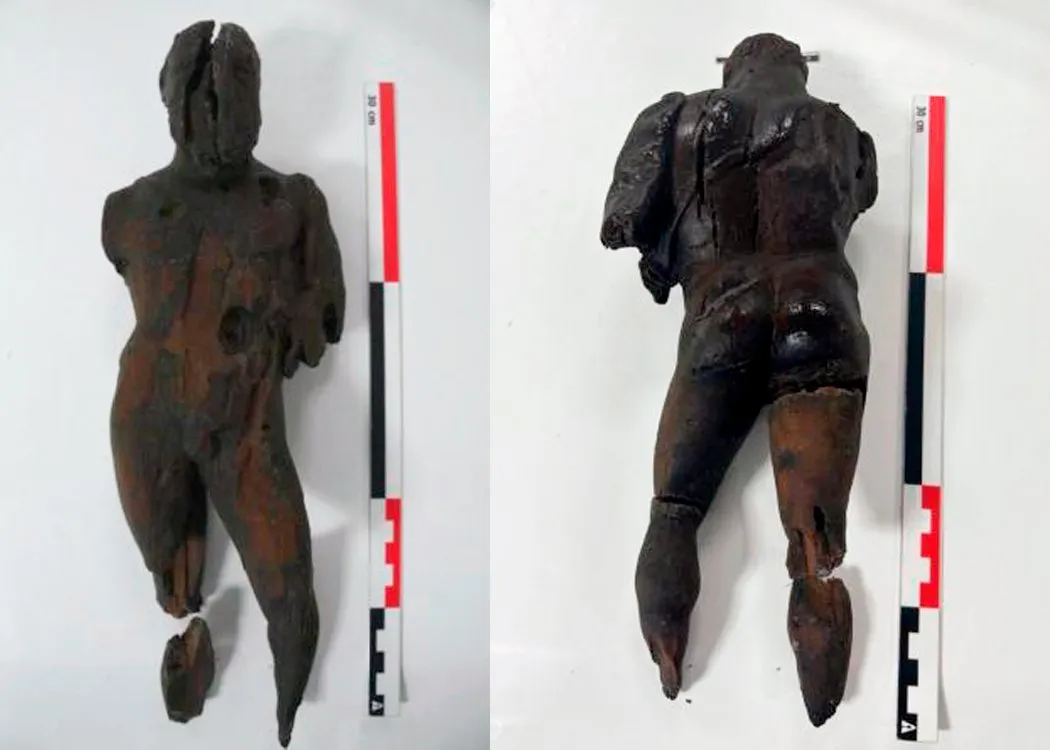
For centuries, it lay silent beneath Ibiza’s shifting groundwater — a small wooden Hercules sealed away from air and time.
Now, archaeologists have brought the ancient figure back to light: a 30-centimeter Greco-Roman–style statue, carved in wood and astonishingly preserved by the island’s subterranean waters.
The discovery was made during preventive excavations on the corner of Calle Madrid and Avenida Isidor Macabich, where the Balearic Housing Institute (Ibavi) plans to build new public apartments.
Directed by archaeologists Glenda Graziani Echávarri and Juan José Marí Casanova, the project revealed what local authorities describe as one of the most exceptional finds ever recorded in the Balearic Islands — a rare organic artifact that survived because it never truly dried out.
Protected by Water, Not Stone
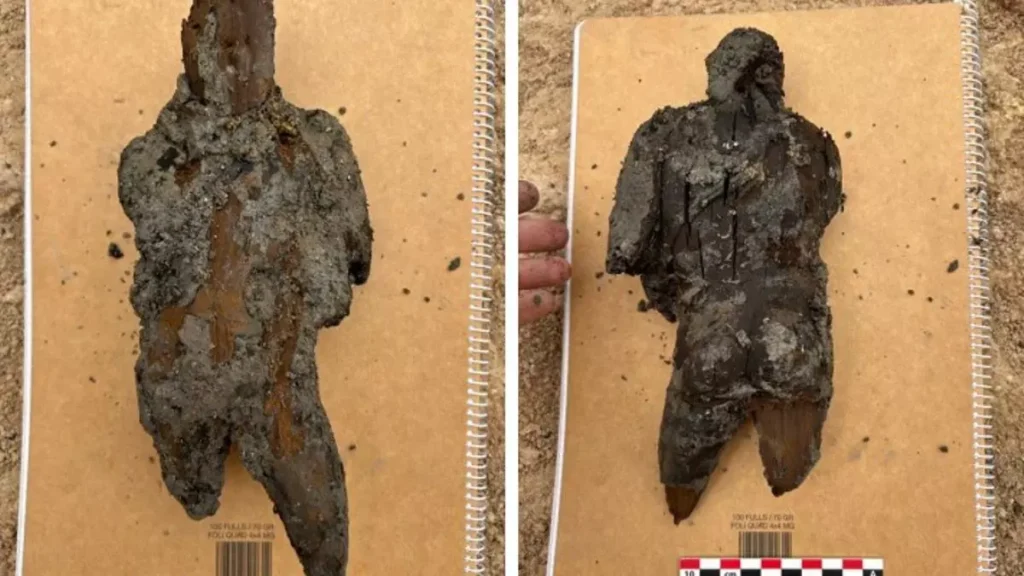
The excavation area sits barely 1.2 meters above the water table, forcing engineers to install eight pumps and a retaining wall to lower the groundwater by ten meters.
Ironically, this same water that challenged the excavation had been the statue’s guardian. In the oxygen-poor environment, organic materials — wood, leather, even seeds — remained untouched by decay for nearly two millennia.
The Hercules figure appeared deep within a Roman well (Unit 205), which in later centuries had been reused as a refuse pit. Alongside the sculpture, archaeologists unearthed a leather sandal sole, carbonized wood, and plant remains, all preserved by the same underwater conditions.
Now under treatment at the Museum of Archaeology of Ibiza and Formentera (MAEF), the wooden Hercules is undergoing a slow, controlled drying process to prevent warping or cracking — a delicate task that will determine its survival outside the water that protected it for so long.
Layers of Life Beneath Ibiza
Beneath the modern foundations, the excavation also exposed evidence of Roman domestic structures and medieval Andalusian occupation layers — hearths, storage pits, and traces of everyday life.
These overlapping settlements, archaeologists say, reveal how Ibiza evolved from a modest Roman settlement into a dynamic medieval town shaped by agriculture and trade.
Such stratigraphy is rare in the Balearic Islands, where centuries of development have often erased the archaeological record. The site now promises to fill critical gaps in the island’s urban and agricultural history.
From Local Discovery to European Science
Samples of seeds, wood, and charcoal from the excavation will soon join the MEEDGREENREV Project (“Rethinking the Green Revolution in the Medieval Western Mediterranean”), funded by the European Research Council (Horizon Program).
Led by universities in Barcelona, Granada, Reading, and York, the project explores how medieval communities adapted farming systems to shifting climates and environments.
For Ibiza, the preserved seeds and organic remains may reveal what crops once grew on the island — and how its inhabitants managed to thrive between land and sea.
“This kind of preservation is almost unknown in Mediterranean contexts,” said one of the lead archaeologists. “It’s as if the island’s own waters decided to keep one small piece of its past alive.”
Cover Image: The wooden Hercules, about 30 cm tall, preserved for centuries beneath Ibiza’s groundwater, photographed after initial conservation cleaning at MAEF.