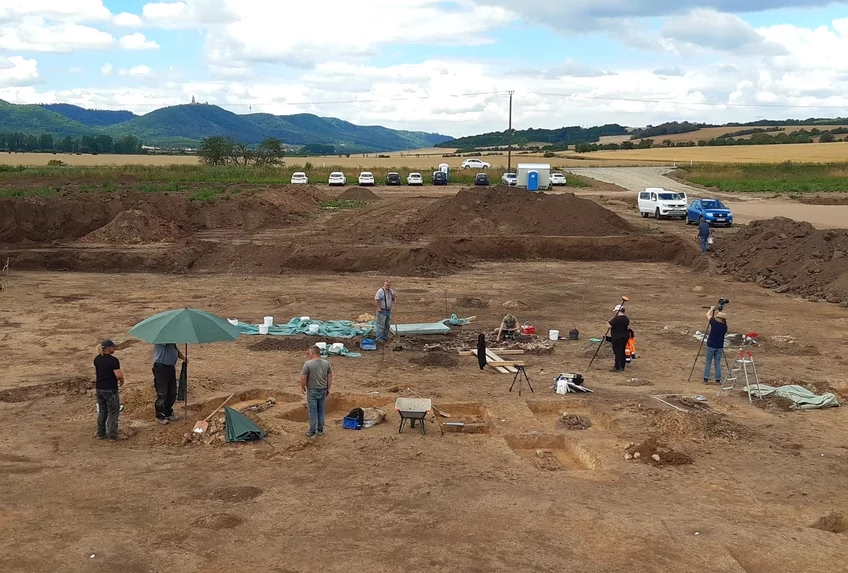
One of the most influential yet long-misunderstood events in European history—the spread of the Slavs from the 6th century CE—is finally being clarified. New genetic analyses reveal the scale of Slavic migrations, regional diversity, and the social organization of early medieval communities.
Migration and Social Transformation
An international team from Germany, Austria, Poland, Czechia, and Croatia, led by the HistoGenes consortium, sequenced over 550 medieval genomes to trace Slavic ancestry. Their findings confirm that these populations were highly mobile, reshaping the demographic landscape of modern Central and Eastern Europe.
Joscha Gretzinger of the Max Planck Institute for Evolutionary Anthropology explains, “Our genetic results provide the first concrete clues to the formation of Slavic ancestry, pointing to a likely origin between the Dniester and Don rivers.”
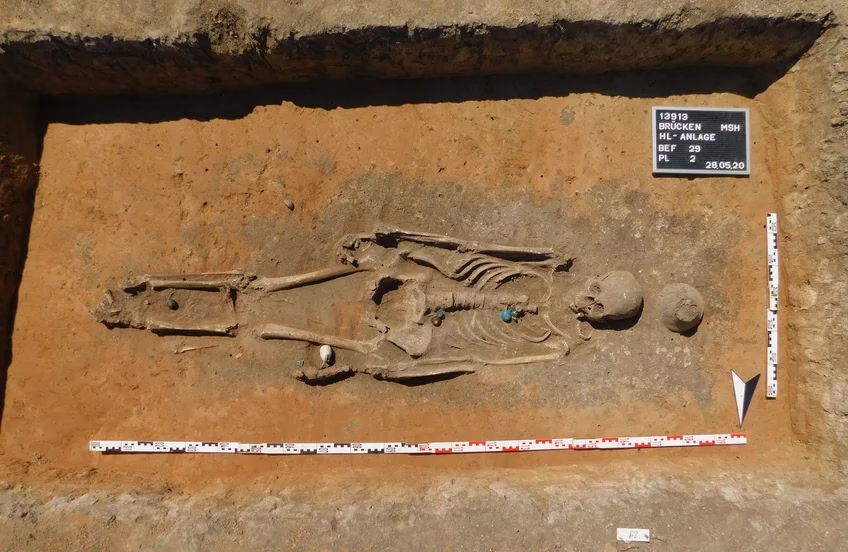
The spread of Slavs did not follow the model of conquest or empire. Instead, they established flexible, family-centered communities. Zuzana Hofmanová of MPI EVA and Masaryk University adds, “The Slavic expansion was not a monolithic event but a mosaic of different groups, each adapting and blending in its own way. There was never just one ‘Slavic’ identity, but many.”
In Eastern Germany, after the decline of the Thuringian kingdom, over 85 percent of the regional ancestry traces to newcomers from the East. Walter Pohl of the Austrian Academy of Sciences notes, “Slavic migrations represent a social model without rigid hierarchies or elite structures. Their success lay in adaptability and practical, egalitarian living rather than conquest.”
Poland and the Balkans: Distinct Patterns
In Poland, 6th- and 7th-century migrations nearly replaced earlier Northern European-descended populations. Early Slavic burials at Gródek provide rare, direct evidence of these settlers.
In contrast, the Balkans experienced partial integration. Eastern European migrants blended with local populations, creating hybrid communities. Hofmanová emphasizes, “This was not a wave of conquest but a long process of intermarriage and adaptation.”

A New Perspective on European History
These findings shed light on why Slavic groups spread so successfully. The migrations were often grassroots, egalitarian, and adaptable—offering a credible alternative to the declining empires around them. Johannes Krause of the Max Planck Institute summarizes, “The spread of the Slavs was likely the last continental-scale demographic event to permanently reshape both the genetic and linguistic landscape of Europe.”
The study not only clarifies the roots of modern Central and Eastern European populations but also reveals the lasting imprint of Slavic migrations on the DNA, languages, and cultures of millions today.