
An Old Kingdom tomb near King Merenre’s pyramid has revealed unusual objects that archaeologists cannot yet fully explain. The discoveries, including two wooden figures and possible medical instruments, raise new questions about the burial of Weni, an Egyptian official whose inscriptions record a distinguished career in royal service.
Two small wooden figures, depicted in a rare posture of worship, were found not inside an Egyptian official’s burial chamber but in a vaulted room directly above it. Below, archaeologists recovered bronze instruments that may have served medical purposes, although none of the tomb owner’s surviving titles identifies him as a physician. The discoveries present two different puzzles within the same Old Kingdom tomb at Saqqara.
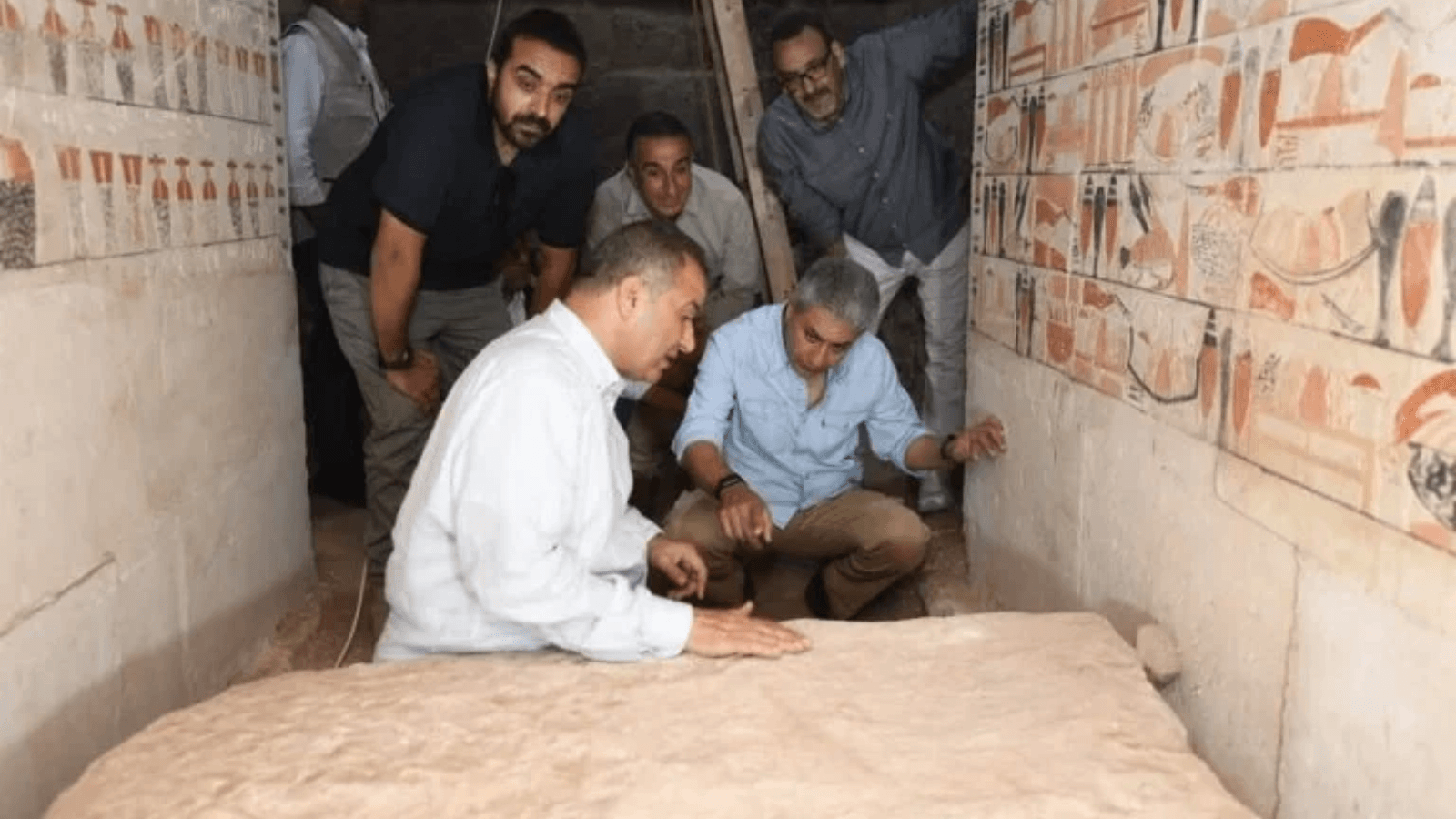
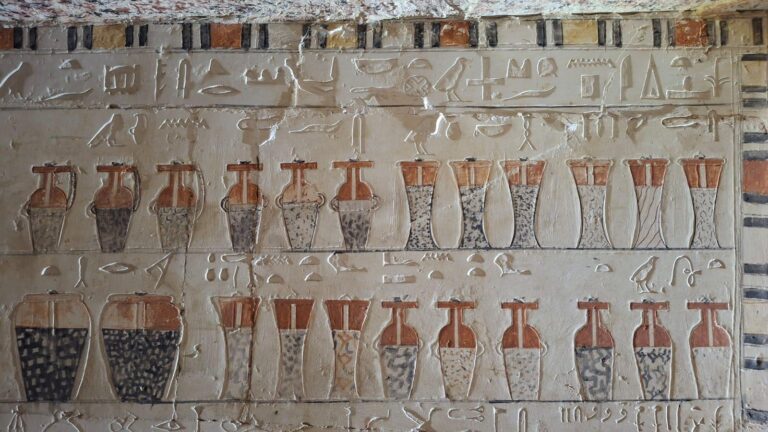
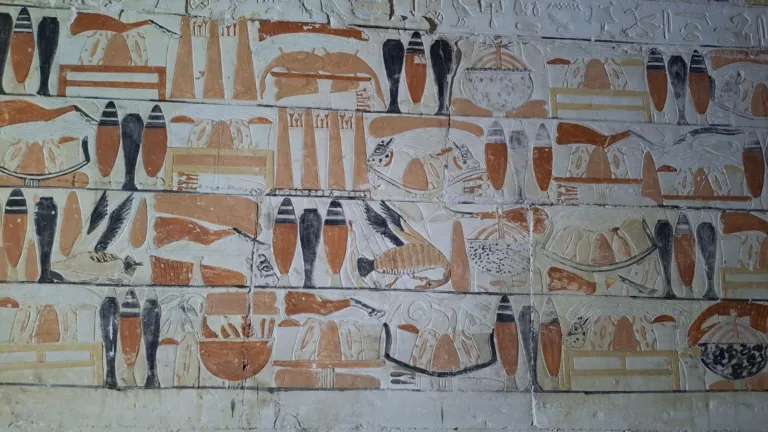
An Egyptian archaeological mission from the Supreme Council of Antiquities made the discoveries northwest of the pyramid of King Merenre. Excavations uncovered a mudbrick mastaba containing several burial shafts, including one leading to a decorated chamber belonging to an official named Weni. Its surviving inscriptions provide an unusually detailed record of his administrative and religious positions.
Two Wooden Figures Above the Burial Chamber
The wooden figures were discovered inside a vaulted room immediately above Weni’s burial chamber, along with other archaeological objects. Mohamed Abdel Badie, head of the Egyptian Antiquities Sector at the Supreme Council of Antiquities, described their devotional posture as rare. Their discovery offers an opportunity to investigate how different spaces within Old Kingdom tombs were used.
Mastabas were rectangular funerary structures built for members of ancient Egypt’s elite. Their architecture frequently incorporated spaces for offerings and ceremonies intended to maintain the deceased’s relationship with the living. The positioning of the wooden figures in a separate room may therefore be significant, although their precise function has not been established.
The figures also draw attention to a broader question about funerary arrangements. Egyptian tombs could contain statues and other objects associated with religious beliefs about death and the afterlife, but their placement was not necessarily arbitrary. Understanding why these particular figures were deposited above the burial chamber will require closer study of the room and its relationship to the rest of the mastaba.
Bronze Instruments Raise an Unexpected Question
Another discovery came from Weni’s burial shaft, where archaeologists recovered a collection of bronze instruments. Egyptian antiquities officials believe the objects may have been used for medical purposes, although their function remains under investigation. Such finds are relatively uncommon in funerary contexts, making their presence particularly noteworthy.
The difficulty lies in the identity of the tomb’s owner. Inscriptions inside the burial chamber record numerous prestigious titles, but none identifies Weni as a physician. Archaeologists must therefore establish whether the objects were medical instruments and, if so, how they were connected to the man buried with them.
Weni’s titles included mayor, sem priest, treasurer of the King of Lower Egypt, sole companion and lord of Elkab. These positions indicate that he occupied an important place in the administrative and religious institutions of ancient Egypt. Yet they provide no immediate explanation for the bronze objects, leaving an important part of the burial assemblage open to interpretation.
A Priestess of Hathor and the Man Behind the Titles
The excavation also revealed a false door bearing the name of a woman called Sekhet Nebti, whose religious titles included priestess of Hathor. In ancient Egyptian funerary architecture, false doors symbolically connected the world of the living with that of the dead and played an important role in offering rituals. The inscription provides evidence of a woman holding a religious office during the Old Kingdom, although her relationship to Weni remains uncertain.
Archaeologists have also begun examining Weni’s skeletal remains, revealing details of his life that the inscriptions could not preserve. According to excavation director Amr El-Tibi, preliminary analysis indicates that he died after the age of 50 and suffered from advanced dental disease affecting his teeth and surrounding tissues. His bones also display changes consistent with repeated physical strain, although their precise cause remains unknown.
These findings add a physical dimension to the biography recorded on the tomb walls. Weni’s inscriptions describe his standing in Egyptian society, while his skeleton preserves evidence of the health problems he experienced. Together, they offer a more detailed picture of an individual who would otherwise be known primarily through his official titles.
New Evidence from an Old Kingdom Cemetery
Saqqara served as one of ancient Egypt’s most important burial grounds, particularly for the royal court and officials associated with nearby Memphis. The newly discovered mastaba lies within the funerary landscape surrounding the pyramid of Merenre, a ruler of the Sixth Dynasty. The discovery contributes to the study of how elite tombs were constructed and used during the Old Kingdom.
The Egyptian mission is continuing its examination of the architecture, inscriptions and objects recovered from the complex. These studies will be essential for understanding the relationship between the vaulted room, the burial chamber and the objects deposited in different parts of the tomb. The unusual wooden figures and bronze instruments offer evidence of funerary arrangements that Weni’s extensive list of official titles cannot explain.
Cover Image: Egyptian officials and archaeologists examine the decorated burial chamber of Weni at Saqqara. Credit: Egyptian Ministry of Tourism and Antiquities.