
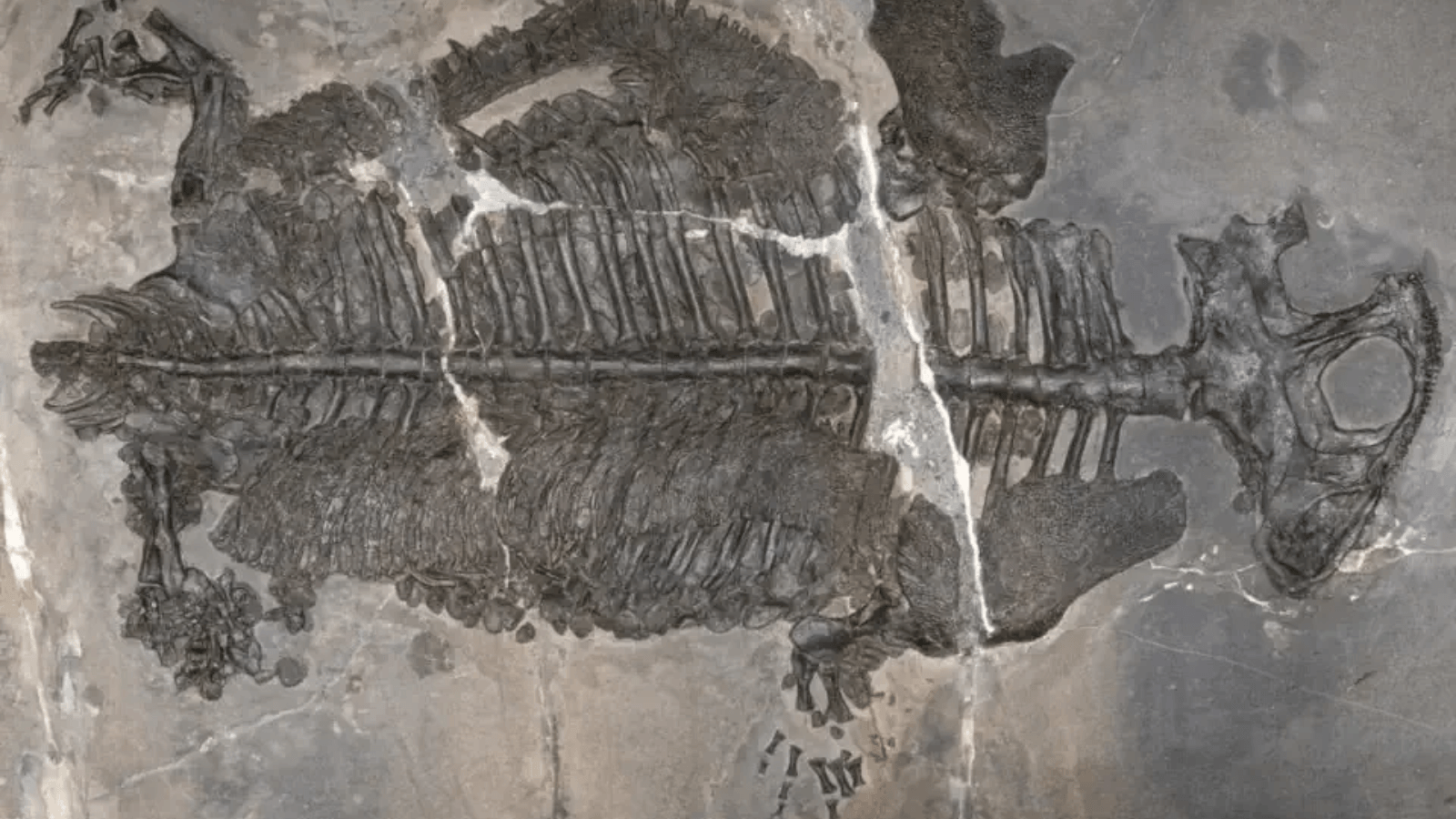
Two remarkably preserved skeletons from China reveal an armored amphibian that lived permanently in the ocean 237 million years ago. The discovery challenges a long-standing view of amphibian evolution and offers clues to how an animal normally restricted by saltwater could survive at sea.
Two fossil skeletons discovered in China have revealed something scientists had never documented before: an amphibian that spent its entire life in the ocean. Even their delicate finger bones remain attached, an extraordinary detail that helped researchers determine where these animals lived and died. Named Gerrothorax maritimus, the armored creature represents the first known fully marine amphibian in the fossil record.
The discovery, described in Nature Ecology & Evolution, comes from Guanling County in China’s Guizhou Province. Researchers examined two nearly complete skeletons dating to the Late Triassic, approximately 237 million years ago. The animals belonged to the temnospondyls, an extinct group of early amphibian relatives, and had broad, flattened bodies measuring up to about 75 centimeters long.
The international team, including scientists from the Geological Museum of Guizhou, Peking University and the University of California, Davis, identified several features that set the species apart from other known amphibians. More importantly, the fossils provide evidence that at least one ancient amphibian lineage overcame the biological barriers that prevent its living relatives from inhabiting the open ocean.
Evidence from the Ancient Seafloor
Establishing that Gerrothorax maritimus actually lived in the sea was central to the investigation. Amphibian fossils occasionally appear in marine sediments, but their presence does not necessarily mean the animals lived there. Rivers and currents can carry carcasses considerable distances before burial.
In this case, the geological setting told a different story. Both skeletons came from the same rock layer, deposited in an ancient marine environment at least 30 kilometers from the nearest island. Their exceptionally complete preservation also made long-distance transport unlikely.
The most revealing evidence came from the animals’ hands. Small finger bones remained attached to the limbs, although these delicate elements typically separate when a carcass decays or drifts through water. Their survival suggests that the amphibians died close to where their bodies eventually settled on the seabed.
The researchers then examined strontium isotopes preserved in the fossil bones. Their chemical signatures closely matched those of Late Triassic seawater, supporting the conclusion that the animals had lived in the ocean rather than merely being washed into it. The surrounding sediments showed different signatures, further strengthening the interpretation.
An Armored Amphibian Adapted to Saltwater
The discovery raises an intriguing biological question. Why could this ancient animal live in the sea when no known modern amphibian can do so permanently?
Living frogs, salamanders and other amphibians generally rely on moist, permeable skin to absorb water and exchange gases. Unfortunately, that same characteristic makes prolonged exposure to seawater dangerous. Salt draws water from their bodies, and even species with some salt tolerance usually depend on freshwater or less saline environments.
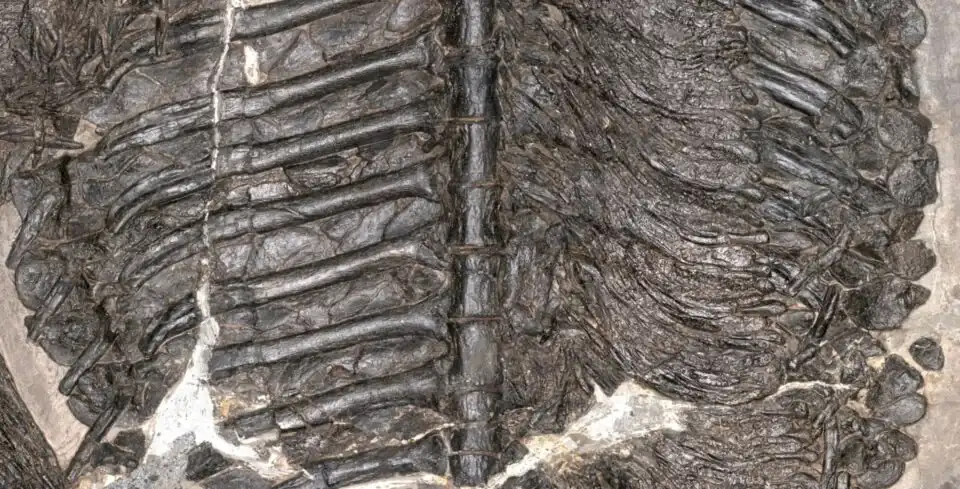
Gerrothorax maritimus had a very different body structure. Much of its broad, flattened torso was enclosed in bony armor, an inherited characteristic that may have proved essential to its marine lifestyle. Researchers propose that this covering reduced the movement of water and salts through the skin, helping the animal avoid the dehydration that affects most amphibians in seawater.
The creature also retained gills, allowing it to breathe underwater without depending primarily on its skin. Scientists suggest that its gills and digestive system may have helped it manage salt intake, although the precise physiological mechanisms cannot be established from the fossils alone.
Rather than evolving entirely new structures for marine life, this lineage may have adapted existing anatomical features to an environment that remained inaccessible to other amphibians.
A Suction-Feeding Predator Among Marine Reptiles
Despite its unusual evolutionary history, Gerrothorax maritimus appears to have been well suited to life on the seafloor. Its flattened body and heavy armor suggest an animal that spent much of its time resting near the bottom rather than swimming continuously through open water.
Its broad skull, large mouth and strongly developed gill structures point toward another distinctive adaptation: suction feeding. Researchers believe the amphibian could have waited for smaller animals to approach before rapidly drawing water and prey into its mouth. A similar hunting strategy is used by modern wobbegong sharks, which ambush fish from the seabed.
The armored amphibian shared its marine environment with much larger predators. Fossils from the same deposits include Guizhouichthyosaurus, an ichthyosaur that could grow beyond six meters in length. Body armor may therefore have offered protection as well as helping the amphibian maintain its position near the bottom.
The two skeletons are preserved at the Geological Museum of Guizhou in Guiyang, where they form part of an important collection of Triassic marine fossils. Their discovery reveals a previously unknown chapter in amphibian evolution: a lineage that developed an alternative way to survive in saltwater long before the appearance of modern frogs and salamanders.
The findings also show how anatomical features inherited from earlier ancestors can open unexpected evolutionary possibilities. In Gerrothorax maritimus, the combination of body armor and gills may have allowed an amphibian to occupy an environment that remains beyond the reach of its living relatives.
Cover Image: The nearly complete fossil skeleton of Gerrothorax maritimus, a 237-million-year-old armored amphibian identified as the first known fully marine member of its lineage. Credit: Ryosuke Motani / UC Davis.