
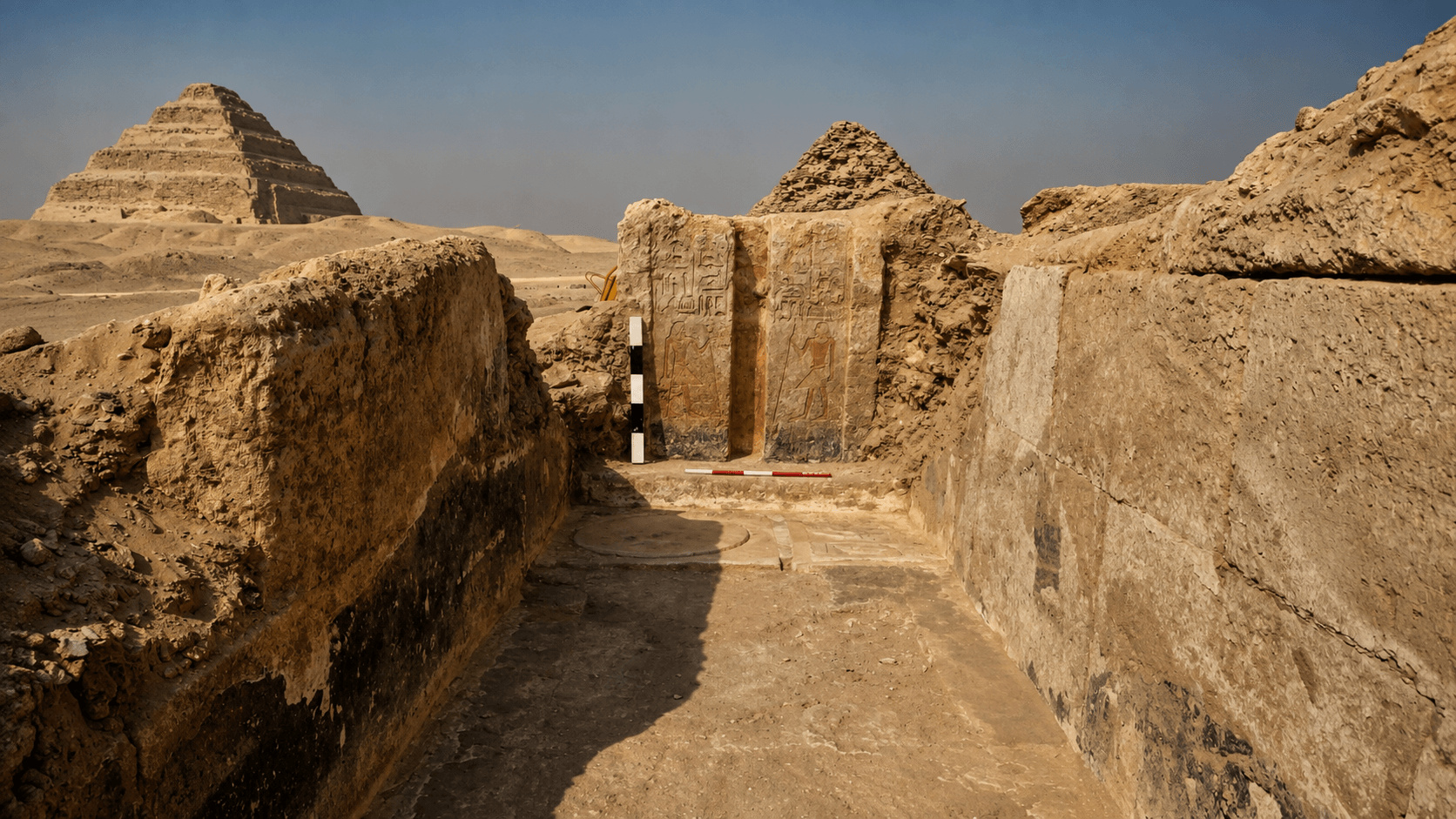
Archaeologists at Saqqara have uncovered the Old Kingdom tomb of a high-ranking Egyptian official named Sekhentiu-Ptah, together with part of his funerary chapel, an inscribed false door and a group of alabaster ritual objects still preserved in their original setting.
The excavation also exposed a network of burial shafts containing later human burials, painted funerary cartonnage, more than 100 faience ushabti figures and three stone sarcophagi that were still closed when found.
Egypt’s Ministry of Tourism and Antiquities announced the discoveries following the first excavation season in Sector A, west of the Bubasteion necropolis. The ministry dates Sekhentiu-Ptah’s tomb to the Old Kingdom, while material recovered from the surrounding shafts points to later phases of burial, including the Late Period.
Ritual objects preserved in front of a false door
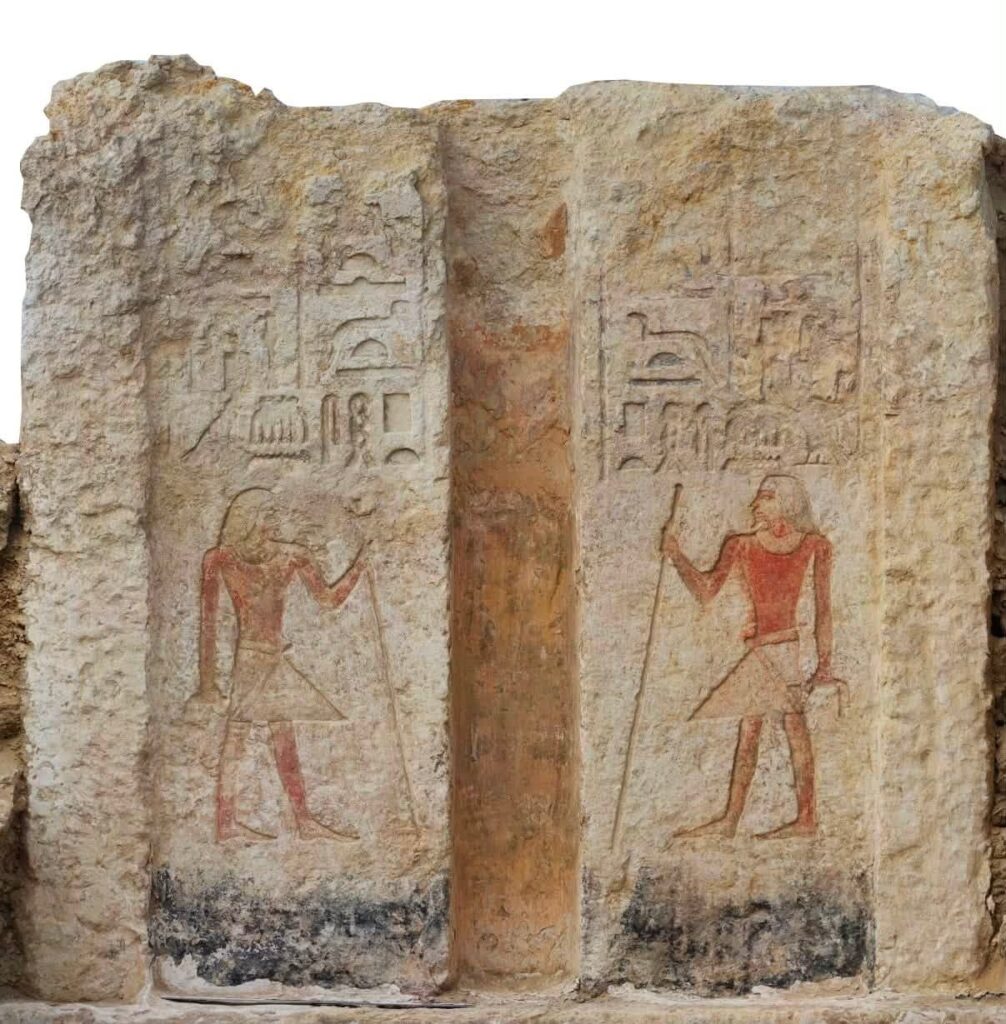
Inside the remains of Sekhentiu-Ptah’s funerary chapel, archaeologists found a false door still standing in its original position.
In ancient Egyptian elite tombs, false doors formed a symbolic point of contact between the deceased and the living. Offerings could be presented in front of them during funerary rituals, making their position within the chapel especially important.
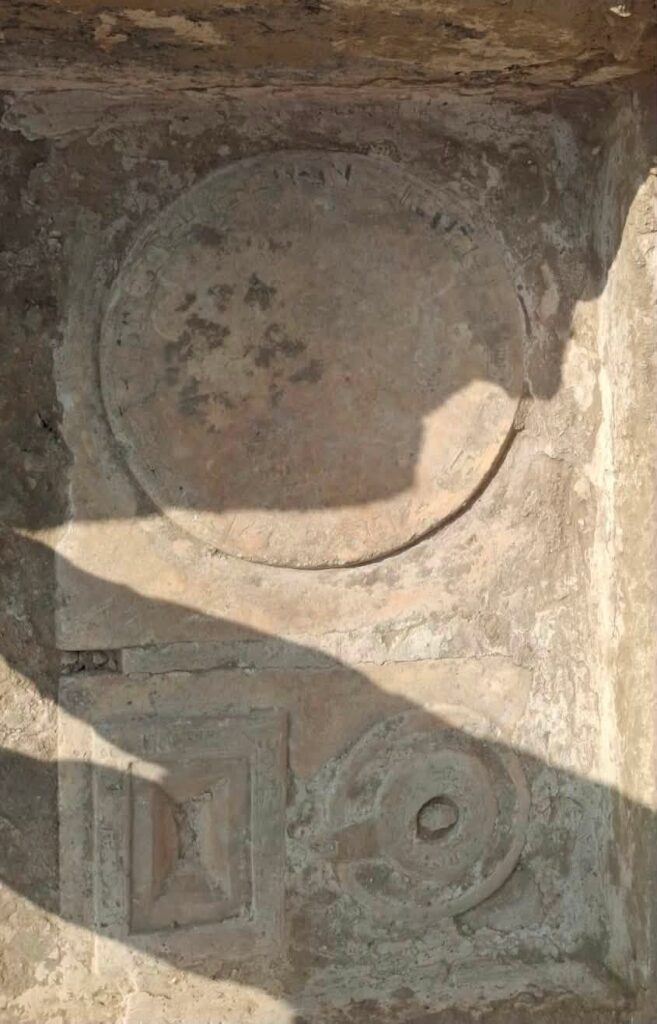
Directly in front of Sekhentiu-Ptah’s false door, the team uncovered a group of alabaster objects used in funerary ceremonies. The assemblage includes an offering table, an offering disc, a purification basin, a jug and a bowl.
All carry hieroglyphic inscriptions recording the tomb owner’s name and titles.
The preservation of the objects together in their original setting gives archaeologists evidence for how this part of the chapel was used. Mohamed Abdel Badie, head of Egypt’s Antiquities Sector, said the assemblage could provide important information about Old Kingdom funerary rituals and practices.
His titles point to a senior role in the royal administration
The inscriptions also provide a detailed picture of Sekhentiu-Ptah’s career.
Among his recorded titles were Royal Chamberlain, Overseer of All the Works of the King, Overseer of Royal Documents, Keeper of the Secrets of Royal Commands, Priest of the Goddess Maat and Overseer of Scribes.
Several of these offices are closely tied to written administration, royal orders and state works. Together, they indicate that Sekhentiu-Ptah held a senior position within the Old Kingdom bureaucracy and operated close to the royal administration.
His title as priest of Maat adds a religious role to that administrative profile. Maat represented truth, justice and cosmic order, concepts closely linked to kingship and the proper functioning of the Egyptian state.
The ministry has not yet assigned the tomb to a specific dynasty or reign. Further study of the inscriptions, architecture and associated finds may provide a narrower date. Egypt’s Old Kingdom spans the Third through Sixth Dynasties, roughly 2686–2181 BCE.
Later burials changed the picture
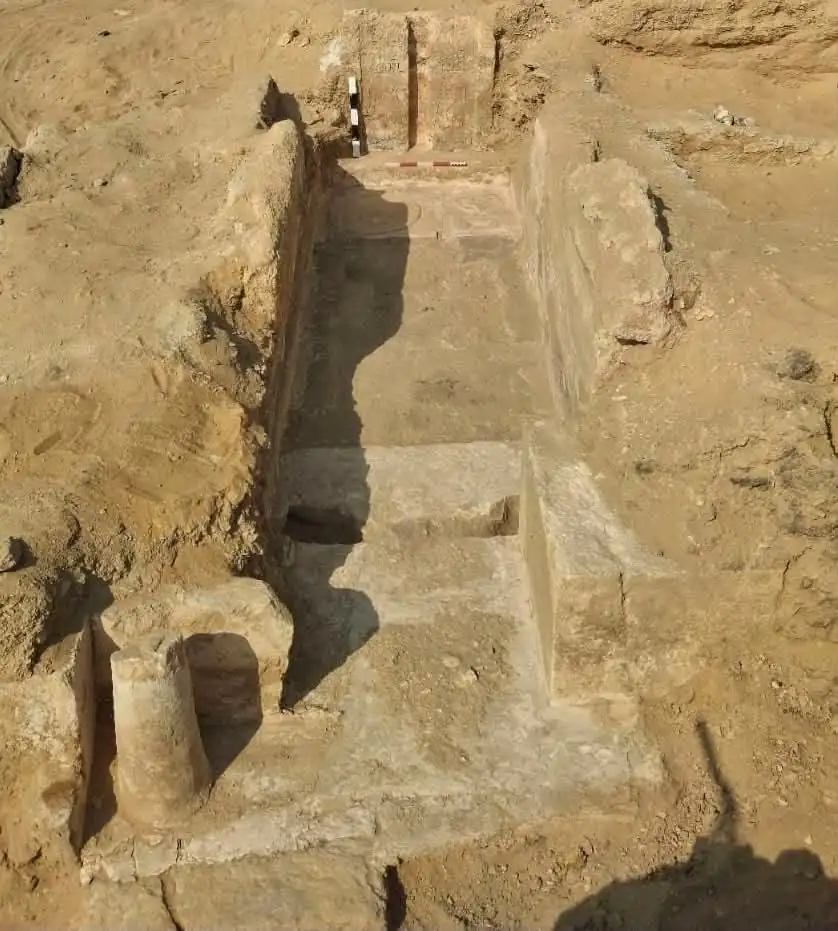
The excavation expanded beyond the Old Kingdom chapel when archaeologists identified an interconnected system of burial shafts nearby.
These shafts contained numerous human burials, large quantities of painted funerary cartonnage, pottery vessels and other archaeological material. The team also recovered a wooden statue in the form of a falcon.
More than 100 faience ushabti figures were found among the funerary material.
Ushabtis were placed in Egyptian burials to perform work on behalf of the deceased in the afterlife. Their presence, together with the cartonnage and other objects, points to later funerary activity in this part of the cemetery.
The most striking finds from the shafts were three stone sarcophagi discovered still closed and apparently undisturbed.
These burials do not belong to the same period as Sekhentiu-Ptah’s Old Kingdom tomb. The ministry specifically links material from the burial shafts to research into Late Period funerary practices.
That chronological difference is important because it shows that this part of Saqqara remained a burial place long after Sekhentiu-Ptah was laid to rest.
A cemetery used again and again
Previous excavations in and around the Bubasteion have already shown that the area preserves remains from several distinct periods. Saqqara has continued to produce unusual evidence from elite burials, including the enigmatic 5,000-year-old Sabu Disk found inside a First Dynasty mastaba.
Research west of the New Kingdom cemetery has documented Old Kingdom tombs, including the decorated tomb of the lector priest Wahty and another belonging to Khufuemhat, an overseer of builders.
Later activity transformed parts of the same landscape. During the Late Period, sections of the Bubasteion became associated with the sacred-animal necropolis linked to the cult of the goddess Bastet.
Other excavations have revealed New Kingdom elite tombs that were reused centuries after their original construction. In some areas, later catacombs and animal burials were cut into or around much older funerary structures.
The newly excavated sector adds another example of this long history of reuse.
In July 2026, an Egyptian archaeological mission also announced the discovery of three New Kingdom rock-cut tombs in the eastern part of the Bubasteion necropolis. The finds underline how many phases of Egyptian history are preserved within the wider cemetery.
Old Kingdom officials, New Kingdom tomb owners, Late Period burials and later sacred-animal cults all left traces across the same funerary landscape.
Ancient tomb robbers left passages between the chambers
Several of the newly investigated burial shafts had already been entered in antiquity.
Archaeologists found openings cut between adjoining burial chambers, apparently created by tomb robbers moving through the underground complex.
Although looting disturbed parts of the cemetery, the surviving passages can still help researchers understand how the shafts and chambers were connected and how the underground layout changed over time.
The survival of three closed stone sarcophagi is therefore particularly significant. Their condition suggests that at least some parts of the burial system escaped the level of disturbance seen elsewhere.
Amr El-Tayebi, director general of the Saqqara archaeological area and head of the Egyptian mission, said the discoveries provide valuable material for studying Late Period burial customs and the successive reuse of the cemetery during different periods.
The team is continuing archaeological, architectural, linguistic and comparative studies of the finds.
According to the Ministry of Tourism and Antiquities, the results are expected to be published in specialized peer-reviewed journals. Excavation will also continue in the sector, where archaeologists say there are promising indications of additional structures and artifacts.
Sekhentiu-Ptah’s tomb now sits within a much broader archaeological picture: an Old Kingdom funerary chapel preserved beside later shafts, burials and ritual objects that record how the same part of Saqqara remained connected with the dead for centuries.
Cover Image: The newly excavated Old Kingdom tomb of Sekhentiu-Ptah at Saqqara, with pyramids visible in the background. Credit: Egyptian Ministry of Tourism and Antiquities.