
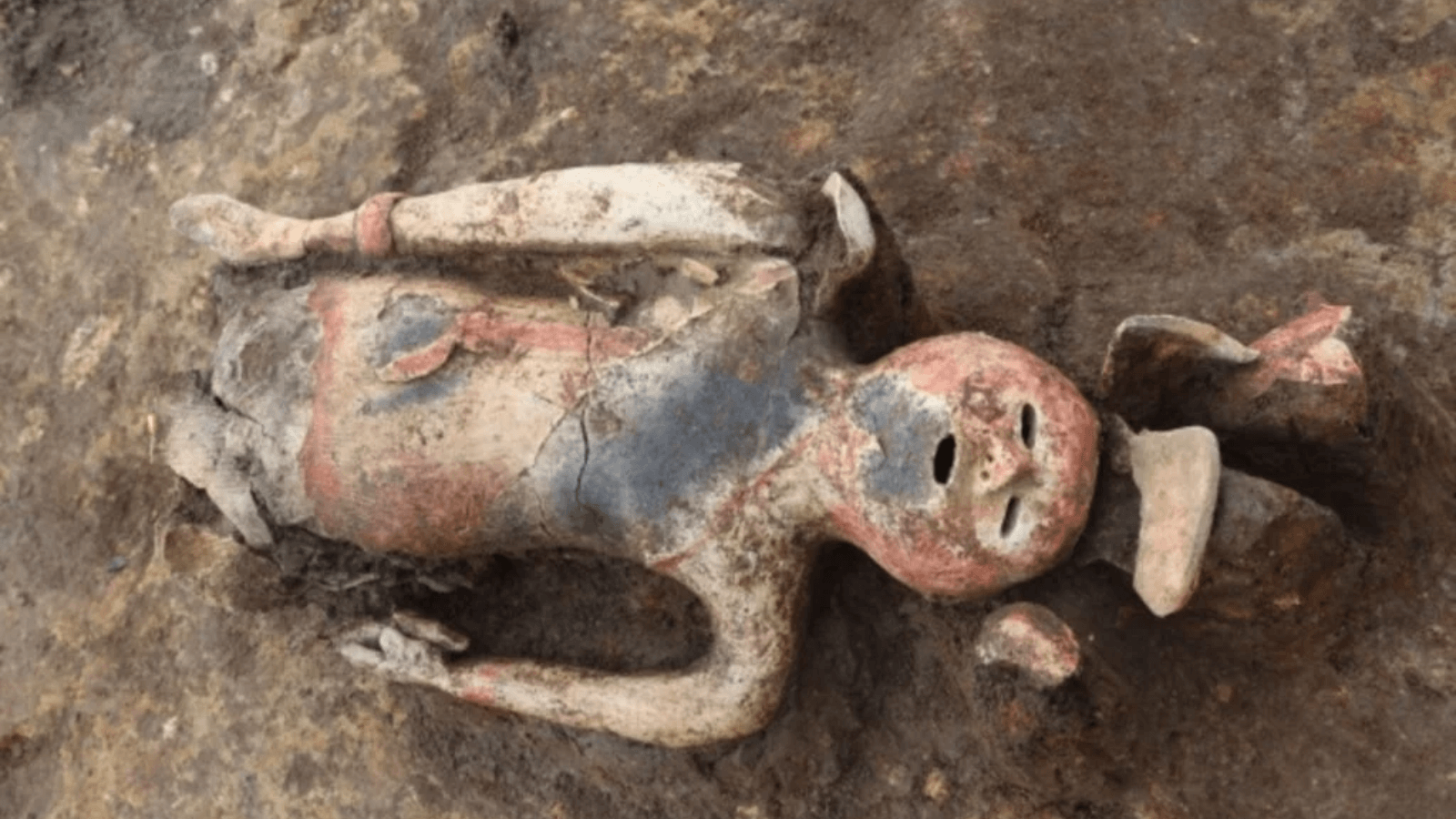
An early clay sculpture of a woman believed to have taken part in rituals has been recovered from a fifth-century tomb in Gunma. The find is among the region’s oldest human-shaped haniwa and comes from a burial mound whose unusual layout was only recently established.
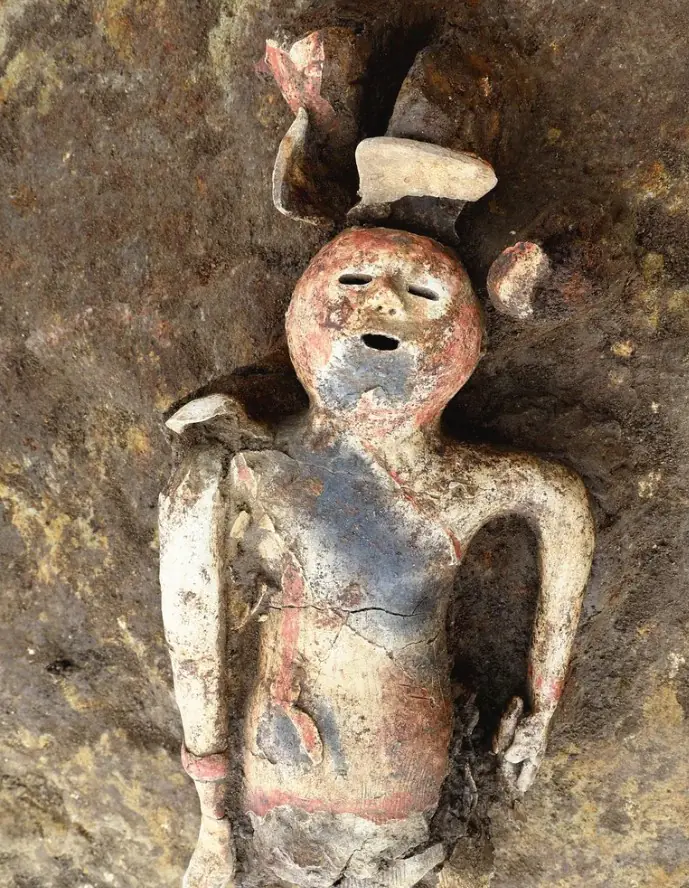
The woman represented in a 1,500-year-old Japanese clay figure wears bracelets that look different on each wrist. Her face has carefully pierced nostrils, and red pigment still marks her sash and hair ties. These unusually fine details have survived on a haniwa recovered from the ditch of a burial mound in Gunma Prefecture, where such human figures were only beginning to appear in the fifth century.
Archaeologists found the sculpture at the Nishikaminomiya site in Isesaki, beside the Tone River. Only its head and upper body survive, measuring about 40 centimeters (16 inches), but the figure’s pose is clear: both arms hang down, and the left hand holds a narrow rod. Gunma officials interpret the object as a ritual implement and describe the woman as a miko, a female participant in ceremonial practices.
That identification does not establish that the statue portrays an actual shaman or priestess. The exact function of the rod remains unknown, and the figure’s surviving attributes provide only indirect evidence of the practices it may represent. Its importance is more secure in another respect: it belongs to one of the earliest phases of human-shaped haniwa production documented in Gunma.
A Painted Figure Made for a Tomb
The ancient craftsperson worked on details that may have been difficult to see from a distance. Clay was used to model the bracelet on the right wrist, while red paint alone created the bracelet on the left. A clay strip on the crown indicates tied-up hair in a style known as Kofun Shimada; the artist also shaped individual fingers and pierced small holes for the nostrils.
The red paint was not confined to the face. It also marked the sash crossing the upper body, the hair tie and the jewelry, suggesting that color helped distinguish elements of the woman’s dress and accessories. Because the lower body is missing, archaeologists cannot determine how the complete figure was decorated.
Haniwa were arranged on and around burial mounds during Japan’s Kofun period, roughly the third to seventh centuries AD. The earliest examples included cylindrical forms, with houses and other objects appearing later, while sculpted people and animals emerged from the middle of the fifth century. According to the Tokyo National Museum, figures of women engaged in rites were among the human forms that developed as part of tomb displays.
Credit: Gunma Prefecture / Gunma Prefectural Archaeological Research Center
A Newly Understood Burial Mound
The excavation has also changed how archaeologists understand the tomb itself. Researchers originally identified Mound No. 1 as circular, but investigations in 2026 revealed a projecting section along its southern side. The female haniwa was found where it had fallen from this projection into the surrounding ditch, providing a clearer link between the sculpture and the mound’s design.
Mound No. 1 dates to the second half of the fifth century and extends approximately 45 to 50 meters, with a ditch about 18 meters wide. It is the largest of 11 burial mounds identified at Nishikaminomiya, dating to the fifth and sixth centuries. Archaeologists also recovered the lid of a boat-shaped stone coffin, another indication that this was a prominent monument within the cemetery.
Excavations began in 2020 as part of river improvement work along the Tone River. The wider project has documented a substantial funerary landscape, but the new discovery is particularly useful because the figure, the dating of the tomb and the location of the mound’s projection can be studied together. These findings provide a firmer archaeological context for an early example of the clay representations that became widespread in later Kofun burials.
Gunma Prefecture plans to exhibit the figure from October 28 to November 30, 2026, at the Archaeological Information Museum of the Gunma Prefectural Archaeological Research Center. It will be the sculpture’s first public display, allowing visitors to examine the surviving paintwork and carefully modeled features that distinguish it from many other examples of early human-shaped haniwa.
Cover Image: A 1,500-year-old human-shaped haniwa figure discovered at the Nishikaminomiya site in Isesaki, Gunma Prefecture, preserves traces of red pigment on the face, sash and ornaments. Archaeologists believe the figure may represent a woman engaged in ritual activity. Credit: Gunma Prefecture / Gunma Prefectural Archaeological Research Center