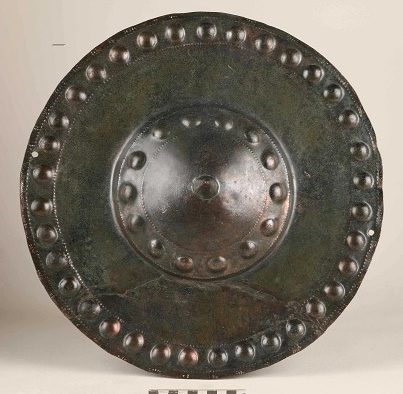
A bronze shield belonging to the Urartian king Argišti I has produced a rare historical surprise: the name of a land never before recorded in Urartian sources.
The shield, now part of the collection of the Rezan Has Museum, carries a cuneiform inscription that identifies a country called Qarini—a name absent from known royal annals, stone inscriptions, and campaign records of the Urartian Kingdom.
A Military Object Turned Historical Record
Believed to have been found in the region between modern-day Ağrı–Patnos and the Muş plain in eastern Türkiye, the bronze shield measures approximately 40 centimeters in diameter. Its surface is decorated with dotted and domed bands typical of high-status Urartian metalwork, but it is the inscription that sets it apart.
The text includes the determinative KUR, the Urartian marker used specifically to denote a land or political territory. What follows—Qarini—points to the existence of a previously unknown country within the Urartian sphere of military or political activity.
This detail, small in appearance, carries significant implications for reconstructing the geography of Urartu’s expansion in the Early Iron Age.
“Shields Were Not Only Weapons, but Symbols of Victory”
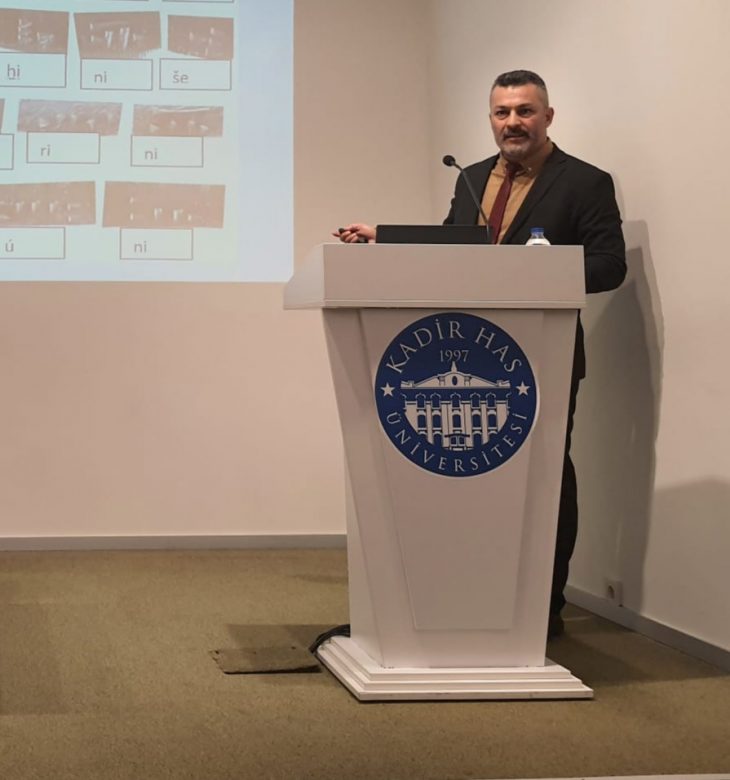
Assoc. Prof. Orhan Varol of Van Yüzüncü Yıl University, who examined the inscription, stresses that Urartian military equipment often played a symbolic role beyond the battlefield.
“Most Urartian inscriptions are carved onto stone blocks or rock surfaces to commemorate military campaigns,” Varol explains. “However, weapons such as shields could also function as victory objects. In some cases, they were transformed into symbolic monuments through cuneiform inscriptions.”
According to Varol, shields associated with successful campaigns were sometimes dedicated to the chief god Haldi. Inscriptions could record conquered lands or offerings, turning a functional object into a lasting statement of royal power and divine favor.
“A shield that played a decisive role in battle could later gain symbolic meaning once inscribed,” he adds. “It became both a memory of conquest and a message of authority.”
What Qarini Tells Us About Urartu
The mention of Qarini suggests either a newly conquered territory or a political unit integrated into the Urartian realm during Argišti I’s reign. While its precise location remains unknown, its inclusion on a royal object implies strategic importance.
Each newly identified place-name also contributes to linguistic research. After Sarduri I, Urartian kings wrote in the Urartian language—an isolate, unrelated to Indo-European or Semitic families, though distantly linked to Hurrian—using an adapted Assyrian cuneiform system. New inscriptions refine scholars’ understanding of Urartian political terminology and regional networks.
The Reign of Argišti I
Argišti I ruled Urartu from approximately 786 to 764 BCE and is remembered as one of the kingdom’s most expansionist rulers. He pushed Urartian control into northern Syria, strengthened dominance in eastern Anatolia, and extended influence toward the Caucasus.
Under his leadership, Urartu emerged as the strongest post-Hittite power in the region. The appearance of Qarini aligns with this phase of aggressive territorial growth, offering tangible evidence of campaigns that may not have been recorded elsewhere.
Urartian Craftsmanship and Royal Ideology
From its earliest centuries, the Urartian Kingdom produced distinctive bronze artifacts—belts, shields, helmets, horse equipment, vessels, and jewelry—often inscribed with royal texts and decorated with scenes of warfare, ritual, hunting, and mythological beings.
These objects were not merely decorative. They served as instruments of ideology, reinforcing the bond between king, god, and conquest. The bronze shield of Argišti I fits squarely within this tradition.
A single line of cuneiform, engraved nearly 2,800 years ago, has now expanded the known political landscape of Urartu. Qarini may have vanished from memory—but through this shield, it has re-entered history.
Cover Image: Urartian bronze shield bearing a cuneiform inscription from the reign of King Argišti I, revealing the name of a previously unknown ancient country.
Courtesy of Rezan Has Museum. Used with permission.