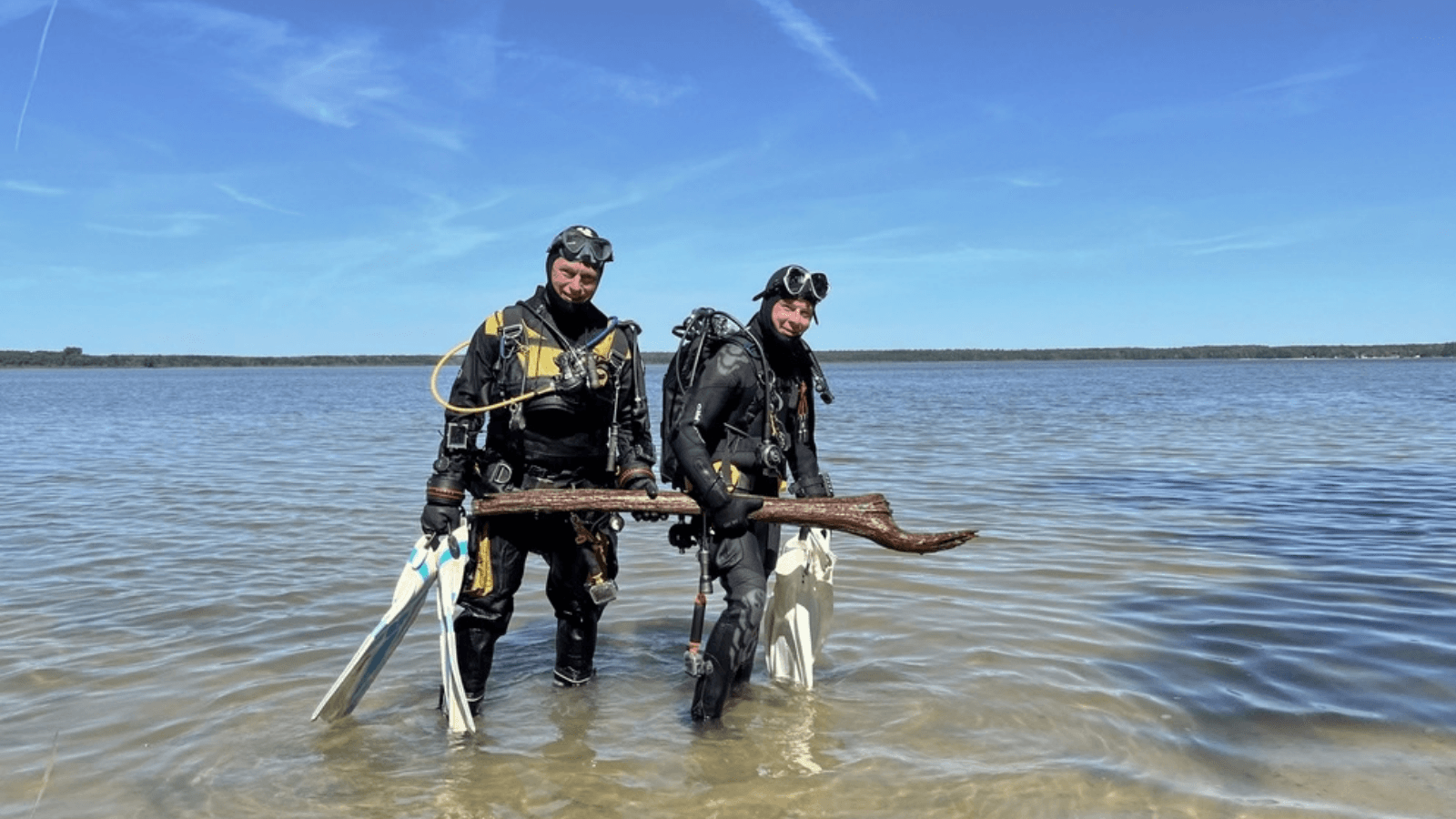
Deep beneath a lake in northern Germany, archaeologists have found remarkably preserved wooden remains dating back some 10,500 years. The discovery could provide rare evidence of how Mesolithic hunter-gatherers built and organized the places where they lived.
The wooden remains were discovered in Lake Arendsee in Saxony-Anhalt, according to the State Office for Heritage Management and Archaeology Saxony-Anhalt, which has been investigating submerged landscapes in the lake for several years. Among the finds are an approximately 1.6-meter-high wooden post with clear felling and working marks and split boards measuring up to 1.3 meters long.
Researchers do not yet know what the timbers originally formed. They may have belonged to huts or other structures, but archaeologists are also considering the possibility that they represent a type of wooden construction not previously documented from this period.
A Mesolithic landscape preserved underwater
Around 10,500 years ago, people living around Arendsee survived through hunting, gathering and fishing and had not yet adopted the permanently settled farming lifestyle that would later transform Central Europe.
Most surviving evidence from the Mesolithic consists of stone tools, animal bones and traces preserved in the ground. Wood rarely survives for thousands of years, making the material from Arendsee particularly unusual.
Its preservation is linked to the geology of the lake. Arendsee lies above an underground salt structure, and geological processes have caused the lakebed to sink gradually over time. Instead of disappearing as the lake slowly filled with sediment, sections of the ancient shoreline were submerged.
Mesolithic remains now lie beneath a thin layer of sediment at a depth of around 20 meters, protected by waterlogged conditions that preserved material normally lost to decay.
Worked timbers point to possible structures
The approximately 1.6-meter post is among the most striking discoveries. Its felling and working marks show that people deliberately shaped the timber, and archaeologists believe it may once have served as a supporting element in a structure.
The split boards provide another clue. Measuring up to 1.3 meters long, they offer direct evidence of woodworking at a time from which wooden architectural elements are extremely rarely preserved.
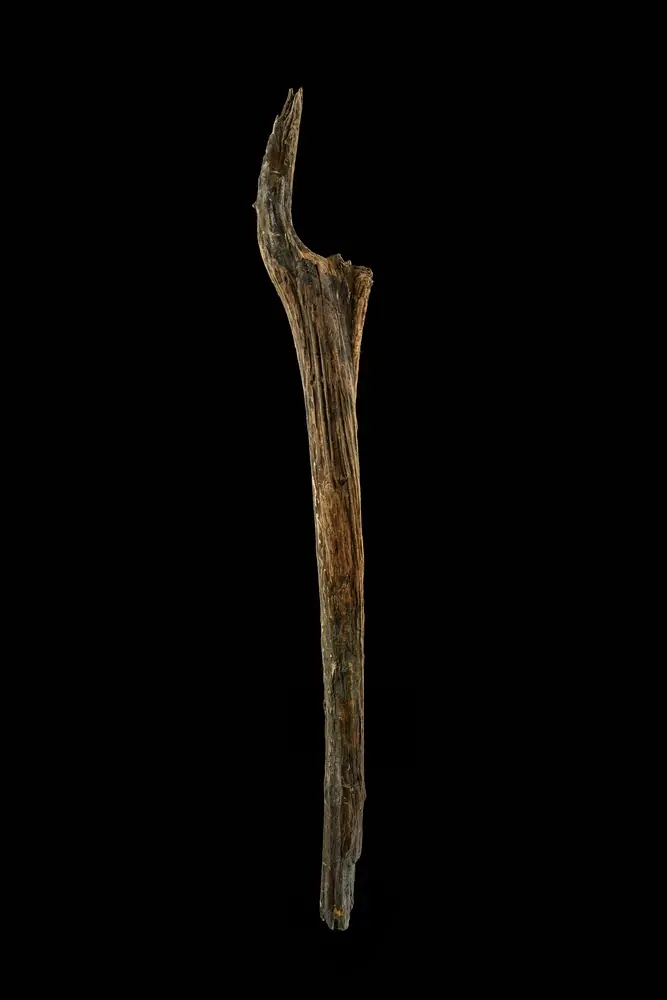
State Archaeologist Harald Meller said traces of Mesolithic buildings in central Germany have previously been known mainly through discolorations left in the soil. At Arendsee, archaeologists are instead dealing with surviving pieces of the wood itself.
Whether those pieces belonged to huts remains unanswered. Researchers will need to establish how the timbers were positioned along the former shoreline and whether further elements remain beneath the lakebed before they can reconstruct what stood there.
Three thousand years before the first farmers
The age of the material makes that question particularly important.
The first farming communities arrived in central Germany around 5500 BCE, bringing agriculture, livestock and timber longhouses associated with more permanent settlements. The Arendsee remains are roughly 3,000 years older.
Project leader Marcel Weiß said that if permanent buildings or intensively shaped living spaces already existed 10,500 years ago, the evidence could change how archaeologists view hunter-gatherer communities and the beginnings of human-made cultural landscapes.
The suggestion remains a hypothesis rather than a conclusion. But the preserved timbers offer a chance to test ideas that are normally difficult to investigate because so little Mesolithic wood survives.
The discovery also comes from the same broad period as the famous burial known as the Shaman of Bad Dürrenberg, another major Mesolithic find from Saxony-Anhalt. Together, such sites are providing an increasingly detailed picture of hunter-gatherer societies in the region.
Mapping a shoreline lost beneath the lake
After the initial discovery in spring 2026, archaeologists recovered additional samples and selected finds to determine the age and extent of the site.
A second campaign, carried out with the Fraunhofer Institute in Ilmenau, used a remotely operated underwater vehicle equipped with high-resolution sonar. The scans recorded the relief of the former shoreline and helped researchers identify areas where additional archaeological material may survive.
Arendsee has already produced evidence of human activity from later periods, including Neolithic fishing installations and medieval watercraft. Elsewhere in Europe, underwater environments have preserved equally striking archaeological material, including a perfectly preserved Bronze Age sword recently found beneath Italy’s Lake Mezzano.
Future investigations will focus on the relationship between the individual wooden elements and the landscape around them. If more pieces survive in their original positions, archaeologists may eventually be able to determine whether Mesolithic hunter-gatherers built shelters here or created another kind of wooden space along the ancient lakeshore.
Cover Image: Underwater archaeologists recover a 10,500-year-old worked timber from Lake Arendsee in Saxony-Anhalt, Germany. © Landesamt für Denkmalpflege und Archäologie Sachsen-Anhalt, Juraj Lipták.