
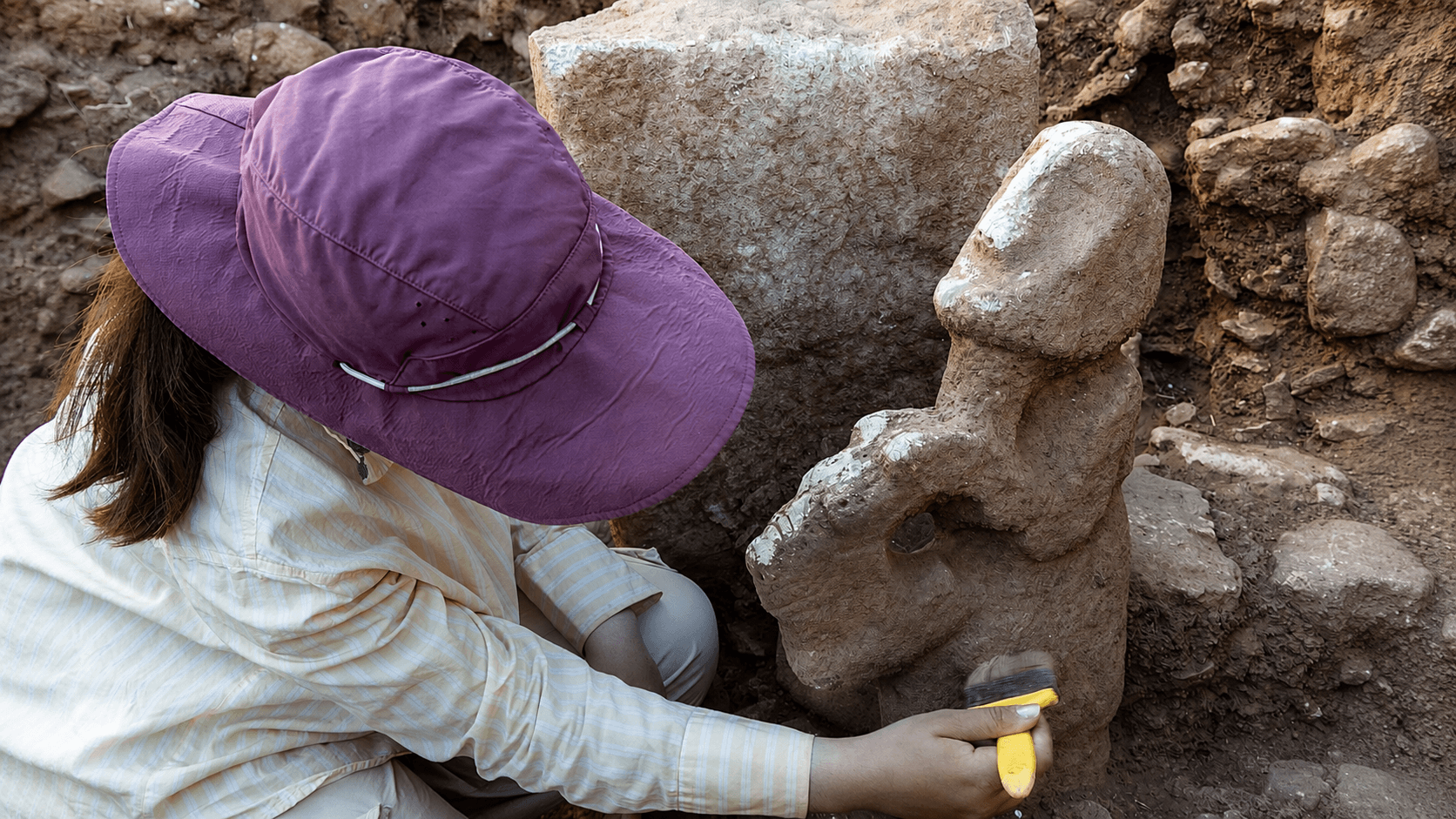
An 11,000-year-old “leopard rider” found at Karahantepe has reversed one of the Neolithic site’s strangest images. An earlier sculpture showed a human carrying a leopard; in the newly discovered composition, the predator bears the human.
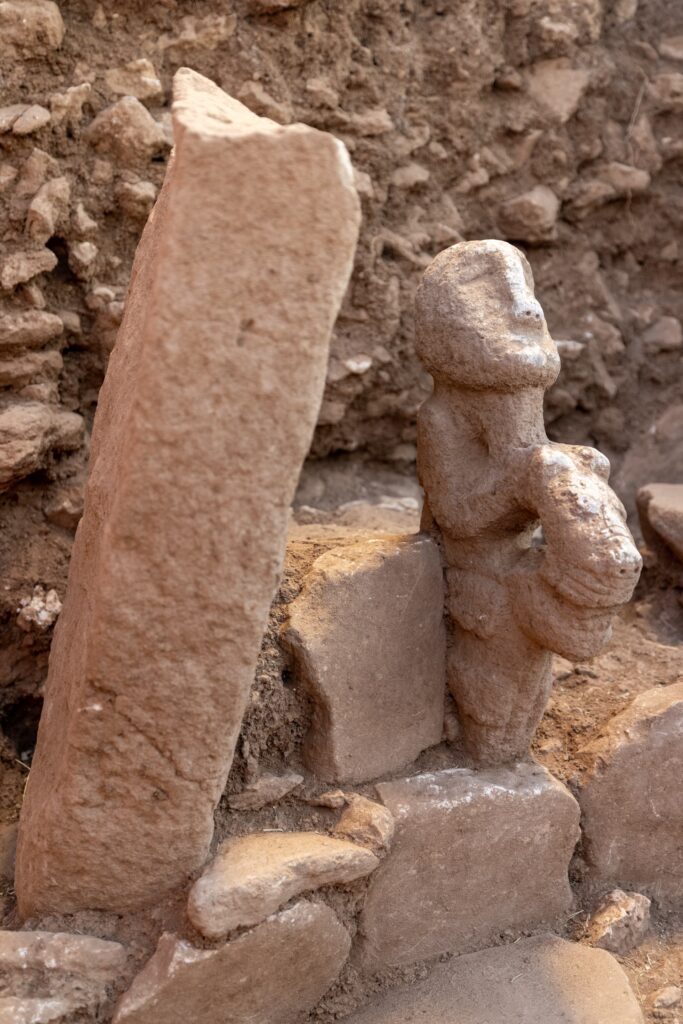
The 70-centimeter-tall stone sculpture was uncovered during the 2026 excavation season at Karahantepe, near Şanlıurfa in southeastern Türkiye. Archaeologists found it on a bench extending along the wall of a structure approximately three meters in diameter. Flat stones covered the building’s floor.
Türkiye’s Ministry of Culture and Tourism described the find as a composite sculpture created in a style not previously encountered at the site. No detailed archaeological study has yet accompanied the announcement, leaving the date within Karahantepe’s occupation sequence and the purpose of the building to be clarified.
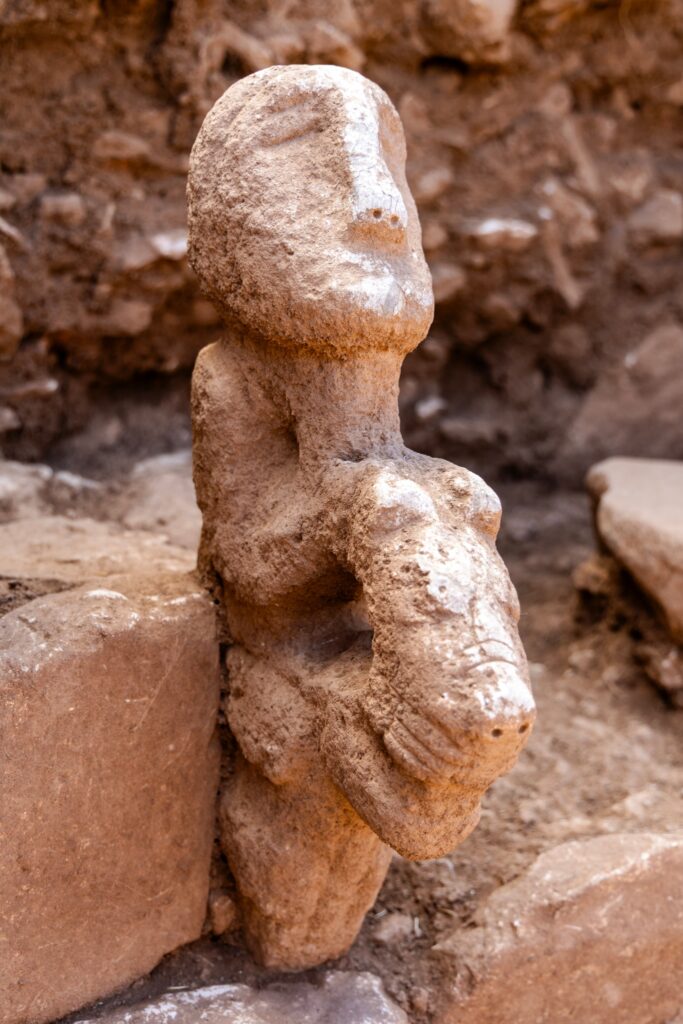
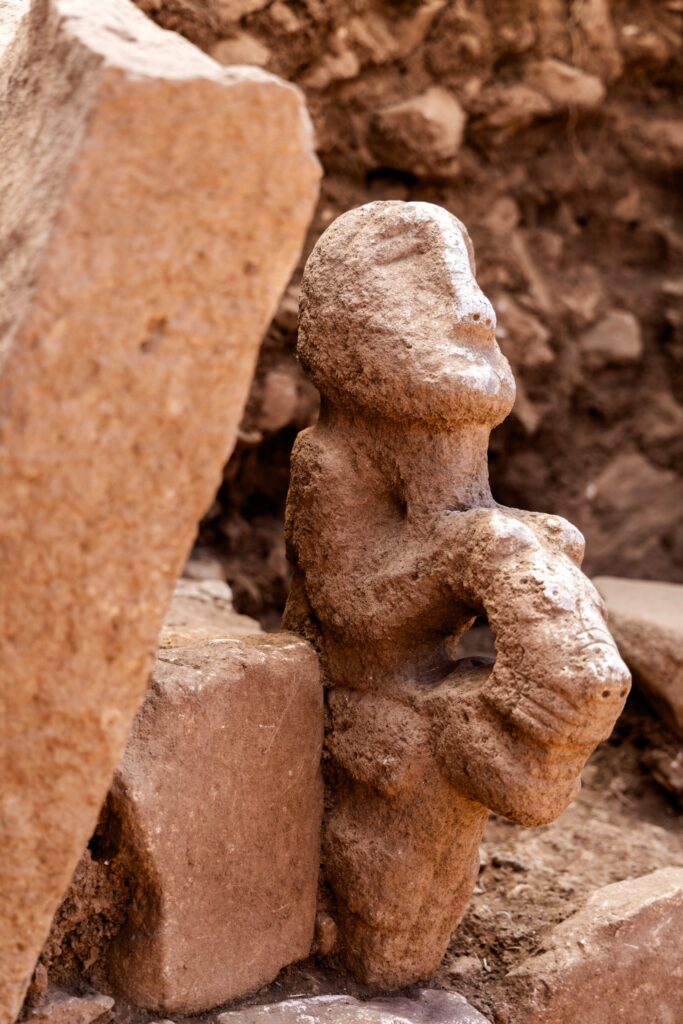
Its defining feature is already clear: a human figure sits directly on the back of a leopard.
The leopard has changed places
Karahantepe’s artists had brought humans and leopards together before, but not in this arrangement.
One of the site’s best-known sculptures depicts a person bent beneath a leopard carried across the back and shoulders. The animal’s open mouth and visible teeth suggest that it was represented alive and alert rather than as dead prey brought home from a hunt.
Excavation director Prof. Dr. Necmi Karul has previously noted how difficult that scene is to explain. Carrying a living predator does not correspond to an ordinary encounter between a hunter and an animal. The sculpture appears to preserve an action whose meaning was understood by its makers but is no longer available to us.
The 2026 discovery reverses the burden. The person no longer carries the leopard; the leopard carries the person.
The two sculptures were not found together, so they cannot be treated as consecutive scenes from a single surviving story. Their contrast is nevertheless hard to overlook. Karahantepe’s sculptors represented both a human beneath a leopard and a human above one, changing the balance between the same two figures.
Whether that reversal expressed control, transformation, status or a story associated with the building remains unknown. The figure resembles a rider, but the sculpture is not evidence that Neolithic people actually mounted or domesticated leopards. It records an imagined or symbolic scene, not necessarily an event from daily life.
Why place the statue on a bench?
The archaeological setting distinguishes the sculpture from an object recovered without context.
It was still resting on a bench constructed along the wall of a small building with a carefully paved floor. Its position suggests that the sculpture and the architecture were connected, although archaeologists must still determine when it was placed there.
If the figure stood on the bench while the building remained in use, it would have been visible to people occupying the room. It may instead have been deposited when the structure was abandoned or deliberately closed. Both practices are known from early Neolithic sites in the Şanlıurfa region, where buildings and objects were sometimes carefully covered rather than simply left to collapse.
Karahantepe has already shown how closely sculpture and architecture could be combined.
In 2023, archaeologists uncovered a 2.3-meter human statue fixed within a stone bench. Deep incisions emphasized its ribs, spine and shoulders, giving the seated figure an emaciated or deathlike appearance. A carved vulture occupied the surrounding space.
Another chamber contains upright elements cut directly from the bedrock, while a human head projects from one of its walls. These figures were not scattered ornaments. Their positions shaped the appearance of the spaces in which people encountered them.
The newly discovered human and leopard may have served a similar architectural role.
From individual animals to arranged scenes
Animals dominate the imagery of Karahantepe, Göbekli Tepe and other settlements within the Taş Tepeler region. Snakes, foxes, wild boars, birds and felines appear on pillars, stone vessels and portable objects.
Yet some discoveries indicate that Neolithic artists did more than identify individual species. They arranged humans and animals in ways that created action.
At nearby Sayburç, a carved wall panel places people, leopards and a bull within a continuous scene. One human stands between two confronting leopards, while another faces the bull. The figures have been interpreted as one of the earliest surviving examples of narrative art.
A miniature ensemble from Karahantepe, announced in 2025, offers a much smaller example. Stone carvings of a fox, wild boar and vulture—each only about 3.5 centimeters tall—were deliberately positioned inside nested containers. The head of each animal had been placed within a limestone ring.
Their arrangement mattered as much as the individual carvings. Separated from one another, they would have been three small animal figures. Placed together, they became a composition.
The same distinction applies to the new statue. A human carving and a leopard carving would each be significant. Joining them so that one body carries the other creates a scene.
Karahantepe’s growing focus on people
Excavations began at Karahantepe in 2019, revealing monumental buildings, T-shaped pillars, rock-cut chambers and an unusually rich group of human representations.
The site’s emphasis on the human form became even clearer in 2025 when archaeologists uncovered the first known T-shaped pillar with a clearly carved face. Arms and hands on other pillars had long supported the idea that these stones represented stylized human bodies. The addition of eyes, a nose and facial contours made that connection explicit.
Together with carved heads, seated statues and smaller figurines, the discovery established Karahantepe as one of the most important sources for studying how early settled communities represented themselves.
The leopard rider adds movement to that collection. The sculpture does not simply show what a person or animal looked like; it captures an unequal relationship between their bodies.
Approximately 11,000 years after the figure was left on a stone bench, the action remains visible even though its meaning has disappeared. Karahantepe has now produced both sides of an extraordinary pairing: a leopard carried by a human and a human carried by a leopard.
Cover Image: An archaeologist works beside the newly uncovered human-and-leopard sculpture during the 2026 excavation season at Karahantepe. Credit: Türkiye’s Ministry of Culture and Tourism