
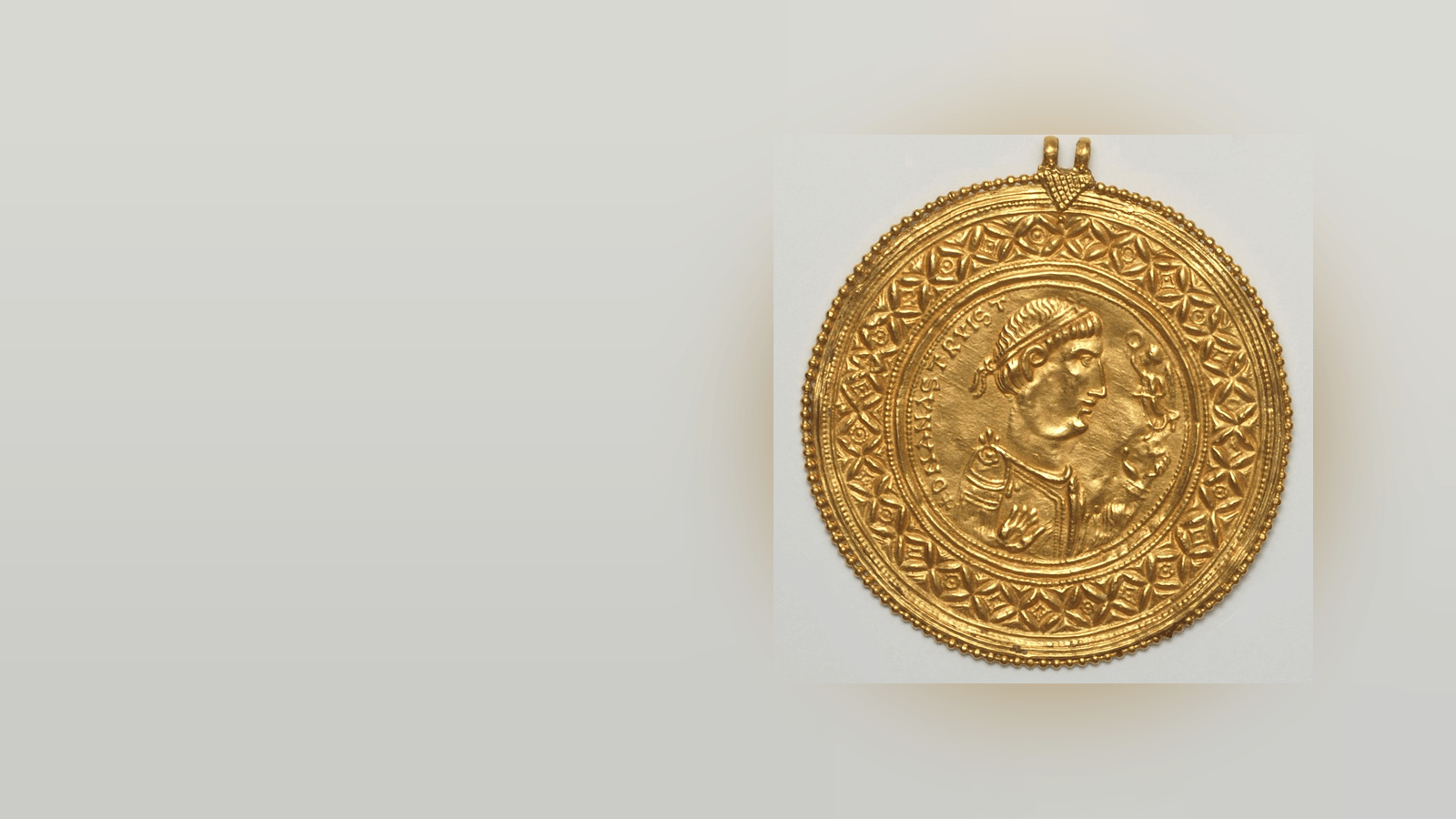
Two gold medallions preserved in a Washington museum may reveal how the Eastern Roman Empire attempted to secure the loyalty of a Caucasian kingdom nearly 1,500 years ago. Decorated with portraits of Emperor Anastasius and the Greek god Dionysus, the elaborate objects are now being interpreted as diplomatic gifts intended for a ruler in what is today Georgia.
The most compelling evidence comes from an unusual Latin inscription that scholars previously considered a badly executed imitation of Roman coin lettering. A new analysis suggests it may instead contain a message from the emperor recognising a foreign ruler’s royal authority.
Historian Marco Cristini of the University of Florence argues that the medallions formed part of royal insignia sent to a king of Lazica, a strategically important territory on the eastern Black Sea coast. His research, published on October 23, 2026, offers a fresh interpretation of how Constantinople used precious objects to build political alliances along its eastern frontier.
A Gold Pendant With an Unusual Message
The objects belong to the Byzantine collection at Dumbarton Oaks in Washington, D.C., where they were acquired in 1958 from antiquities dealer George Zacos. Although reportedly discovered in Syria, their original archaeological context remains unknown.
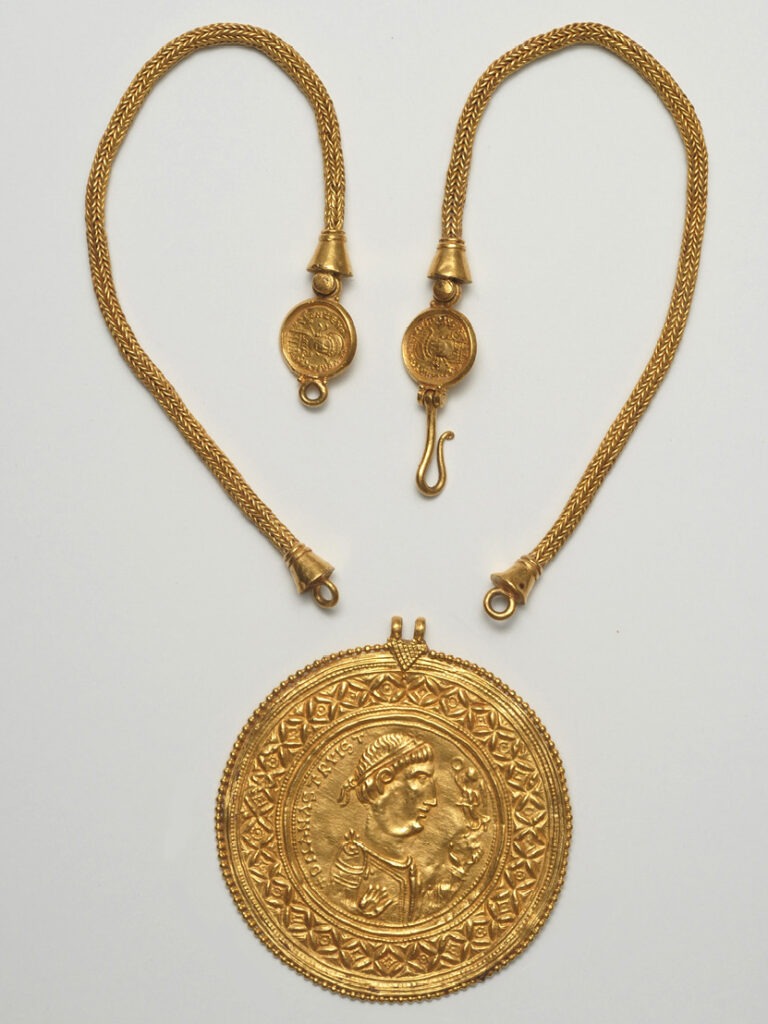
The surviving ornament consists of two gold medallions joined back to back and suspended from elaborate chains. One shows Emperor Anastasius, who ruled from AD 491 to 518, wearing military armour, a cloak and a diadem. He holds a globe surmounted by a winged figure of Victory.
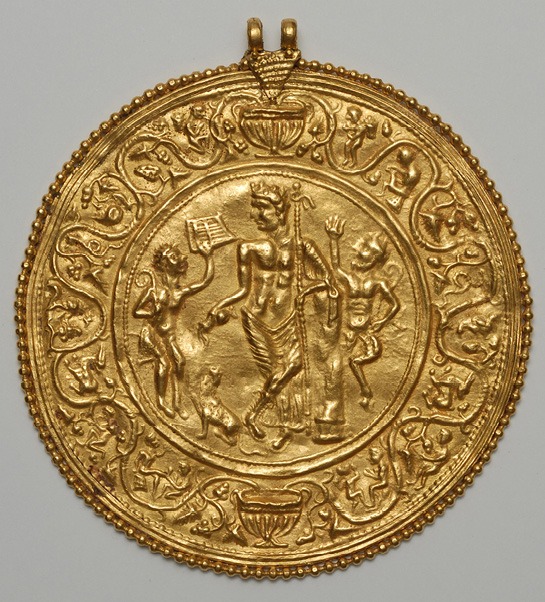
The second medallion presents a strikingly different scene. Dionysus, the Greek god of wine, pours liquid from a jug into the mouth of an animal, possibly a panther. Two satyrs stand beside him, surrounded by grapevines, birds, hares and smaller decorative figures.
For decades, the imperial medallion’s inscription presented a problem. Its opening letters resembled those on official Roman gold coins, but the remaining characters appeared meaningless.
Earlier scholars classified the piece as an unofficial imitation. Cristini questions why a skilled goldsmith producing such an expensive object would reproduce the emperor’s name correctly but make several apparent mistakes immediately afterward.
His solution is to read the puzzling letters as abbreviated Latin words rather than errors.
Under this interpretation, the inscription means:
“Our lord Anastasius wishes to appoint you as king.”
The proposed reading remains open to scholarly scrutiny, but it provides a remarkably different explanation for the medallion’s purpose.
The wording may also have been politically deliberate. By expressing a desire to recognise a ruler rather than issuing a direct command, Anastasius could acknowledge the authority of a foreign king without abandoning Rome’s claim to imperial supremacy.
A Kingdom Between Two Great Empires
The proposed recipient was a ruler of Lazica, a kingdom occupying part of present-day western Georgia. During the early sixth century, its position between the Eastern Roman and Sasanian empires made it valuable to both powers.
An account written by the sixth-century chronicler John Malalas provides an important clue.
In AD 522, Tzath, king of the Lazi, travelled to Constantinople after the death of his father, Damnaz. Rather than accepting recognition from the Persian ruler, he sought the support of Emperor Justin I.
Tzath was baptised, married a Roman woman named Valeriana and received royal garments decorated with imperial imagery. Among them was a ceremonial cloak bearing the emperor’s portrait.
The description closely resembles the diplomatic function Cristini attributes to the gold medallions.
There is, however, one important difference: the surviving pendant depicts Anastasius, not Justin.
Cristini suggests that negotiations between Constantinople and the Lazian royal family may have begun earlier, during the reign of Damnaz. The medallions could have been sent to him or another member of the ruling dynasty in the 510s, following the Roman-Persian war of 502–506.
Such a move would have allowed Constantinople to cultivate an alliance with Lazica before the political realignment formally recorded in 522.
The identity of the original recipient cannot be established with certainty, but the surviving historical accounts make the proposed connection plausible.
Why Does the Pendant Show Dionysus?
The inclusion of Dionysus is perhaps the most distinctive feature of the ornament. Why would a Christian Roman emperor choose a pagan deity for a gift intended for a foreign king?
Cristini believes the answer lies in the cultural traditions of ancient Georgia.
Dionysian imagery had been familiar in the region for centuries. At Sairkhe, archaeologists discovered an Attic red-figure vessel depicting a procession associated with Dionysus. Other finds, including a richly decorated silver belt from Vani and a mosaic depicting Dionysus and Ariadne at Dzalisi, demonstrate the importance of these mythological themes among local elites.
Wine production and ceremonial drinking also occupied a prominent place in the region’s cultural history.
By selecting Dionysus, the imperial court may have incorporated imagery that a Lazian ruler and his aristocracy would immediately recognise.
The two medallions could therefore have communicated complementary messages. Anastasius represented political authority and imperial recognition, while Dionysus appealed to the cultural traditions of the receiving kingdom.
This interpretation also helps explain the apparent contradiction of pagan imagery appearing on a diplomatic gift from a Christian emperor.
According to the historical evidence discussed by Cristini, traditional religious practices remained influential among the Lazi before Tzath’s conversion in 522.
The choice of Dionysus may consequently have been less a religious statement than a calculated gesture of cultural diplomacy.
When Gold Became an Instrument of Power
Gold medallions were more than expensive decorations in Late Antiquity. Unlike ordinary coins, they were produced for ceremonial occasions and distributed as prestigious gifts.
Their recipients included military commanders, imperial officials and rulers beyond the empire’s borders.
An object bearing the emperor’s portrait conveyed a message that went far beyond its monetary value. For a foreign ruler, wearing imperial imagery could demonstrate a personal relationship with Constantinople and reinforce claims to legitimate authority.
The practice continued in different forms across the Byzantine world. Gold objects were also used to express personal identity and status, as illustrated by a Byzantine gold seal ring bearing the name and title of an aristocratic woman.
The Dumbarton Oaks pendant may represent an earlier and explicitly diplomatic application of this tradition.
Cristini suggests that its two medallions originally belonged to ceremonial clothing or royal insignia before being incorporated into a necklace.
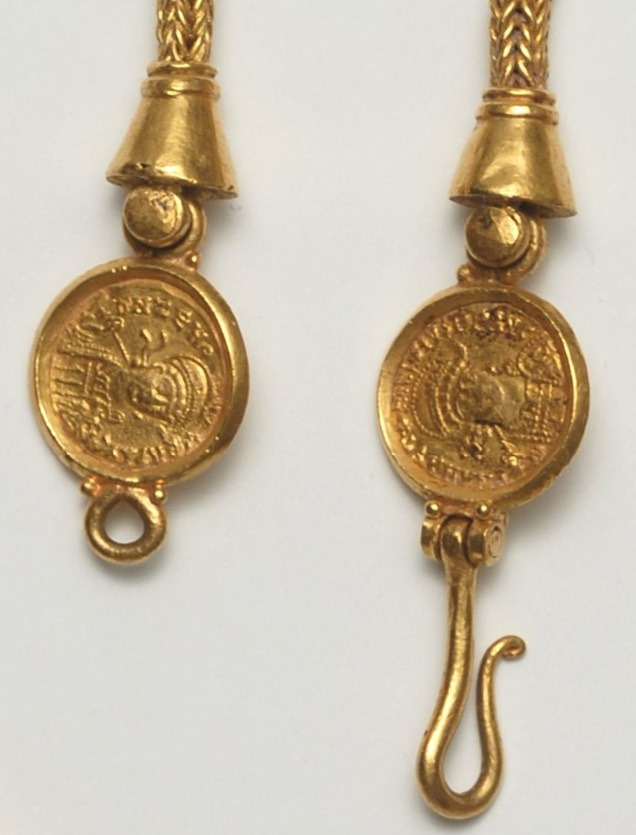
The surviving chains include a clasp made from gold coins depicting Emperors Zeno and Anastasius. This arrangement raises the possibility that the original diplomatic gifts were later transformed into a more elaborate piece of jewellery.
Such transformations were not unusual. Precious imperial objects could remain valuable long after their original political purpose had faded.
The importance of Byzantine gold beyond the empire’s borders is also evident in archaeological discoveries such as the sixth-century gold coin pendant found in Essex, England, demonstrating how imperial imagery could acquire new meanings in different societies.
A Diplomatic Mission That Left No Written Record
Despite the new interpretation, the medallions still leave several questions unanswered.
Their precise place of discovery remains unknown, and no surviving document identifies their first owner. The proposed connection with Damnaz rests on the combination of historical circumstances, iconography and the newly interpreted inscription.
The construction of the pendant presents another uncertainty. Because the two medallions were soldered together, the hidden surface of the Anastasius piece cannot currently be examined directly.
Future non-destructive imaging could help determine whether additional decoration survives beneath the joined disks. Such evidence might clarify when the medallion was produced and whether it originally served a different ceremonial purpose.
The possibility is particularly interesting because Anastasius held three consulships, in 492, 497 and 507. If the concealed surface contains imagery associated with a consular ceremony, researchers might be able to narrow its date.
For now, the strongest argument is historical rather than purely archaeological.
The medallions preserve an imperial portrait, an unusual inscription and imagery closely associated with the traditions of ancient Georgia. Written sources independently describe Roman emperors presenting royal insignia to Lazian kings.
Taken together, these clues suggest that the objects may have been part of an attempt to draw a Caucasian kingdom away from Persian influence.
Whether Anastasius succeeded during his lifetime remains unknown. Yet the events of 522 show that Lazica eventually established the closer relationship with Constantinople that his diplomatic efforts may have sought.
The gold medallions cannot reveal every stage of those negotiations. They do, however, suggest that the struggle for influence between two powerful empires was fought not only through armies and fortifications, but also through carefully chosen gifts carried across their borders.
Cover Image: Gold medallion depicting Eastern Roman Emperor Anastasius I (AD 491–518), whose inscription may contain a diplomatic message addressed to a foreign king. Credit: Dumbarton Oaks Research Library and Collection, Washington, D.C.