
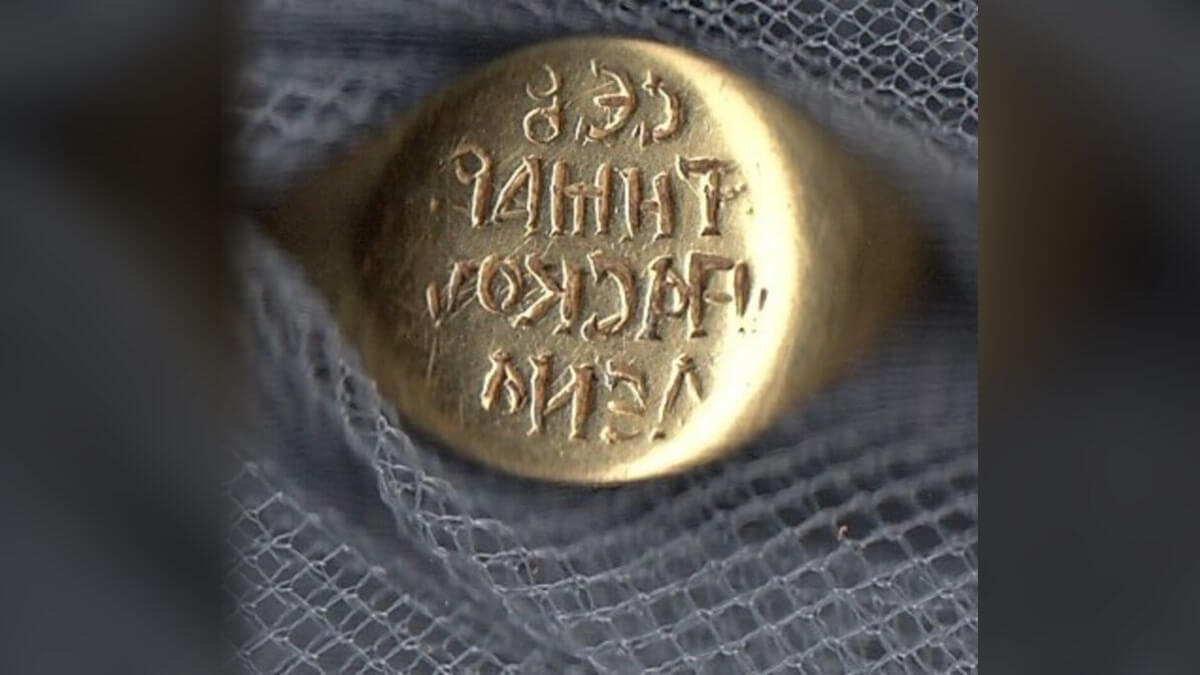
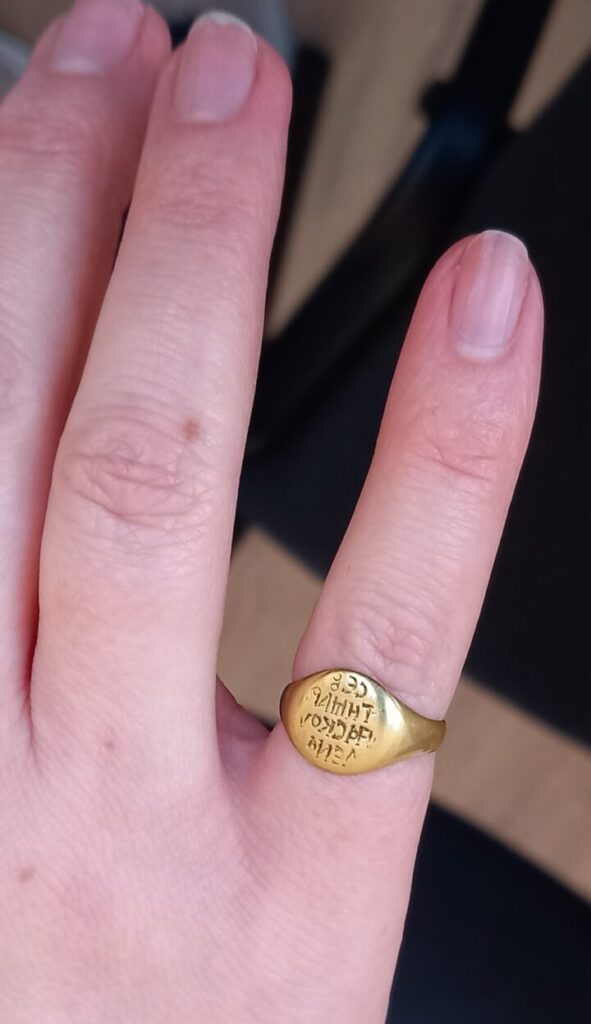
A 14th-century Byzantine gold seal ring associated with southern Bulgaria preserves more than the name of an aristocratic woman. Inscribed for “sevasta Maria Skulena,” the ring was designed to authenticate documents in her name—an unusual glimpse of a woman exercising social or legal authority in the late Byzantine world.
The gold ring reportedly originated near Zlatograd, close to Bulgaria’s present-day border with Greece. Its precise findspot remains unknown, however, leaving researchers with an unusually informative inscription but none of the archaeological context that might reveal where the object was used or how it was lost.
Her Name Was Carved Backwards
Unlike an ordinary piece of medieval jewelry, the ring carried a practical function. Its Greek inscription was engraved in reverse so that Maria’s name and title would appear correctly when the ring was pressed into warm wax attached to a letter or document.
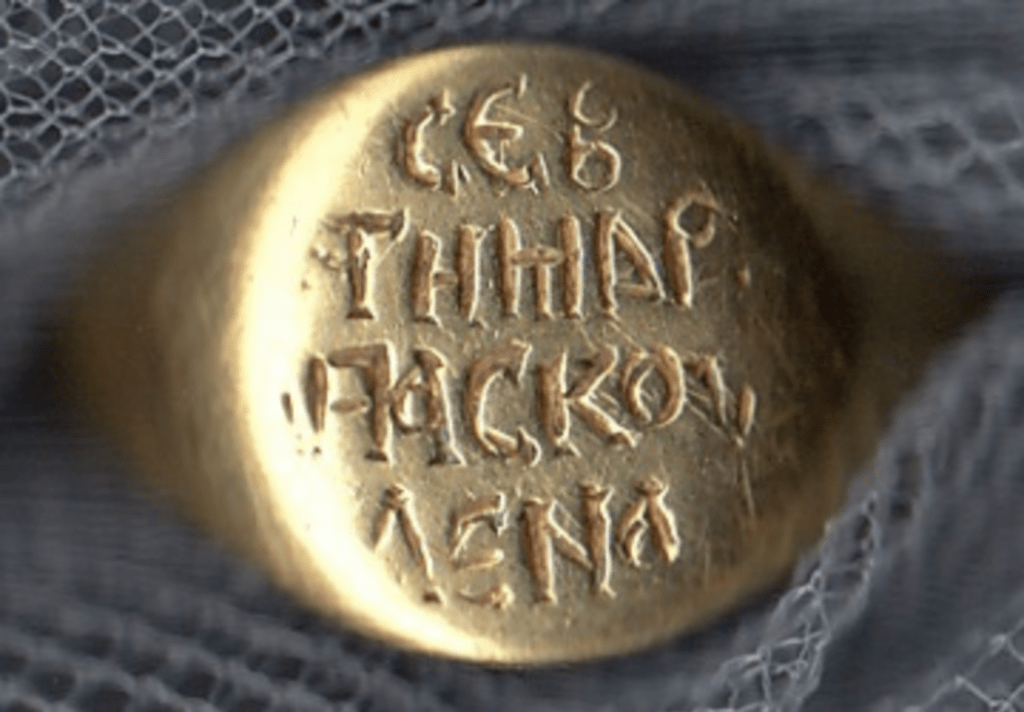
Sigillography specialist Dimitar Stoimenov read the inscription as “To sevasta Maria Skulena.” Paleographic features, including the forms and combinations of individual letters, place its production between the 1330s and 1350s, during the rule of Byzantium’s Palaiologan dynasty.
Archaeologist Nikolay Ovcharov believes the ring was made in a provincial Byzantine workshop. Its value did not rest solely in the gold from which it was fashioned; the inscription turned it into a personal instrument of authentication.
What the Ring Says About Maria’s Position
The title sevasta is the feminine form of sevastos, a Greek term associated with reverence and elevated status. It had occupied a prominent position in the Byzantine court hierarchy established under Emperor Alexios I Komnenos in the late 11th century.
By Maria’s lifetime, the title had lost much of its earlier imperial prestige. It was frequently associated with members of provincial elites, including officials, landowners and individuals involved in judicial or financial administration.
Even within this altered hierarchy, Maria’s personal seal is significant. Named seal rings associated with women are considerably rarer than those belonging to men, reflecting the overwhelmingly male character of official correspondence and public administration.
The ring cannot reveal what kind of documents Maria handled. They may have concerned property, inheritance, financial agreements or family affairs, but no surviving text has yet been connected with her seal.
It would therefore be premature to assign Maria a particular office or administrative role. What the object demonstrates more securely is that her name carried enough weight to be engraved in gold and reproduced on written acts.
Can Maria Be Identified in Medieval Records?
Maria’s surname appears to derive from the masculine name Skules, which occurs in 14th-century documents preserved by monasteries on Mount Athos. People bearing the name appear in records concerning land around Thessaloniki, Serres, the Chalkidiki Peninsula and the southern Rhodope region.
Ovcharov has proposed that Maria may have been the wife of a sevastos named Skules who is mentioned in a document from 1338. That man reportedly owned substantial property east of the Serres plain, within the broader region connected to the mountain routes passing near Zlatograd.
The proposed identification is plausible but remains unconfirmed. The surviving document does not name Maria, while Skules was not necessarily restricted to a single family whose members can all be connected through blood or marriage.
A later figure, Michael Skules, served as “general judge of the Romans” in 1370–1371. His position shows that the name was present within the Byzantine administrative elite, although no direct relationship between Michael and Maria has been established.
A Route Between the Rhodopes and the Aegean
During the Middle Ages, the Zlatograd area formed part of Achridos, a regional administrative territory whose principal center was Hyperperakion, now known as Perperikon. Routes following the Arda and Varbitsa river valleys linked settlements in the Eastern Rhodopes with Xanthi, Drama, Serres, Kavala and Thessaloniki.
These corridors moved merchants, officials and landowners between the mountainous interior and the northern Aegean. The reported origin of the ring therefore fits the geographical world in which individuals bearing the Skules name appear in written records.
This historical connection does not prove that Maria lived near Zlatograd. The ring could have arrived through travel, trade, marriage, inheritance or the movement of property across a region in which political and economic connections crossed modern national borders.
What the Missing Archaeological Context Changes
According to information presented in Zlatograd, a local resident recovered the ring during agricultural work within several kilometers of the Greek border. It later entered the collection of Alexander Mitushev and was publicly presented at the Archaeological and Ethnographic Museum in Zlatograd.
Because the ring did not emerge from a documented excavation, researchers cannot associate it with a particular building, settlement layer or medieval estate. That missing context limits any attempt to reconstruct Maria’s life from the object alone.
The conclusions currently rest on the inscription, paleographic dating, historical geography and comparisons with written records. Ovcharov said that a more detailed study prepared with Stoimenov is forthcoming in an academic volume commemorating historian Vasil Gyuzelev.
Maria Skulena remains absent from known portraits and historical narratives. Yet an object created to make her identity visible has survived: whenever the ring touched wax, it left behind the name of a Byzantine woman whose authority was meant to be recognized.
Cover Image: The engraved face of the 14th-century Byzantine gold seal ring associated with Maria Skulena. The Greek inscription was carved in reverse so it would appear correctly in wax. Image courtesy of Prof. Nikolay Ovcharov.