For decades, it was little more than a damaged stone fragment—catalogued, stored, and largely overlooked. Now, after 83 years, that fragment has been reunited with its missing half, revealing a rare script and raising new questions about cultural exchange in ancient Korea.
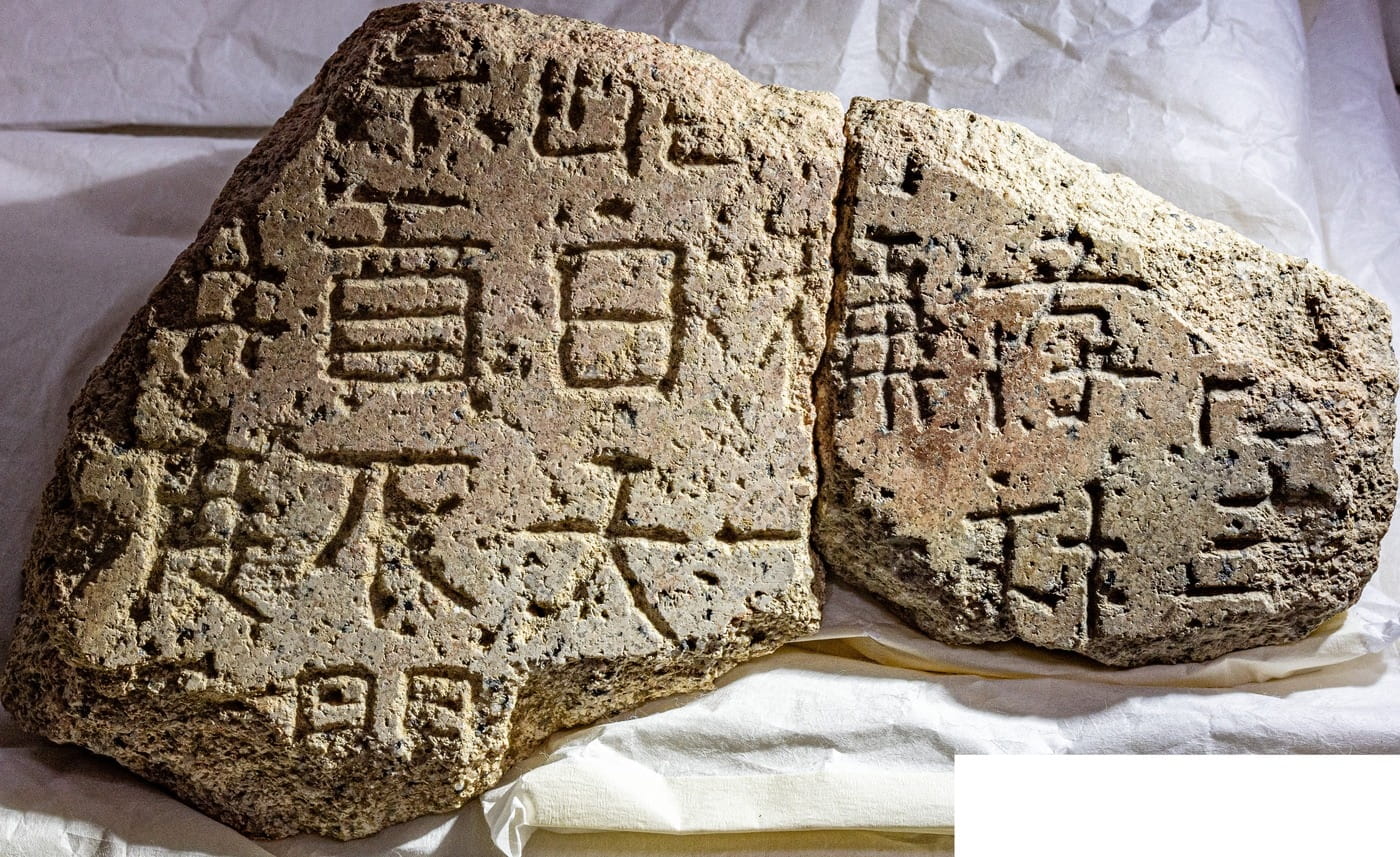
At the Gyeongju National Museum, two pieces of a Silla-period stele have been brought together for the first time, forming a single inscription that had remained incomplete for nearly a century. The reconstructed artifact is now on display in a special exhibition running through August 17.
A Discovery Separated by Time
The first fragment was uncovered in 1937 at the Wolseong Palace, once the royal residence of the Silla Kingdom. Small and heavily worn, it preserved only traces of its original inscription. Most characters were too damaged to read, and just one—meaning “to exist”—could be identified with certainty.
For decades, the piece stood alone.
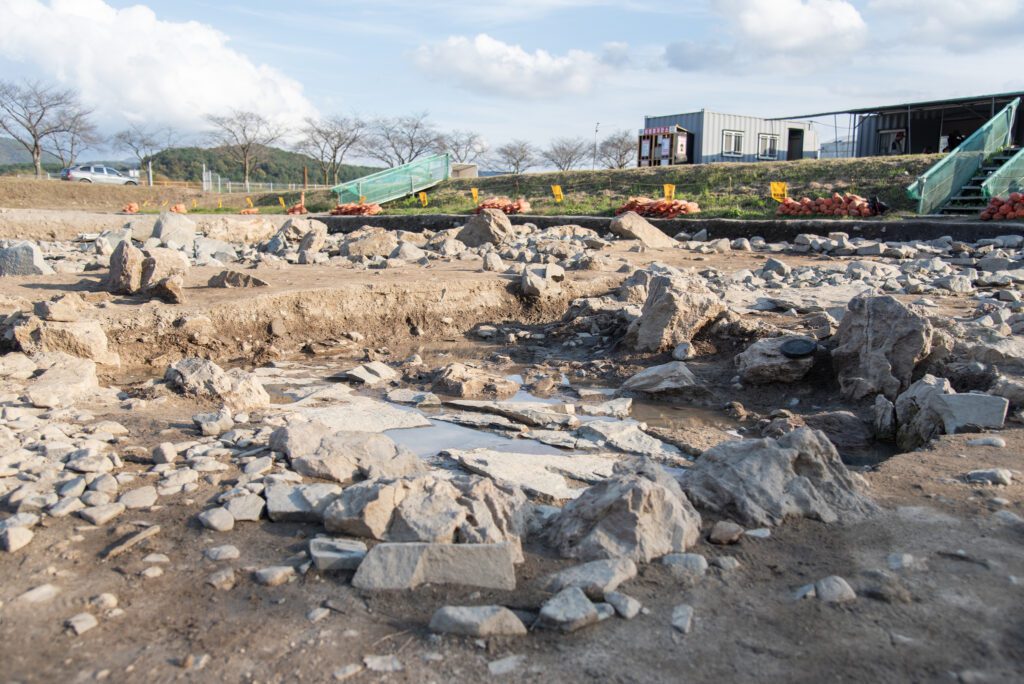
A second fragment emerged much later, in 2020, during excavations of the palace’s defensive moat. Larger and better preserved, it contained several legible characters, including references to tribute, heaven, and crossing. At first, it was treated as a separate find.
Only in 2024 did researchers begin to suspect a connection between the two stones.
Matching Stone, Matching Edges
Closer examination revealed that both fragments were made from the same material: alkali granite sourced from Namsan Mountain, a known quarry area near Gyeongju. This raised the possibility that they once belonged to a single monument.
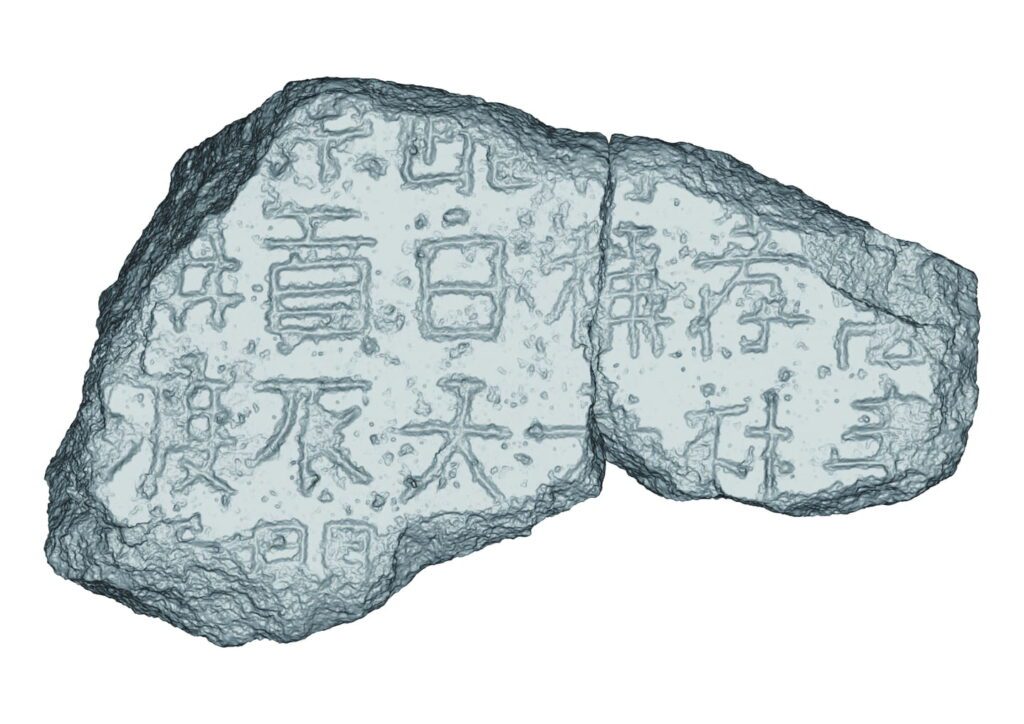
The decisive evidence came from 3D scanning. When the fragments were digitally aligned, their broken edges matched precisely. Once physically joined, previously incomplete characters became legible. Among them was a newly reconstructed character meaning “to call” or “to name,” offering a clearer glimpse into the original text.
A Script That Doesn’t Fit Expectations
What makes the stele especially significant is its writing style.
Silla inscriptions are typically carved in haeseo, the standard script used across East Asia. This stele, however, is written in yeoseo—a clerical script not previously confirmed in Silla epigraphy. Its presence here is unexpected and difficult to explain within the usual framework of Silla writing traditions.
One possibility is that the inscription reflects external influence. In the 5th century, the Goguryeo Kingdom sent military support to Silla during a period of regional conflict involving Baekje, Gaya, and forces from the Japanese archipelago. The use of a different script could point to that moment of contact.
Interpreting the Evidence with Caution
Despite these possibilities, researchers are careful not to overstate the case.
Writing styles do not belong exclusively to a single kingdom or period. A script alone cannot confirm political origin. Since both fragments were found within the Wolseong Palace complex, it remains entirely plausible that the stele was commissioned locally under Silla authority, even if it shows stylistic variation.
The artifact, in this sense, does not settle the debate—it complicates it.
A Reconstruction That Opens New Questions
The reunited fragments are now displayed as part of the “Treasury of the Silla Millennium” exhibition, alongside digital reconstructions and comparative materials, including references to the famous stele of King Gwanggaeto.
Kim Hyeon-hee, head of curatorial research at the museum, emphasized that the discovery may not yet be complete.
“We hope additional fragments will be discovered to help reveal more about the identity of this stele,” she said.
For now, the reconstructed inscription offers a rare, tangible reminder of how much of the ancient world still survives in pieces—and how those pieces can reshape the historical record when they finally come together.
Cover Image Credit: Two stone fragments uncovered decades apart at the Wolseong Palace site in Gyeongju have now been identified as parts of the same stele, according to research released on April 13. The image shows the pieces joined together for display. Courtesy of the Gyeongju National Museum.