
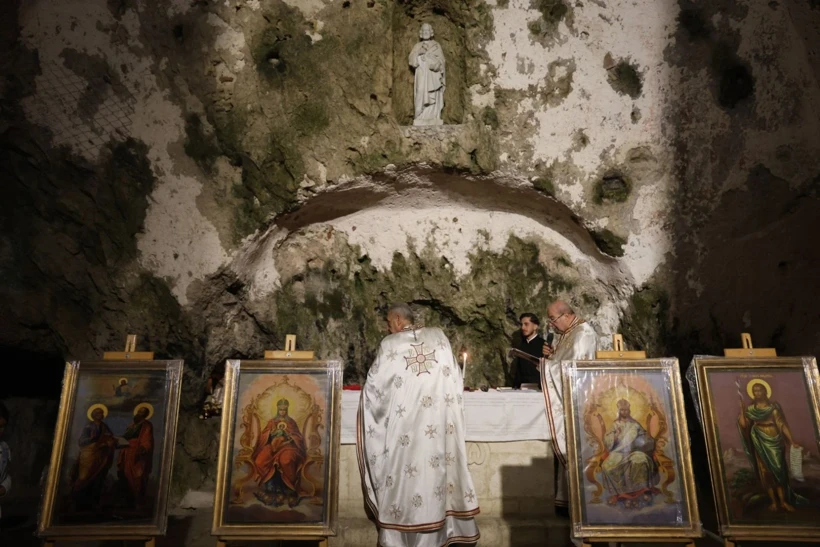
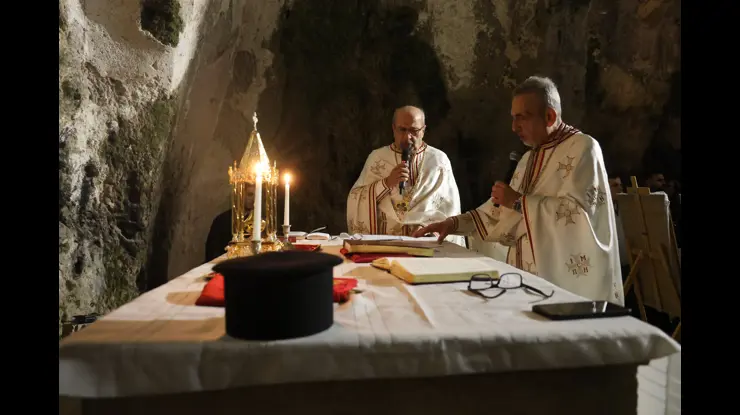
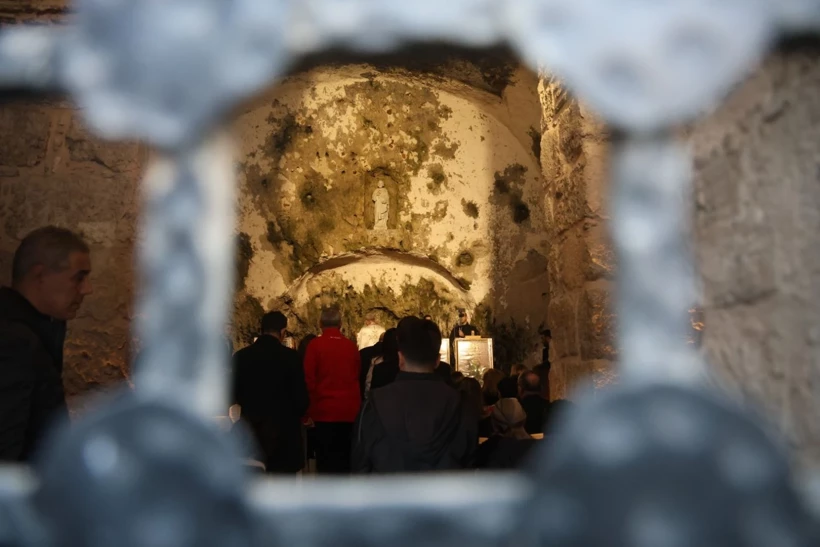
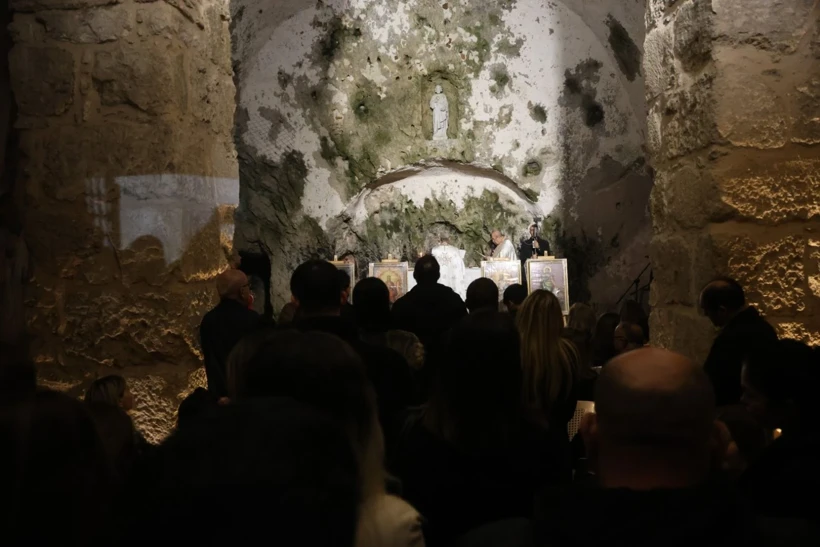
A Christmas liturgy was held at Saint Pierre Church, a site revered in Christian tradition as the world’s oldest cave church. Set into the rocky slopes near Habib-i Neccar Mountain, the ancient sanctuary once again hosted prayers and hymns, linking a present-day religious ceremony with the earliest chapters of Christian history.
The liturgy was led by Dimitri Doğum and Jan Delüller and attended by members of the local Christian community as well as visitors. Alongside prayers and choral hymns, participants marked both Christmas and the approaching New Year, concluding the gathering with the cutting of a New Year’s cake. The scene combined contemporary custom with a setting whose spiritual significance dates back nearly two millennia.
The Cave Where “Christians” First Took Their Name
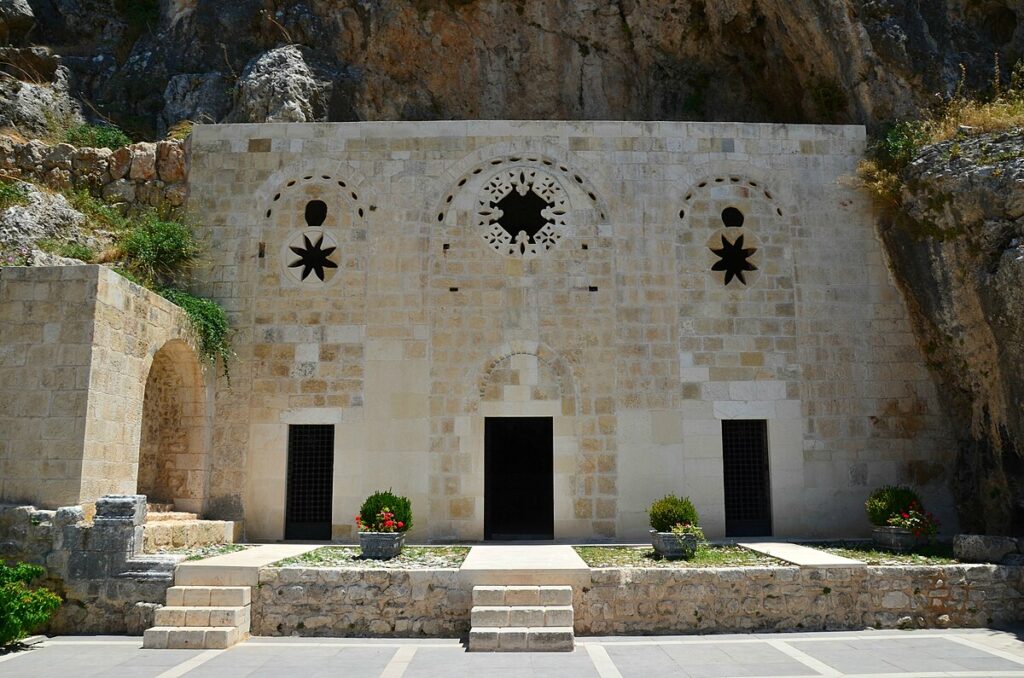
Saint Pierre Church occupies a unique place in Christian memory. According to tradition and the Acts of the Apostles, this is the location where the followers of Jesus were first referred to as “Christians.” The site is closely associated with Saint Peter, one of Jesus’ twelve apostles, who is believed to have delivered his earliest sermons here and organized the first Christian community in Antioch.
Originally a natural cave, the space was later adapted into a church through architectural additions. Archaeological evidence indicates that the cave was already being used as a place of worship around AD 38–40. Although the exact date of its formal establishment as a church remains uncertain, these findings place Saint Pierre Church among the earliest known Christian sacred spaces in the world.
Antioch and the Early Christian World
Beyond its local importance, Saint Pierre Church played a formative role in the development of early Christianity. Tradition links the church to both Saint Peter and Saint Paul, and it later became part of the Pentarchy—the system of five major patriarchates that structured early Eastern Christianity. Within Christian belief, Saint Peter is regarded as the founder of the Antiochene church and the first leader of its congregation.
This historical depth gives particular weight to modern ceremonies held at the site. Each liturgy is understood not simply as a commemorative act, but as a continuation of worship practices rooted in Christianity’s earliest institutional phase.
A Sanctuary Shaped by Secrecy
The physical characteristics of the church reflect the realities faced by early Christians. Carved into the western slopes of Mount Stauris, the cave measures approximately 13 meters in depth, 9.5 meters in width, and 7 meters in height. During periods of persecution, believers are thought to have gathered here in secrecy.
A tunnel opening into the mountain is believed to have been used as an escape route during raids, allowing worshippers to flee in moments of danger. The cave itself functioned as both refuge and ritual space, shaping a form of worship defined by concealment and resilience.
Traces of Late Antique Decoration
Only limited elements of the church’s later decorative phases survive today. Fragments of floor mosaics and faint wall paintings near the right side of the altar have been preserved, with archaeological studies dating these remains to the fourth and fifth centuries AD. Though fragmentary, these traces offer valuable insight into early Christian artistic traditions in Antioch.
At the center of the cave stands the altar, above which rests a stone chair associated with the Feast of the Chair of Saint Peter, a celebration with particular importance in Antakya’s Christian tradition. Excavations have also revealed that the surrounding garden area was used as a burial ground for centuries, with graves discovered near the altar.
Water, Earthquakes, and Survival
One of the church’s most distinctive features is the water that naturally seeps from the rock and collects in a small basin. Historically used for baptisms, this water was long regarded by visitors as having healing properties. Following the 2023 Kahramanmaraş earthquakes, the flow of this water noticeably decreased.
Despite the scale of the disaster, Saint Pierre Church itself sustained no structural damage. Its survival has reinforced its symbolic status as a place of endurance within a region repeatedly shaped by seismic and historical upheaval.
A Living Sacred Site
Today, Saint Pierre Church functions primarily as a museum, yet it remains an active place of worship. With official permission and under museum supervision, liturgical services continue to be held on special occasions, including Christmas.
The recent Christmas liturgy underscored the church’s dual identity: a monument of global religious heritage and a living sacred space. In Antakya—a city long defined by religious and cultural plurality—the ancient cave once again served its original purpose, hosting worship in the very place where Christian identity first took shape.