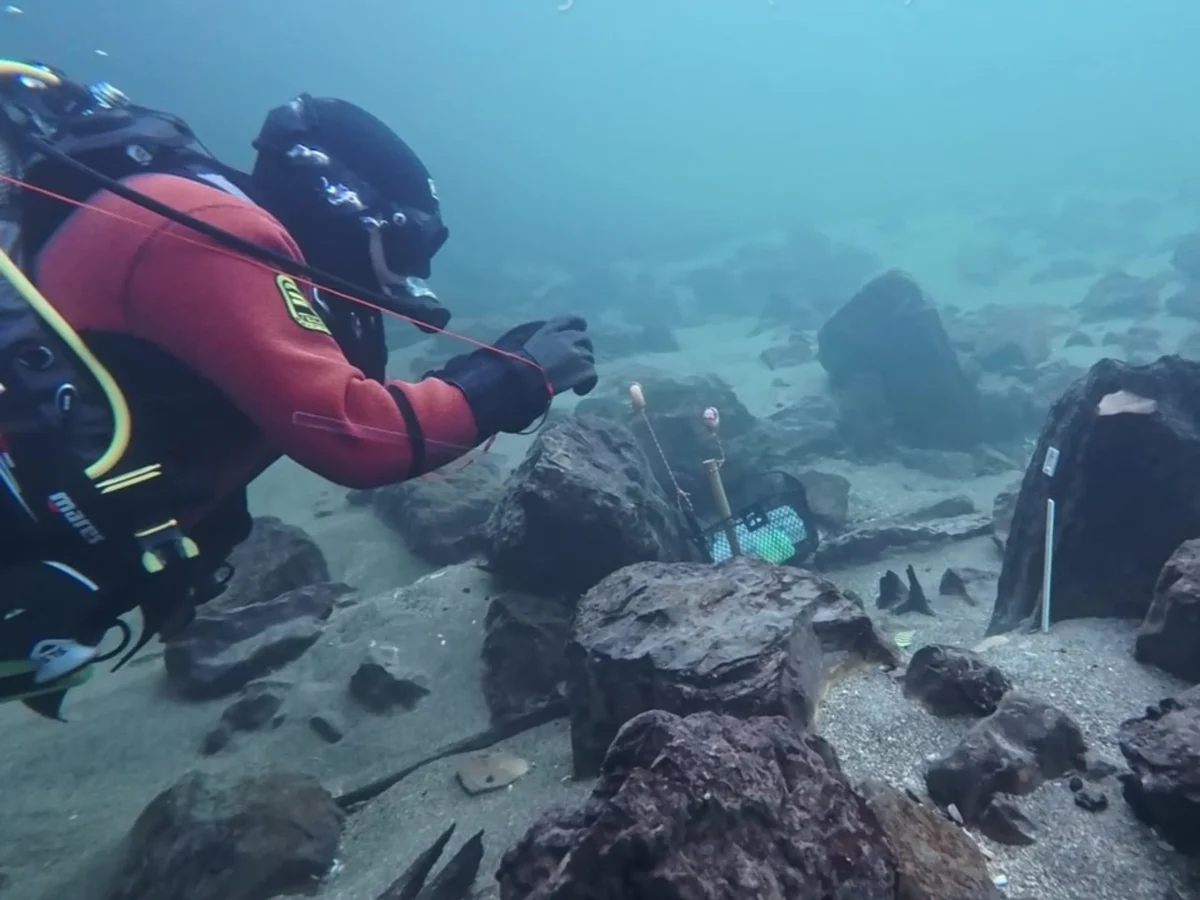
Archaeologists in Switzerland have confirmed the remains of a late Roman bridge beneath the Aare River in Solothurn, ending a long-running question about one of the most likely crossing points of ancient Salodurum.
The discovery was made during underwater archaeological work carried out before the renewal of the SBB railway bridge. Divers working on behalf of the Cantonal Archaeology Office of Solothurn examined the riverbed near the Wengi Bridge, where older reports had already mentioned wooden piles. This time, the investigation produced the evidence archaeologists needed. Wood samples taken from the piles have been dated to the fourth century AD.
The result confirms that a Roman bridge stood at Solothurn around 1,700 years ago. It also helps explain why the settlement, known in antiquity as Salodurum, held such a useful position on the Aare.
Wooden piles still standing in the riverbed
The surviving bridge remains are not large at first glance. They consist of wooden piles embedded in the riverbed a short distance from the southern bank. Several of them stand about ten meters from the riverbank, close to the modern Wengi Bridge.
Archaeologists recorded a row of piles almost two meters long, aligned with the direction of the current. The timbers are believed to have formed part of a bridge pier, or pile bent, which would have supported the upper structure and roadway. The largest visible remains rise roughly one meter from the riverbed and measure about 20 centimeters in diameter.
For a bridge that once carried traffic across the Aare, these traces may seem slight. Yet for archaeologists, they are enough to settle a point that had remained uncertain for decades. The Roman crossing at Solothurn had long been assumed from the layout of the ancient road network and the geography of the river. Until now, however, physical proof from the riverbed was missing.

Salodurum and the Roman road network
Solothurn’s Roman past is closely tied to movement. The settlement of Salodurum developed along an important route that connected Italy with the northern provinces of the Roman world. One major road ran from Italy over the Great St Bernard Pass, through the western Swiss Plateau and the Jura, and onward toward the Rhine.
The Aare crossing at Solothurn fits naturally into that system. Upstream, the river follows a more winding course. Near Solothurn, it narrows into a tighter channel, making it a practical place for a bridge. The ancient name Salodurum is usually understood as the Latinized form of a Celtic place-name referring to a river narrows or a water gate.
This was not a random settlement beside a river. It stood where a route, a crossing, and a defensible landscape met.
Archaeological traces of the Roman road had already been found in the wider region, including between Büren an der Aare and Nennigkofen. The newly dated bridge piles now add the missing river crossing to that picture.
A bridge from Solothurn’s fortified Roman phase
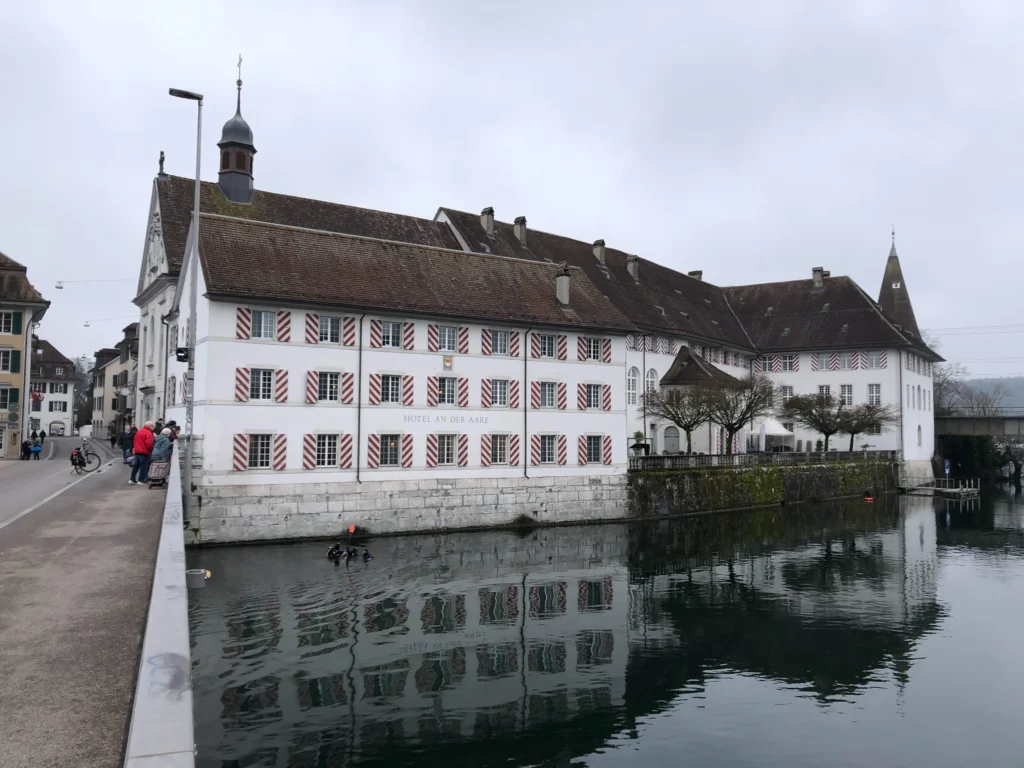
The fourth-century date places the bridge in the late Roman period, when Salodurum was changing. The earlier Roman settlement of the first to third centuries was reshaped after around AD 300 into a fortified site, or castrum.
Such fortifications were common in parts of the Roman world during late antiquity, especially in places linked to roads, rivers, and frontier movement. At Solothurn, the bridge and the castrum likely belonged to the same strategic landscape. A fortified settlement beside a river crossing could protect traffic, control access, and secure a route leading toward the Rhine.
The discovery therefore gives more weight to the idea that late Roman Salodurum was not simply a small town on the Aare. It was part of a wider system of roads, military concerns, and river crossings that shaped Roman Switzerland.
A rare survival beneath modern Solothurn
The preservation of the wooden piles is partly a matter of luck. In 1969, river correction works lowered and reshaped large parts of the riverbed near Solothurn. Ancient remains in the Aare could easily have been removed at that time. The Roman piles appear to have survived because they stood in a protected area near the Wengi Bridge.
The timbers will remain in the water. For ancient wood, the riverbed can be the safest place, since waterlogged conditions slow decay. Removing the piles would be costly and could put them at greater risk once exposed to air.
Further dives are planned as archaeologists continue to search the Aare riverbed for more traces of the late Roman bridge. Additional piles could help clarify the bridge’s original alignment and construction.
For now, the find gives Solothurn a rare piece of its Roman landscape back. Beneath the modern bridges of the city, the remains of an older crossing still stand in the riverbed, marking the place where travelers once crossed the Aare in the age of Salodurum.