
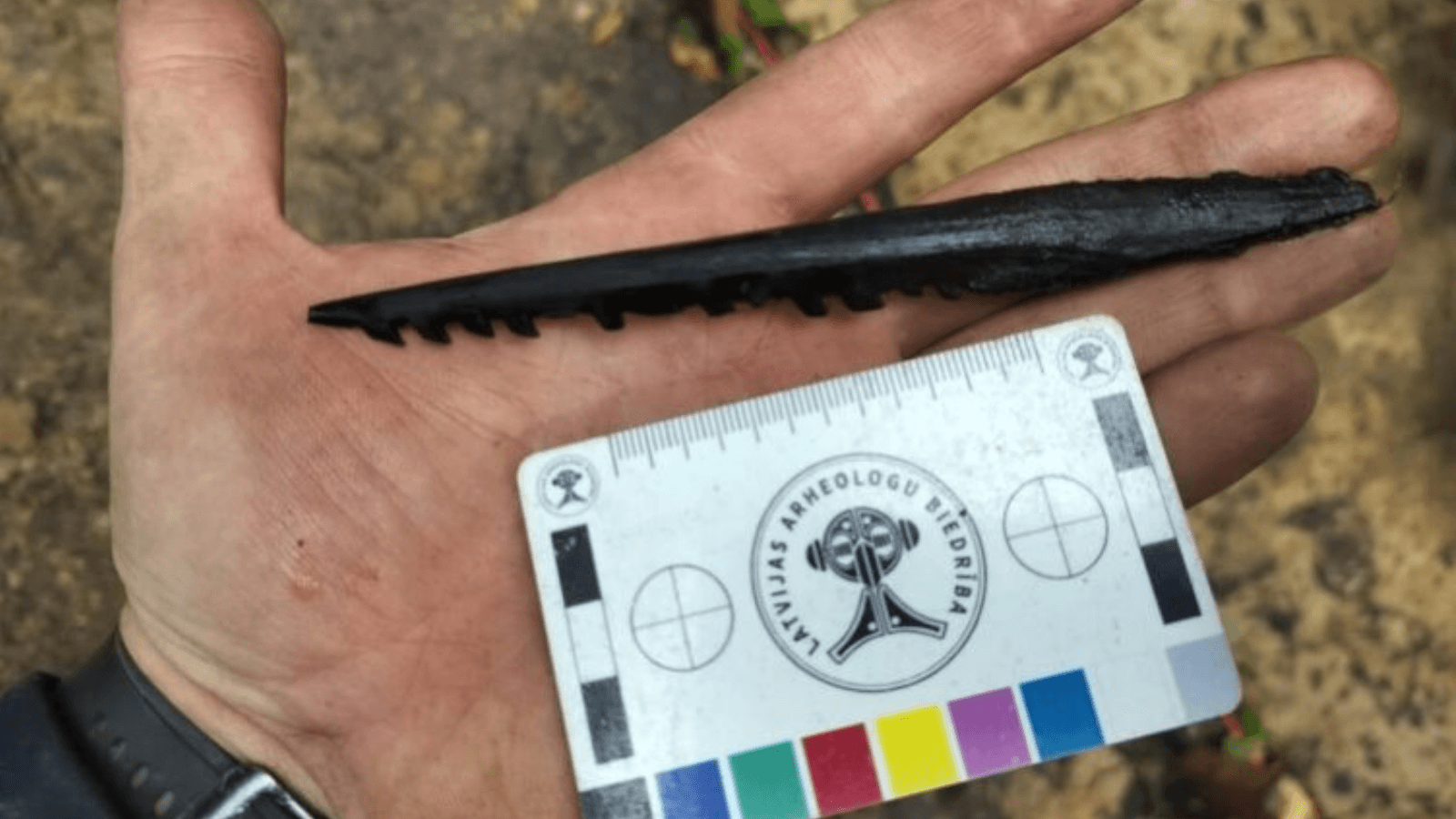
Archaeologists investigating Latvia’s Lake Indzers have recovered a prehistoric fishing spear that may be thousands of years older than a nearby island settlement. Their excavations also revealed an unusual pattern of finds, raising questions about how people occupied the island during the first millennium AD.
A bone fishing spear recovered from the bottom of Lake Indzers in northeastern Latvia could be as much as 11,000 years old. Yet the prehistoric weapon is only part of an archaeological puzzle: on nearby Cepurīte Island, researchers have identified a much later settlement that lacks the wooden structures typically associated with the region’s ancient lake dwellings.
The investigation, led by archaeologist Juris Urtāns of the Latvian Academy of Culture, took place in early August 2026. According to the academy’s official research report, the fieldwork included Latvia’s first archaeological excavations conducted underwater, alongside investigations on the island itself.
An Ancient Fishing Spear, but No Evidence of a Stone Age Village
The bone spear, apparently used to catch larger fish, was recovered from the lakebed near Cepurīte Island. Based on its form, Urtāns provisionally dates the implement to the Middle or Late Mesolithic, between the ninth and sixth millennia BC.
That broad date range places the spear’s possible age between approximately 8,000 and 11,000 years. However, its age has not been established through direct radiocarbon dating, and the estimate remains based on comparisons with other prehistoric fishing implements.
The spear is not the only evidence of Stone Age activity in the area. During a survey in spring 2025, archaeologists found a flint flake that may once have served as a scraper.
Neither discovery, however, establishes that Mesolithic communities lived on Cepurīte Island. Urtāns believes prehistoric fishermen may have visited Lake Indzers to catch fish while maintaining their settlements elsewhere, noting that the lake was probably too small to sustain an entire Stone Age community.
More Archaeological Finds Beneath the Water Than on Land
Archaeologists first recognized Cepurīte Island’s potential in 1983, when Māris Atgāzis identified traces of an ancient settlement. A renewed survey in 2025 found that archaeological deposits covered the island and revealed two intact clay vessels on the nearby lakebed.
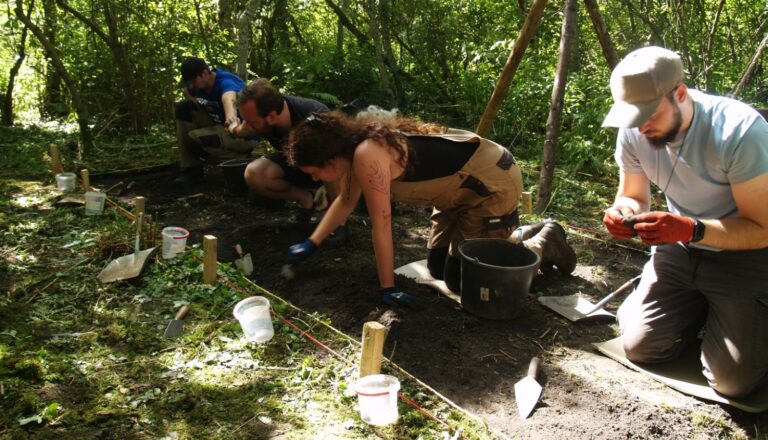
The 2026 team excavated 10 square metres on the island and investigated the remaining areas through test pits. They recorded an archaeological layer approximately half a metre thick, containing numerous pottery fragments but remarkably few other objects.
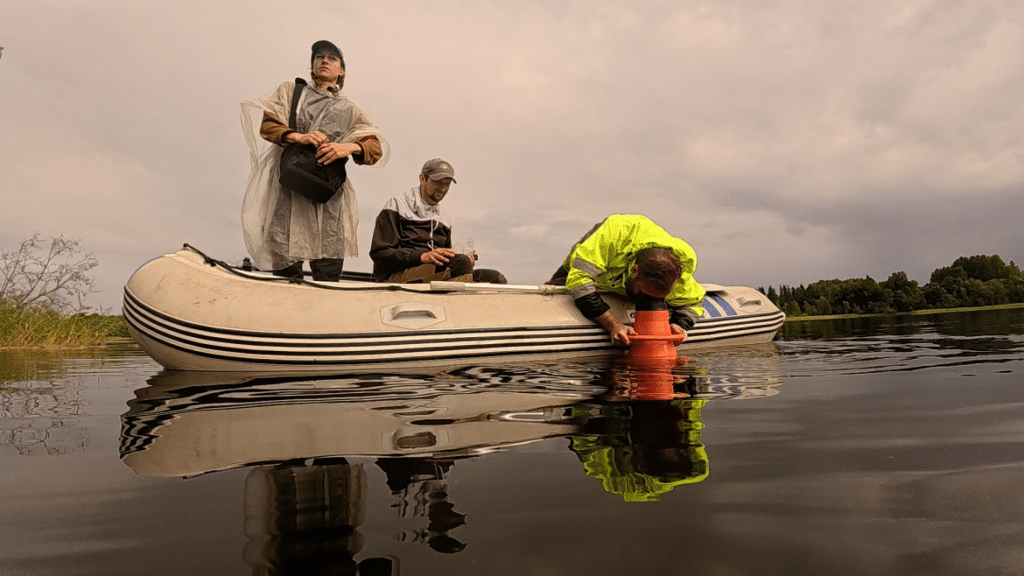
The lakebed told a different story. Divers recovered substantial quantities of pottery fragments and animal bones, along with split and fire-affected stones. Evidence of ancient human activity extended approximately 12 metres from the island’s shoreline, including several vessel bases and large ceramic fragments.
Archaeologists Agnese Čakare and Kaspars Markuss Molls worked with experienced divers to conduct small-scale underwater excavations at a depth of 2.5 metres. Urtāns described the operation as the first underwater archaeological excavation in Latvia’s history, a distinction also highlighted by the Latvian Ministry of Culture.
The contrast between the island and its surrounding waters is particularly intriguing. Although the researchers documented evidence of occupation on land, much of the associated material lay beneath the lake’s surface. Exactly how those objects reached the lakebed remains unresolved.
A Settlement Unlike Latvia’s Known Lake Dwellings
The pottery recovered from Cepurīte Island appears to date mainly to the second half of the first millennium AD. Its characteristics resemble material from ancient lake dwellings in Latvia’s Vidzeme region, associated with the period of Latgalian consolidation.
Those settlements commonly featured buildings supported by wooden piles or platforms. Earlier investigations of other Vidzeme lake dwellings have documented surviving timber structures, some more than a thousand years old.
At Cepurīte, however, archaeologists found no evidence of comparable construction. Despite the substantial archaeological deposits and widespread pottery, the island has not yielded the structural remains researchers would expect from a conventional lake dwelling.
Urtāns considers two possibilities. The island may represent an unusual example of settlement during this period, or it may belong to a distinct form of occupation that combined characteristics of ordinary land settlements and lake dwellings. No comparable long-used ancient island settlement has yet been identified in Vidzeme.
The precise chronology also requires further work. Researchers expect detailed ceramic analysis and radiocarbon dating of recovered organic material to provide a clearer picture of when people occupied the island.
A Human Bone Points to a Wider Settlement Landscape
Another discovery from the 2025 survey provides a more precise chronological reference. Among the animal bones recovered from the lakebed, archaeologists identified a human femur that radiocarbon analysis dated to AD 578–654.
The date broadly corresponds with the period suggested by the pottery, although researchers have not established whether the individual belonged to the community that occupied the island. The bone nevertheless adds an important human dimension to the archaeological evidence from Lake Indzers.
Several ancient burial grounds are also known along the shores of the lake. According to Urtāns, Cepurīte Island appears too small to have accommodated all the people associated with those cemeteries, suggesting that other settlements may once have existed nearby. Surveys of the lake’s two other islands, Liepu and Stradu, have so far revealed no comparable settlement deposits.
The excavations form part of the Archaeological Heritage of Inland Waters: Islands and Lake Dwellings in Latvian Lakes research project, funded by the Latvian Council of Science and scheduled to continue through 2027.
Further investigations will help establish the character of the island settlement and its relationship with the surrounding lakebed. For now, the evidence documents two very different chapters of human activity at Lake Indzers: prehistoric fishing and a much later settlement whose construction and place in the regional landscape remain uncertain.
Cover Image: A barbed bone fishing spear recovered from Lake Indzers in Latvia. Archaeologists believe the artifact may date to the Mesolithic period, potentially as far back as 11,000 years. Credit: M. Kļaviņš / Latvian Academy of Culture.