
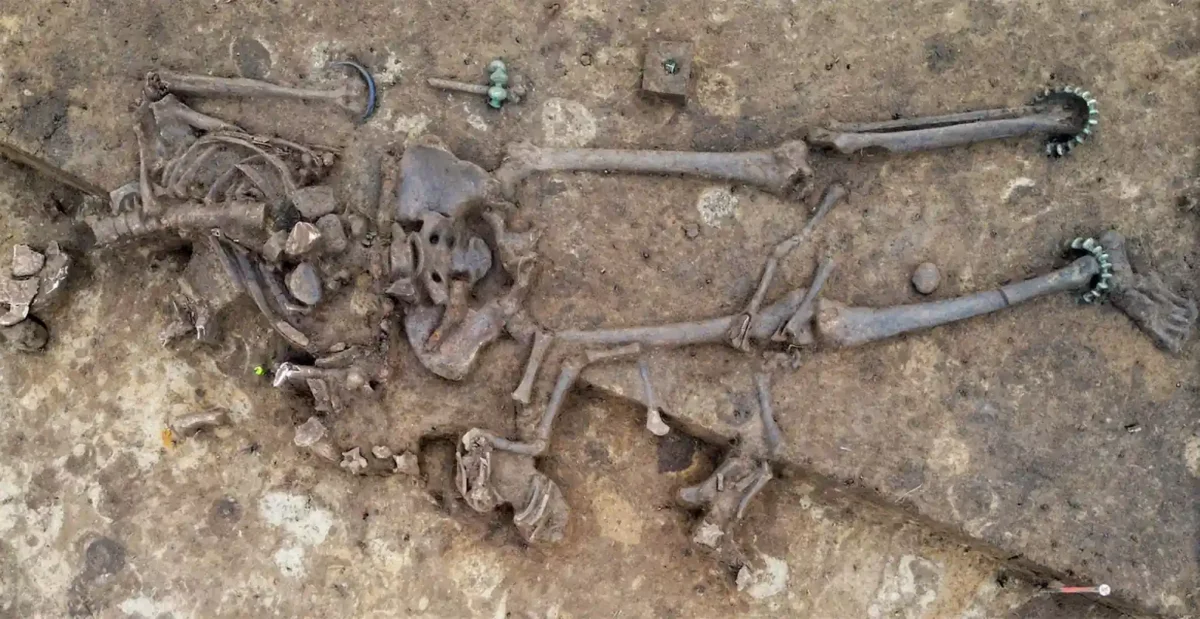
Archaeologists discovered the remains of a lamb or young goat beside a Celtic woman buried in Bavaria around 250 BCE. Her grave also contained elaborate bronze ornaments and a bracelet made from fossilized organic sediment, offering an unusual glimpse into Iron Age burial customs.
A Celtic woman buried approximately 2,300 years ago in southern Germany was accompanied by something archaeologists rarely encounter in graves of her period: the remains of a lamb or young goat. The animal bones lay near her hips, alongside an impressive collection of bronze ornaments and a bracelet made from an unusual dark material.
The grave was discovered in 2024 in Senden, Bavaria, during excavations ahead of commercial development. First reported in 2025, the burial has returned to public attention as the Bavarian State Office for Monument Protection (BLfD) prepares to present the finds at an archaeological conference beginning October 30, 2026.
A Lamb or Goat in an Iron Age Grave
The woman’s burial dates to around 250 BCE, during the La Tène period of the European Iron Age. Archaeologists found the animal remains close to her pelvis, an unusual feature that distinguishes the grave from more familiar Celtic burials containing jewelry, weapons, pottery, or other personal possessions.
The BLfD describes the bones as the remains of a possible food offering. Such an interpretation suggests that the animal may have been placed in the grave as part of the funerary ceremony, although its precise purpose remains uncertain.
Excavation director Dr. Matthias Leicht offered another possibility when the discovery was first reported by German broadcaster BR24 in January 2025. He explained that the animal could have been a ritual offering or even a pet belonging to the deceased, emphasizing that archaeologists knew of very few comparable grave deposits.
Researchers have not yet determined whether the bones belonged to a lamb or a young goat. Their presence in the burial may indicate a funerary offering, although the reason for their inclusion remains uncertain.
Bronze Jewelry and a Bracelet Made from Fossilized Sediment
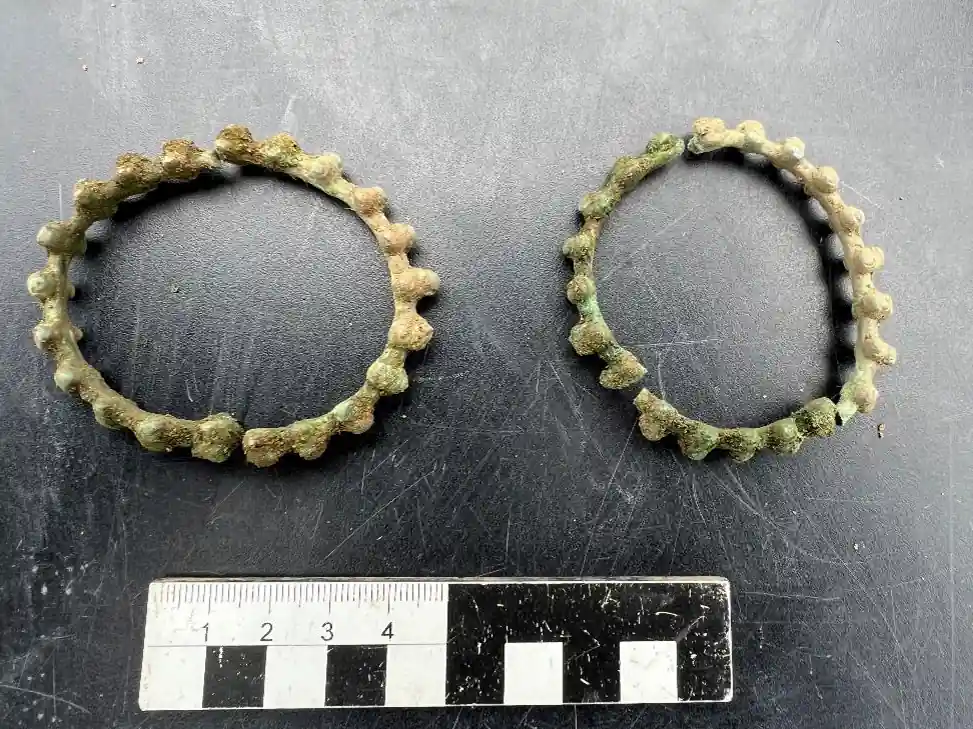
The woman’s grave also contained an unusually rich collection of ornaments. Archaeologists recovered substantial bronze ankle rings, arm ornaments, and an elaborately decorated brooch, suggesting that considerable care went into preparing her burial.
Among the objects was a bracelet made from sapropelite, a dark material derived from ancient organic-rich sediments. Formed through geological processes that harden and preserve such deposits, sapropelite was used to produce jewelry during the Celtic Iron Age. Its appearance contrasts with the metal ornaments recovered from the same grave.
Two rings decorated with raised, knot-like elements were also among the finds. Their distinctive design adds another example of the craftsmanship represented in the burial assemblage.
The quantity and quality of the jewelry suggest that the woman may have held a relatively high position within her community. Although the ornaments cannot establish her exact social identity, they indicate that her burial received considerable attention and resources.
A Celtic Grave in a Landscape Used for Centuries
The burial belongs to a much larger archaeological site in Senden’s St.-Florian-Straße area, where investigations began in 2022. Excavations covering approximately six hectares have revealed traces of settlement and burial activity from several historical periods.
Researchers documented 12 Roman cremation graves, along with an extensive early medieval Alamannic settlement and 11 Alamannic burials. The Celtic woman’s grave predates these remains by centuries, showing that people were using the area long before Roman rule reached this part of southern Germany.
Dr. Stefanie Berg, head of archaeological monument preservation at the BLfD, described the woman’s grave as an exceptional individual find within a much broader archaeological landscape. According to Berg, evidence spanning the Celtic and Roman periods reflects the region’s long history of settlement and human activity.
The discoveries from Senden will feature at the Archaeology in Bavaria conference, running from October 30 to November 1, 2026. Finds from the woman’s grave are scheduled to be presented during the opening press conference, giving researchers an opportunity to discuss a burial whose unusual animal remains still lack a definitive explanation.
Cover Image: The approximately 2,300-year-old burial of a Celtic woman discovered in Senden, Bavaria, with bronze ornaments and animal remains among the grave goods. Credit: Matthias Leicht.