
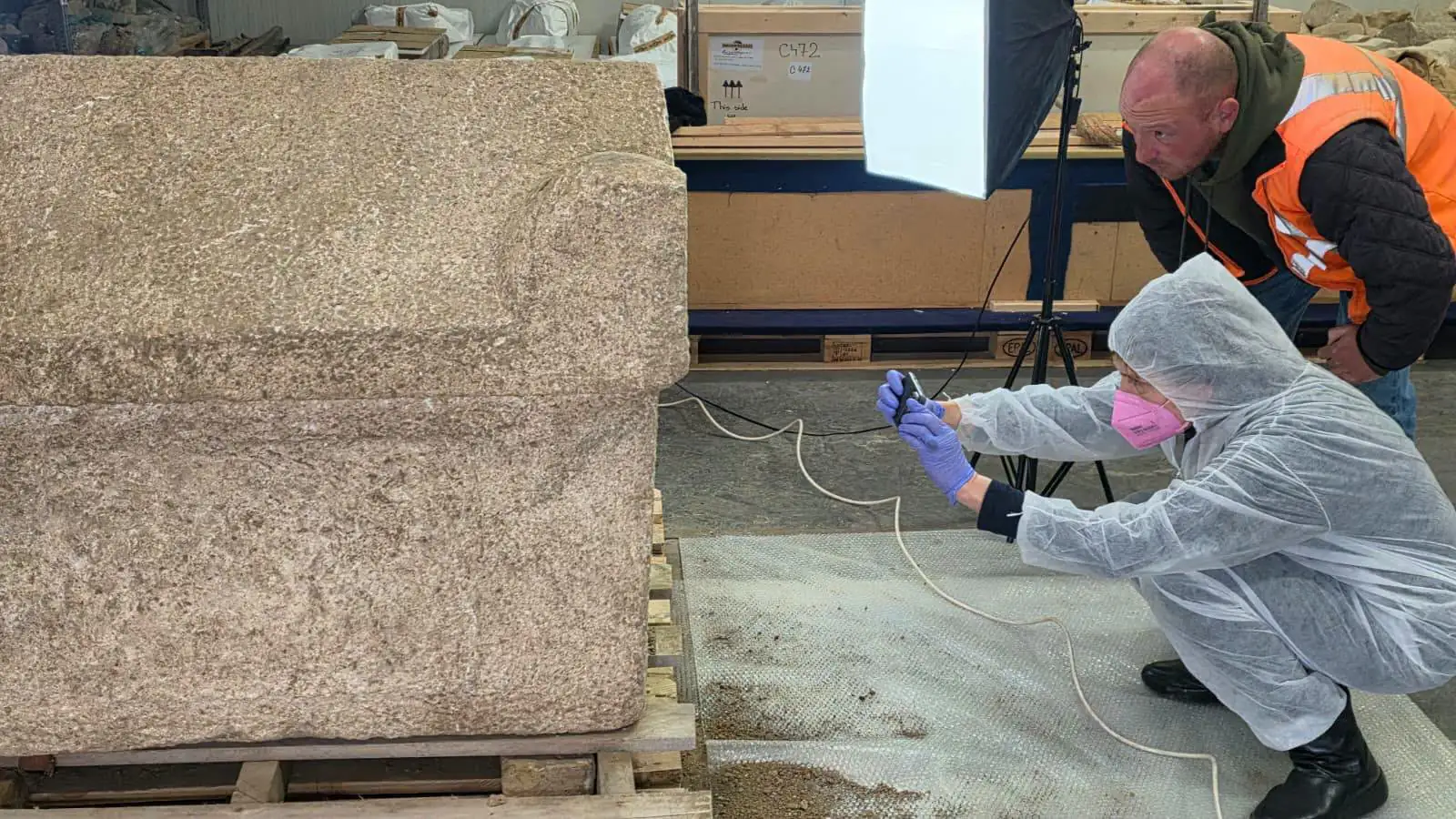
A sealed Roman-era child’s sarcophagus discovered in Constanța, Romania, has preserved clay toys, bronze amulets, floral decorations, and the remains of a wooden coffin. Dating to the second or third century AD, the undisturbed burial offers rare evidence of childhood and funerary practices in ancient Tomis.
A small clay rooster made a rattling sound when archaeologists moved it inside a Roman child’s grave in Romania. Nearly 1,800 years after its burial, tiny pellets remained inside the toy, preserving a detail of childhood that rarely survives in the archaeological record.
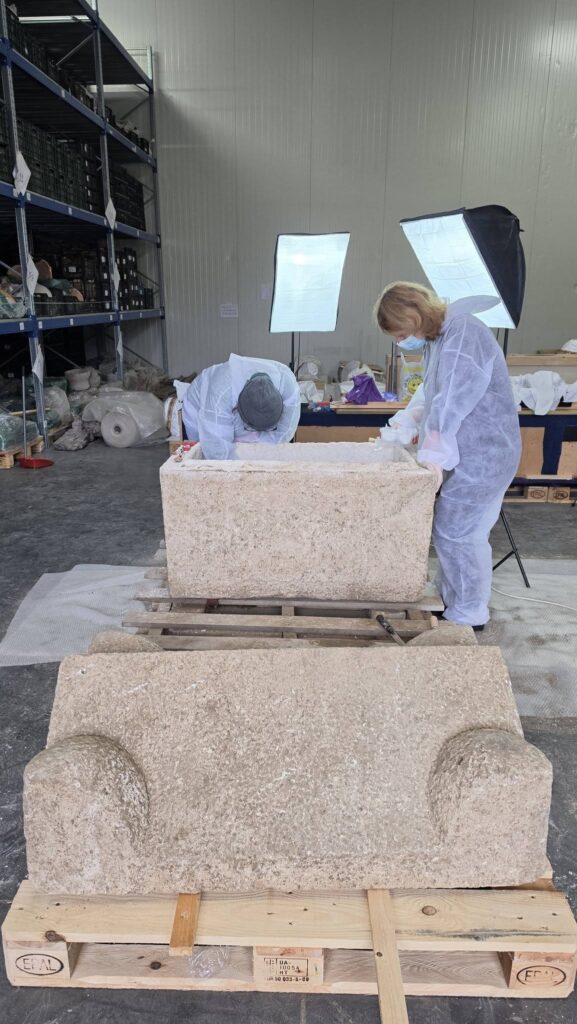
The remarkable object was among the discoveries made by archaeologists from the Museum of National History and Archaeology in Constanța (MINAC). Excavating the northern necropolis of ancient Tomis on the Black Sea coast, the team discovered an intact stone sarcophagus containing a child’s remains, a wooden coffin, personal ornaments, and delicate organic materials.
Painted Toys and Protective Amulets
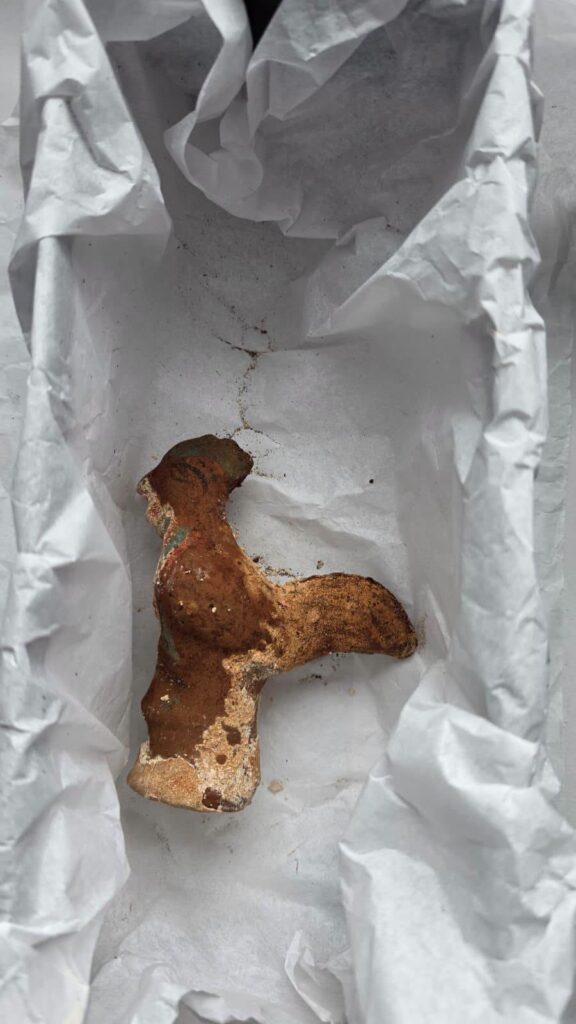
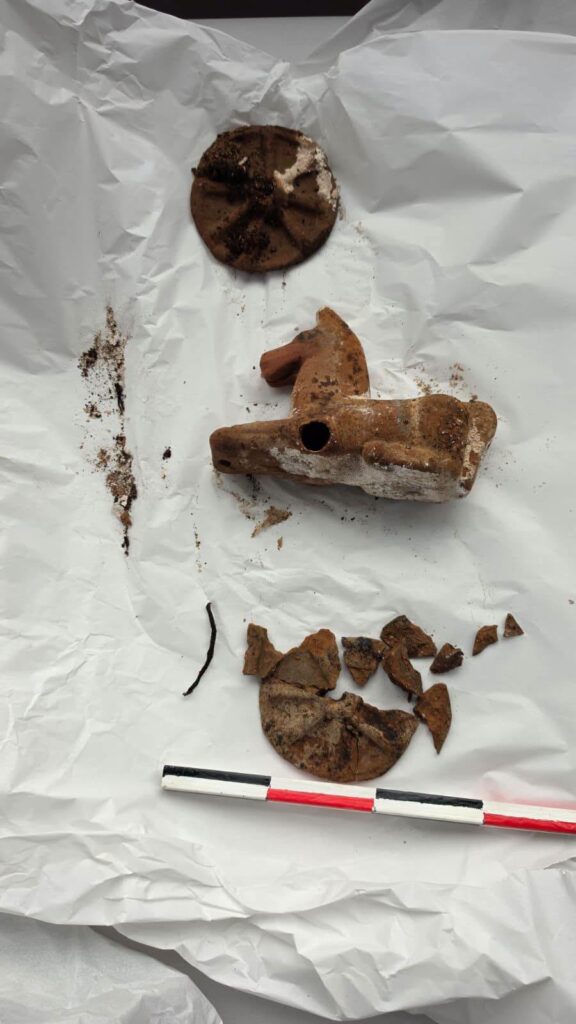
Two terracotta toys accompanied the child: a small horse mounted on wheels and a rooster-shaped rattle. Both retained traces of their original paint, including details such as eyes and eyebrows that remain visible almost two millennia after their creation.
Archaeologist Ana Hamat described the discovery during a press conference reported by Radio România Constanța. When researchers moved the rooster, they discovered that the small pellets inside had survived, revealing that the figurine had originally functioned as a child’s rattle.
The toys also prompted the team to reconsider the child’s age. Based on the sarcophagus’s dimensions, archaeologists initially estimated that the deceased might have been four or five years old. However, the presence of the rattle suggested a considerably younger child, although an anthropological examination is needed to establish the age more reliably.
Alongside the toys, the team recovered two small bronze bracelets and two pendants known as bullae. In Roman society, these protective amulets were traditionally associated with freeborn boys and could also reflect their status within the community.
Hamat believes the pendants indicate that the deceased was probably a boy born into a family with Roman citizenship. The bronze ornaments and costly stone sarcophagus also suggest a household of some means, although the family’s precise social standing remains uncertain.
The archaeologist interpreted the toys as part of the family’s funeral preparations, intended to accompany the child after death. Their presence offers a particularly personal glimpse of Roman burial customs, in which children’s belongings could become part of the rituals surrounding an early death.
A Sealed Tomb Preserved Wood, Cloth, and Flowers
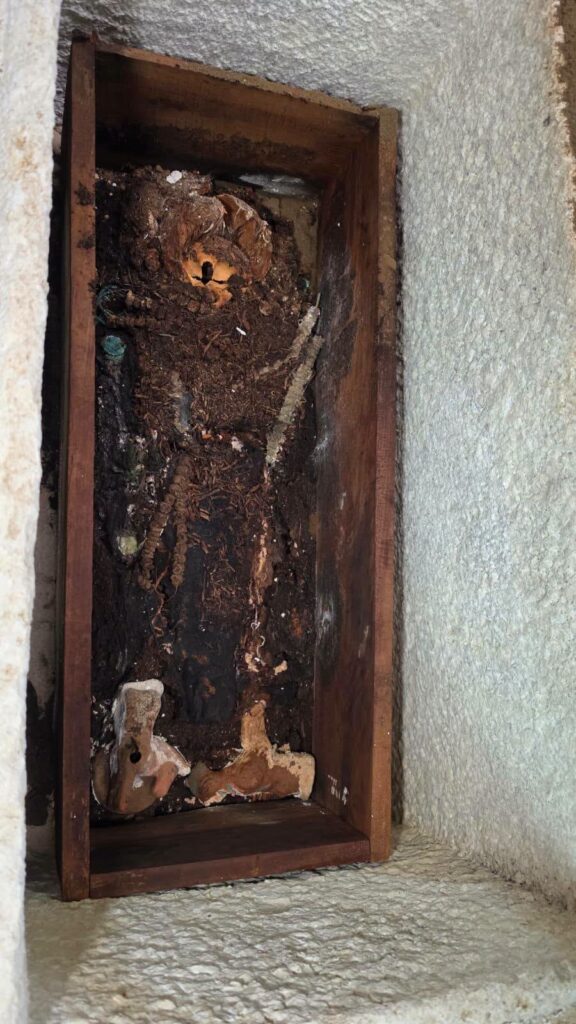
The sarcophagus was exceptional not only for its contents but also for the condition in which researchers found them. Inside, substantial sections of the wooden coffin survived alongside traces of the shroud wrapped around the child’s body.
Archaeologist Constantin Băjenaru explained that two lead clamps had secured the stone lid, while mortar sealed the joint between the lid and the sarcophagus. This construction helped create conditions that protected fragile organic materials from deterioration.
The wooden coffin retained remarkably clear evidence of its construction, including carefully made dovetail joints connecting the panels. Such details allow archaeologists to examine Roman carpentry techniques directly rather than reconstructing them from impressions or surviving metal fittings.
Băjenaru also discussed what he described as a process of pseudo-mummification, noting the unusual preservation of the burial materials. Whether the body received deliberate treatment with particular substances remains unknown, and the sealed environment itself may have contributed significantly to its condition.
The burial also contained floral garlands and arrangements made from folded leaves. Some had been carefully packed into small, cube-like bundles, an unusual detail that attracted the archaeologists’ attention. The identity of the plants and the precise purpose of these arrangements have not yet been established.
An Unusual Child Burial at Ancient Tomis
Archaeologists Constantin Băjenaru and Cătălin Nopcea discovered the sarcophagus during preventive excavations in Constanța’s Flămânda district. The grave lies approximately 1.5 kilometers north of the ancient city, near a major Roman road connecting Tomis with Histria.
Other burials have previously been excavated in the surrounding area, including an unusual brick-built tomb damaged during the early twentieth century. Băjenaru believes the concentration of graves could indicate a burial area associated with a prosperous family, although their relationship has not been established.
Founded as a Greek settlement on the western Black Sea coast, Tomis developed into an important urban center under Roman rule. Its extensive necropolises reflect generations of funerary practices among the communities that lived in the region.
The discovery stands apart from previously documented burials at the site. According to Băjenaru, archaeologists have recovered large sarcophagi intended for adults, but they had never encountered a comparable intact child’s sarcophagus at Tomis.
The child’s name remains unknown, and the preliminary dating places the burial between the second and third centuries AD. Yet the sealed tomb has preserved unusually intimate evidence of a short life: painted toys, protective amulets, floral offerings, and a wooden coffin whose craftsmanship can still be examined.
Cover Image: The intact Roman-era child’s sarcophagus discovered in Constanța, Romania, during archaeological investigations near ancient Tomis. Credit: MINAC.