
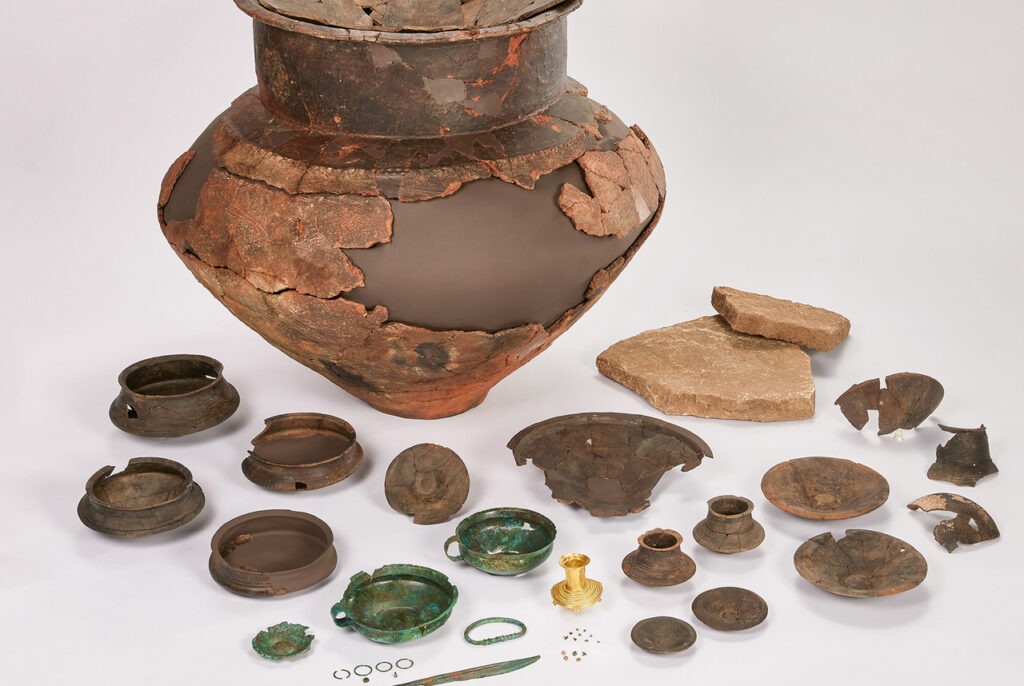
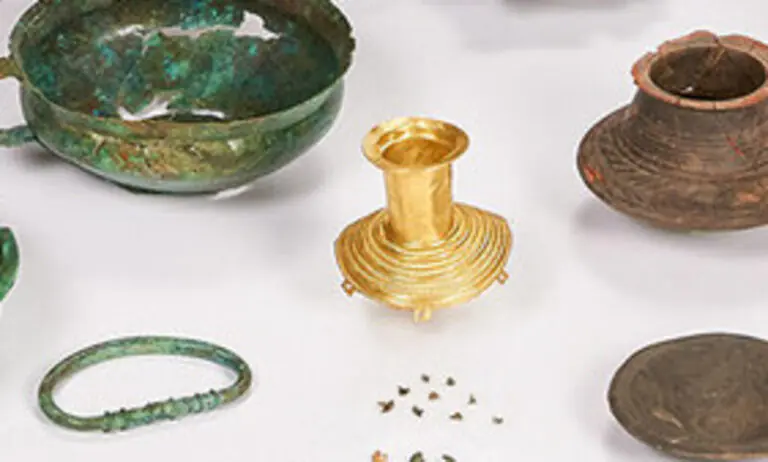
A mysterious gold object from a 3,000-year-old grave in Germany has taken an unexpected turn in the hands of conservators. What archaeologists initially suspected might be a fragment cut from a gold vessel now appears to have been deliberately made in its surviving form. More surprisingly, the gold was once connected to another material that has almost entirely disappeared, leaving its original purpose unknown.
The object comes from an exceptionally rich Late Bronze Age burial near Albisheim, in the German state of Rhineland-Palatinate. On September 29, 2026, the General Directorate for Cultural Heritage of Rhineland-Palatinate (GDKE) presented the first results of an investigation that has begun to change the interpretation of the unusual find.
Archaeologists discovered the burial during investigations ahead of residential construction in the Alzey hill country between 2023 and 2025. Across the excavation area, they documented more than 850 archaeological features from different periods, including a particularly elaborate grave dating to the 12th or 11th century BCE.
The grave contained at least 24 ceramic vessels alongside remarkable offerings made from bronze and precious metals. Among them was the enigmatic gold object, found beneath a bronze bowl. Although the burial contained an impressive collection of valuable objects, the function of this particular piece remained difficult to explain.
A Gold Object That Challenged Its First Interpretation
The unusual shape of the gold originally led specialists to consider whether it had been cut from an existing gold bottle. That possibility offered a relatively straightforward explanation for its appearance, but detailed conservation work has produced evidence pointing in another direction.
Examination of the artifact suggests that its distinctive shape was intentional. Rather than being removed from a larger gold vessel, the piece appears to have been manufactured specifically in the form that archaeologists recovered.
The most revealing evidence concerns how the object was assembled. Conservators identified small nails, traces of adhesive and cord-like structures, all indicating that the gold was originally connected to an organic material that has not survived.
These findings suggest that the surviving gold may represent only one component of a more elaborate object. Its missing elements could have been essential to its appearance and function, although researchers have not yet established what those elements were made from or how they were arranged.
The decoration offers another insight into its manufacture. Specialists believe a craftsperson probably worked the pattern into the thin gold sheet from the inside, revealing a carefully executed technique that adds to the evidence of deliberate construction.
A Rich Bronze Age Burial with an Unsolved Mystery
The Albisheim burial stands out for the number and variety of objects placed alongside the cremated remains. Such an elaborate collection indicates that considerable resources were devoted to the funeral, although the deceased person’s identity and exact social position remain unknown.
The gold object’s location beneath a bronze bowl is another detail archaeologists must consider. Its placement is documented, but the available evidence does not establish whether the two objects had any functional connection before their deposition in the grave.
Dr. Ulrich Himmelmann, acting head of the GDKE’s State Archaeology Directorate, has emphasized the importance of examining small tool marks and material residues when reconstructing ancient artifacts. In this case, seemingly minor traces have already altered the understanding of how the gold piece was manufactured.
Scientific investigations will now focus on the surviving organic residues, adhesive and unusual cord-like structures. Comparisons with other archaeological objects may also help specialists identify parallels for its construction and narrow down its possible purpose.
The investigation has therefore replaced one explanation with a more complicated picture. The gold was apparently created in its surviving shape, yet it once formed part of an arrangement that researchers cannot fully reconstruct. Determining what that arrangement looked like, and why it was valuable enough to accompany the dead, remains the central challenge of the Albisheim discovery.
Cover Image: Grave goods from the Late Bronze Age burial at Albisheim, including ceramic vessels, bronze artifacts and an unusual gold object whose original function remains unknown. Credit: GDKE / Landesarchäologie Speyer.