
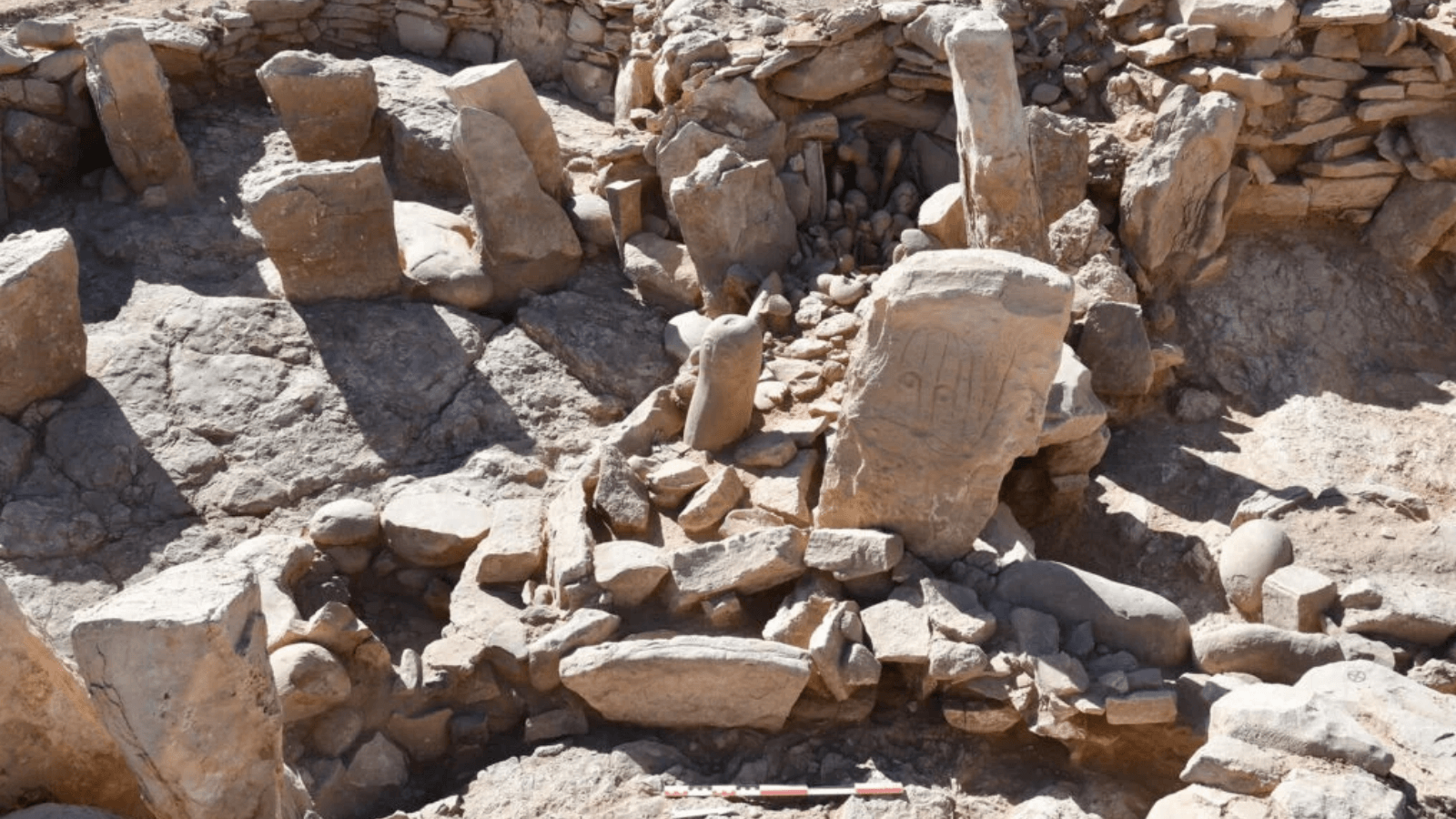
Two human-faced stone figures discovered in Jordan’s southeastern desert stood at the center of an unusual Neolithic ritual complex associated with large-scale gazelle hunting. Dating back approximately 9,000 years, the shrine offers rare evidence of how specialized hunter communities incorporated their survival practices into ceremonial life.
In Jordan’s southeastern desert, Neolithic hunters built enormous stone walls to funnel gazelles into traps. At one of their camps, however, archaeologists discovered something different: two human-faced stone figures standing inside a miniature version of the hunting system, surrounded by marine fossils and animal figurines. Dating to around 7000 BCE, the arrangement links large-scale hunting to rituals whose precise meaning remains unknown.
The discovery came during the 2021 excavations at Jibal al-Khashabiyeh, part of a Jordanian-French archaeological project co-directed by Mohammad Tarawneh of Al-Hussein Bin Talal University and Wael Abu-Azizeh of CNRS and Lumière Lyon 2 University. Further excavations in 2023 identified a second ritual complex in the same region.
Two Human Faces Inside an Ancient Shrine
At the campsite known as JKSH P52, two upright stone figures stood within a carefully arranged ritual installation. Researchers nicknamed them Abu Ghassan and Ghassan. The taller stone measures approximately 112 centimeters and combines a human representation with an engraving of a desert kite, the hunting structure that dominated the surrounding landscape.
The second stone, about 70 centimeters high, displays more clearly carved facial features, including eyes and a nose. Although the figures have recognizable human characteristics, archaeologists have not established whom they represented or whether they depicted particular individuals, ancestors, or supernatural beings.
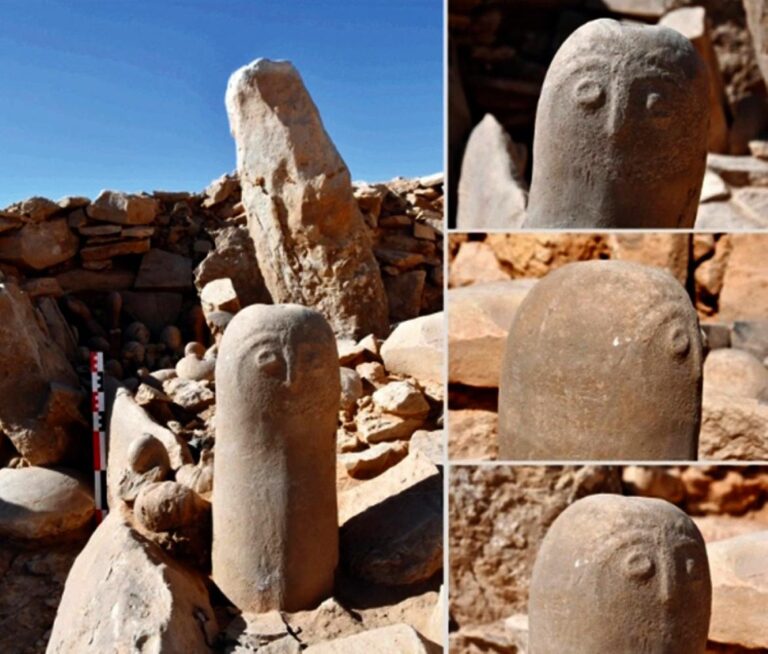
Behind the stones lay nearly 150 marine fossils, several deliberately positioned upright and facing particular directions. The excavation team also documented unusually shaped natural stones, small animal figurines, worked flint objects, and an altar stone associated with a hearth.
Researchers interpret this carefully organized collection as evidence of ritual activity. The altar and nearby hearth may have played a role in offerings, although the purpose of the fossils and the ceremonies performed at the site remain uncertain.
A Hunting Trap Recreated for Ritual Purposes
The arrangement of the stones offers an important clue. The entire installation followed the shape of a miniature desert kite, reproducing the enormous hunting structures found across the surrounding landscape.
These prehistoric traps consisted of long, converging stone walls that directed herds of wild animals, particularly gazelles, toward enclosures equipped with deep pits. Some extended across several kilometers, requiring considerable planning and cooperation among hunters.
At JKSH P52, the miniature hunting structure contained the carved figures and carefully selected objects. The engraving on the taller stone reinforced the connection between the ritual installation and the nearby hunting systems.
According to the French Ministry of Culture’s archaeological documentation, the arrangement demonstrates the importance of hunting in the symbolic practices of these Neolithic communities. Researchers have suggested that ceremonies may have sought supernatural assistance for successful hunts and abundant prey, although this interpretation cannot be confirmed.
A Different Way of Life During the Neolithic
The people who created the figures belonged to a local Neolithic cultural tradition that archaeologists call the Ghassanian. Their partly subterranean settlements contained distinctive stone tools and large quantities of gazelle bones, providing evidence of specialized butchery and collective hunting.
Their economy differed from that of many contemporary communities in the Fertile Crescent, where farming and animal husbandry were becoming increasingly important. Elsewhere in Jordan, the 9,000-year-old Ain Ghazal statues provide another example of human representation in Neolithic society, this time associated with an early farming settlement. The contrast highlights the different social settings in which prehistoric communities created human-shaped figures.
A study published in February 2026 in Archaeological and Anthropological Sciences established a stronger chronology for these hunting structures. The research team analyzed ten radiocarbon measurements and eighteen optically stimulated luminescence dates from six trapping pits belonging to three desert kites.
Their results place the highest probabilities for the construction of these structures in the second half of the eighth millennium BCE, making them the earliest securely dated examples of desert kites. Importantly, the new dates concern the hunting installations rather than the stone figures themselves, whose age remains established through their archaeological context.
Ancient Figures Prepared for Museum Exhibition
On October 28, 2026, Jordan’s Department of Antiquities announced the completion of a Jordanian-French conservation project involving discoveries from Jibal al-Khashabiyeh.
Specialists conserved approximately 30 archaeological objects at the Jerash Regional Conservation Center. The project also used photogrammetry, three-dimensional scanning, and Reflectance Transformation Imaging to document artifacts and preserve information about their surfaces.
The initiative included developing an exhibition plan for the Petra Museum’s permanent displays, although officials have not announced when the objects will go on view.
The two carved figures remain among the site’s most distinctive discoveries. Their original meaning is still unknown, but their placement within a miniature hunting installation reveals a close relationship between the technologies these Neolithic communities relied upon and the rituals through which they expressed their beliefs.
Cover Image: The Neolithic ritual installation at Jibal al-Khashabiyeh, showing the two standing stone figures and their arrangement within the excavated shrine. Credit: South Eastern Badia Archaeological Project (SEBAP).