
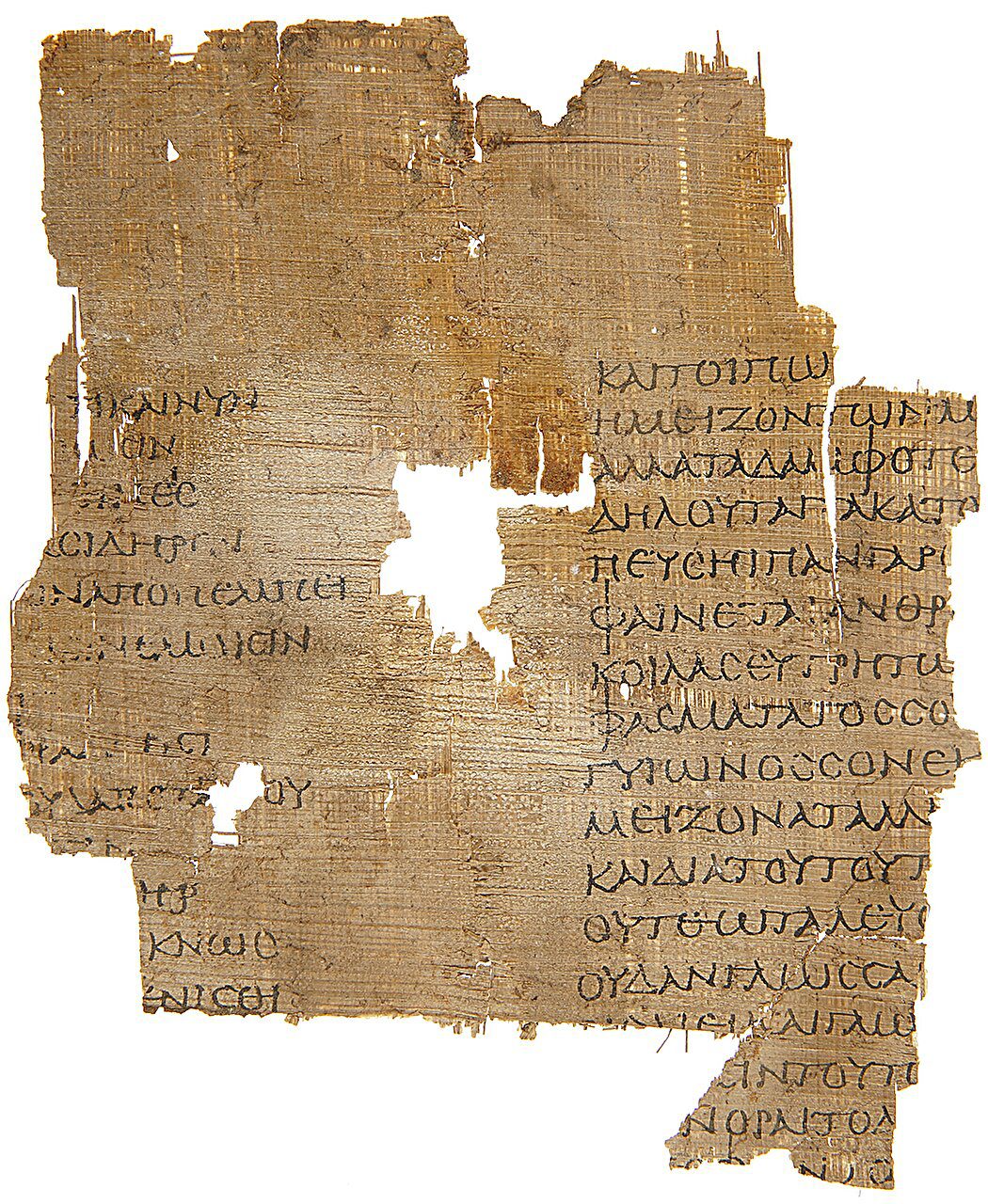
A fragile papyrus fragment preserved for decades in Cairo has unexpectedly brought back the voice of one of antiquity’s most enigmatic thinkers. Hidden within the archives of the French Institute of Oriental Archaeology, the manuscript preserves 30 previously unknown verses by Empedocles, offering scholars something long thought impossible: direct access to his original words.
For centuries, Empedocles’ ideas survived only in fragments—quoted, summarized, and often reshaped by later authors. Now, for the first time, a portion of his philosophical work can be read without mediation.
A Forgotten Manuscript Comes into Focus
The rediscovery began when papyrologist Nathan Carlig of the University of Liège identified the document, catalogued as P. Fouad inv. 218, as part of Physica, a poem attributed to Empedocles of Agrigentum.
Until this moment, knowledge of Empedocles depended entirely on indirect transmission—references scattered through the works of figures such as Plato, Aristotle, and Plutarch. These sources, while invaluable, inevitably filtered and reshaped the original ideas.
This papyrus changes that equation. It is currently the only known manuscript preserving part of the Physica, with related fragments from the same scroll held in Strasbourg collections.
A Rare Glimpse Into Early Scientific Thought
The newly revealed verses explore themes central to early Greek philosophy, particularly the theory of effluvia—tiny particles emitted by objects—and their role in sensory perception. Vision, in particular, appears as a key focus.
Rather than abstract speculation alone, the text suggests a structured attempt to explain how humans perceive the world physically. In doing so, it places Empedocles closer to later developments in natural philosophy than previously assumed.
More striking still are the connections uncovered during analysis. The fragment appears to echo passages in works by Plutarch and shows conceptual parallels with a dialogue by Plato and writings of Theophrastus. These links suggest that Empedocles’ ideas may have circulated more directly—and more widely—than scholars once believed.
Echoes Across Greek and Roman Literature
The influence of Empedocles did not stop with philosophy. Subtle traces of his thought have now been identified in unexpected places, including the works of Aristophanes and the Roman poet-philosopher Lucretius.
Such findings reinforce a growing view of Empedocles as more than a marginal pre-Socratic thinker. Instead, he emerges as a key intellectual bridge, linking early cosmological speculation with later atomist traditions—particularly those associated with Democritus.
Recovering a Lost Voice
To grasp the scale of this discovery, scholars have turned to a modern analogy. Imagine a future in which the works of Victor Hugo survive only as scattered quotations and adaptations. Then, suddenly, a few original pages resurface—restoring the author’s voice in its own words.
That is effectively what this papyrus represents.
For specialists, the experience is both rare and transformative. It offers not just new material, but a shift in perspective—allowing Empedocles to be read as a coherent thinker rather than reconstructed through fragments.
A “Second Renaissance” of Ancient Texts
The findings, published in L’Empédocle du Caire and edited by Alain Martin and Olivier Primavesi alongside Carlig, highlight the enduring importance of papyrology.
Since the late 19th century, scholars have combed archives and excavation records in search of lost texts. Discoveries like this one have led some to describe the field as a “second Renaissance”—a renewed recovery of classical knowledge long thought irretrievable.
This papyrus stands as one of the clearest examples of that process in action.
Redefining Empedocles’ Place in History
Beyond the excitement of discovery, the implications are substantial. With direct textual evidence now available, researchers can reassess Empedocles’ role in the development of Greek philosophy—his relationship to predecessors, his influence on successors, and his contribution to early scientific thinking.
Cover Image: Fragment of “The Empedocles of Cairo” (P. Fouad inv. 218). Credit: Université de Liège / N.Carlig
Nathan Carlig et al, L’Empédocle du Caire (P.Fouad inv. 218). Introduction, texte, commentaire (2025). hdl.handle.net/2268/329390