

Archaeologists in Denmark have discovered an approximately 8,400-year-old axe made from deer antler, with its original wooden handle remarkably preserved. Found on the island of Egholm near Aalborg, the rare Mesolithic tool offers an opportunity to study prehistoric craftsmanship in a level of detail seldom possible with Stone Age discoveries.
The axe was recovered about 1.5 meters beneath the surface during archaeological excavations ahead of the planned third Limfjord crossing. Researchers from Nordjyske Museer identified it as an early type of straight-edged antler axe associated with the late Maglemose culture, whose hunter-gatherer communities inhabited southern Scandinavia thousands of years before agriculture became established in the region.
Torben Sarauw, head of archaeology and cultural heritage at Nordjyske Museer, described the approximately 8,400-year-old discovery as exceptionally rare. Although antler axes are known from several Mesolithic sites, examples that retain their wooden handles are particularly uncommon.
An Ancient Tool That Survived Thousands of Years Underwater
The newly discovered implement belongs to a type known as a retøkse, distinguished by the placement of its shaft hole near the base of the antler, close to the raised ring known as the burr. According to the museum, this particular form is unusual for the Maglemose period.
What makes the discovery especially valuable is the survival of both the antler head and its wooden handle. Egholm’s waterlogged deposits created oxygen-poor conditions that slowed the decay of organic materials. Without those conditions, the wooden component would almost certainly have disappeared, leaving archaeologists to reconstruct the tool’s original construction.
The discovery also provides an opportunity to investigate how the handle was fitted and whether the axe bears evidence of repeated use or modification.
Earlier Danish discoveries demonstrate how much such details can reveal. In 1918, peat cutting at Langes Hoved bog on the island of Funen exposed an antler axe with part of its wooden shaft still lodged in the mounting hole. Another well-preserved example, discovered near Holckenhavn in 1941, measured 25.5 centimeters long and retained a cutting edge that could have been sharpened repeatedly.
Research published by Museum Odense has also shown that some prehistoric antler axes were discarded only after extensive wear, while others entered wetlands in apparently usable condition. Archaeologists have consequently debated whether certain specimens were lost, abandoned or deliberately deposited.
Experimental investigations have demonstrated that antler axes could be effective woodworking implements, particularly when cutting along the grain. However, whether the Egholm axe was used to clear vegetation, work timber or serve another purpose remains unresolved.
Egholm Reveals the Technology of Stone Age Hunter-Gatherers
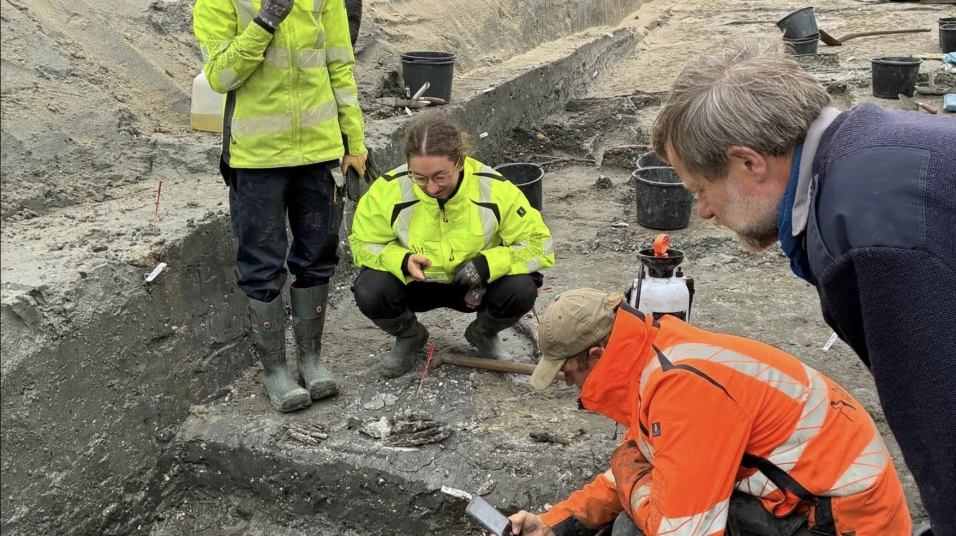
The axe is one of several important discoveries from an approximately 7,000-square-meter excavation area on Egholm. Archaeologists have recovered more than 400 microliths, small flint implements used in hunting equipment, along with animal bones and tools manufactured from bone.
The microliths offer another perspective on Maglemose craftsmanship. Rather than relying exclusively on tools carved from a single material, prehistoric hunters assembled equipment from multiple components. Small flint blades could be attached to wooden shafts using birch-bark pitch, creating cutting edges that could be replaced when damaged.
Nordjyske Museer has explained that this technology allowed hunters to repair composite weapons without replacing the entire implement. The antler axe represents a different application of the same broader principle: combining naturally available materials to produce functional equipment.
Animal remains recovered at Egholm include deer, wild boar and fish, providing evidence of the resources exploited around the prehistoric settlement. Archaeologists have also reported an approximately 8,500-year-old killer whale tooth, another indication of the site’s remarkable preservation conditions.
Together, these discoveries are helping researchers examine how Mesolithic communities adapted to the coastal landscapes of northern Denmark after the last Ice Age. Particularly significant is the survival of wood and other organic materials, which are generally missing from archaeological assemblages dominated by stone tools.
The antler axe is currently protected within a plaster block while awaiting conservation. Specialists plan to examine its surfaces for wear marks and possible decoration, potentially establishing whether it was an everyday woodworking tool, a weapon or an object with another function.
The results may also help clarify how its makers shaped the antler and fitted the wooden handle. Until that examination is complete, the axe’s precise role in Maglemose society remains an open question.
Cover Image: An approximately 8,400-year-old deer antler axe discovered on Egholm Island in Denmark, with its original wooden handle still preserved in waterlogged soil. Credit: Nordjyske Museer.