
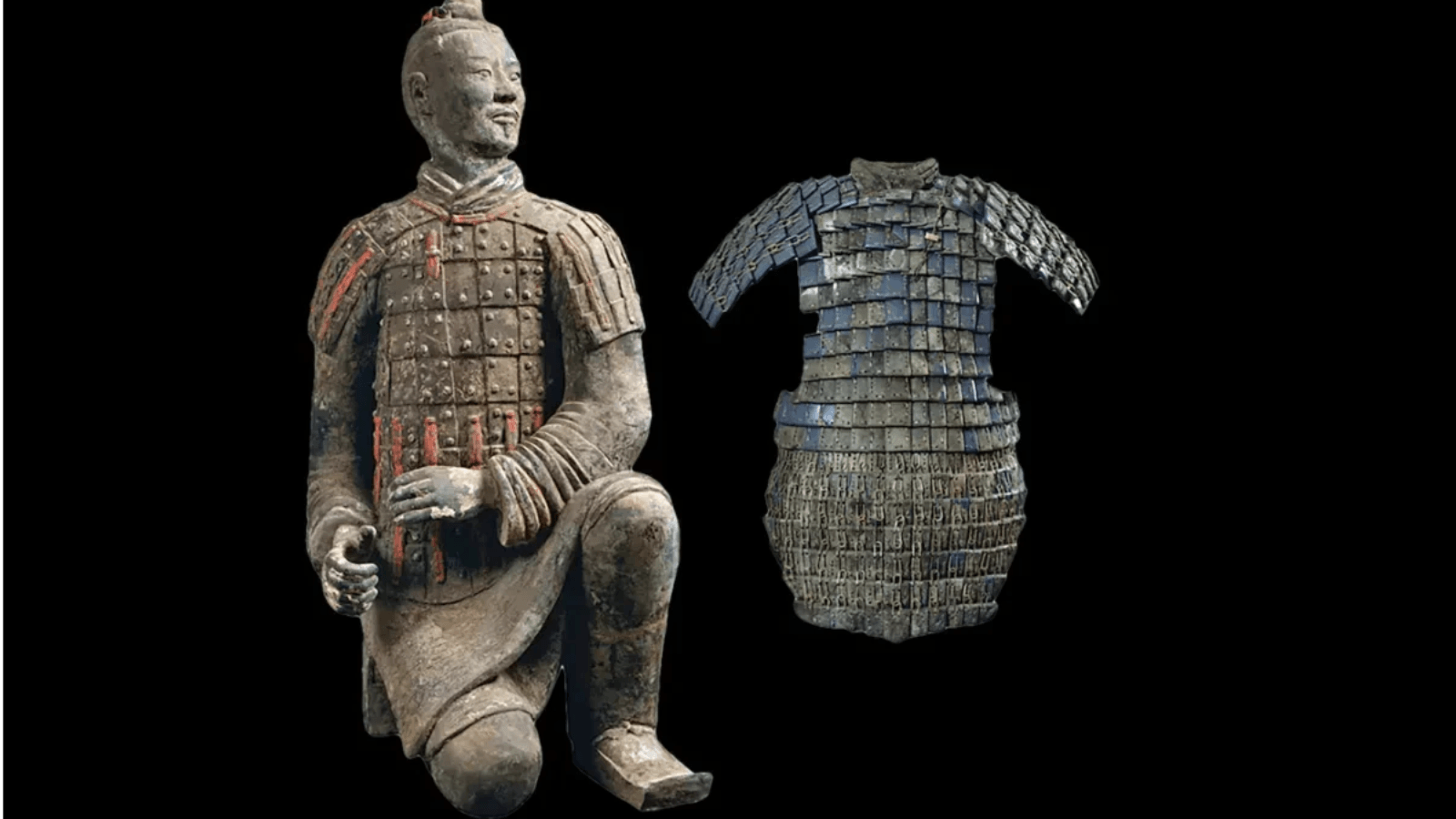
A rare suit of iron scale armor recovered from the mausoleum complex of Qin Shi Huang, China’s first emperor, may represent the earliest known example of its kind in the country. A new scientific study of the approximately 2,200-year-old artifact reveals sophisticated metalworking techniques and traces of its original decoration, while raising questions about whether the famous Terracotta Army accurately reflects the military equipment of the armies that unified ancient China.
The research, conducted by specialists from University College London (UCL) and the Emperor Qin Shihuang’s Mausoleum Site Museum, appeared on November 26, 2026, in the journal Antiquity.
An Extraordinary Burial Near China’s First Emperor
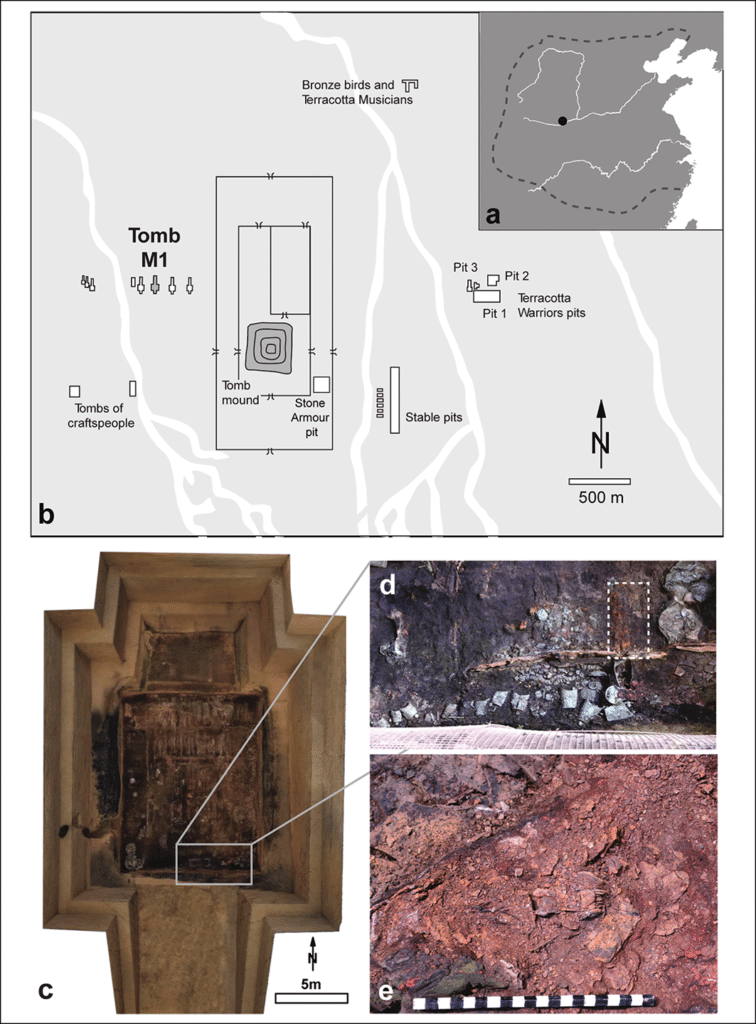
In 221 BCE, Qin Shi Huang completed the conquest of rival kingdoms, establishing China’s first unified empire. His monumental burial complex in present-day Shaanxi Province spans approximately 56 square kilometers and encompasses hundreds of subsidiary tombs and burial pits.
Among them is Tomb M1, where excavations between 2013 and 2023 uncovered an exceptionally wealthy burial. Its enormous underground chamber contained nested coffins, a wooden funerary carriage, and numerous prestigious grave goods. Nearby burial pits held horses and chariots. The researchers consider M1 the wealthiest and best-preserved Qin tomb excavated to date.
Archaeologists recovered the remains of the iron armor from the southern section of the burial chamber. Although the identity of the deceased remains unknown, the extraordinary funerary assemblage suggests that the individual belonged to the highest levels of Qin society.
A senior military commander, an influential official, or a member of the royal family are among the possibilities. However, the armor alone cannot establish the occupant’s identity.
Hundreds of Iron Scales Formed a Single Suit of Armor
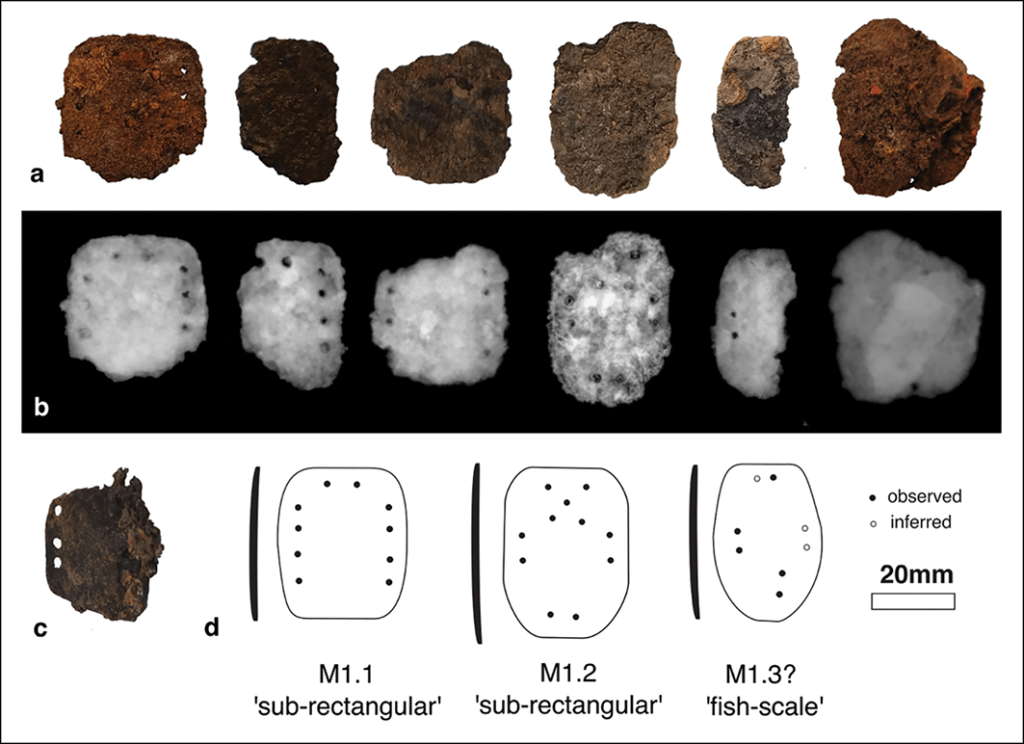
More than two millennia of burial severely damaged the armor, leaving behind a mass of corroded and fragmented metal. Researchers nevertheless estimate that the original garment consisted of between 800 and 1,200 individual scales and weighed approximately 10 kilograms.
Scale armor offered a practical balance between protection and mobility. Rather than enclosing the body in a rigid metal shell, it relied on overlapping plates that created a flexible protective garment.
Radiographic examination helped researchers distinguish three different types of scales. Their varying shapes suggest that the armorers employed a carefully planned design rather than assembling identical metal components throughout the garment.
The discovery provides a valuable opportunity to examine the relationship between specialized craftsmanship, military equipment, and social hierarchy during the formation of the Qin Empire.
Ancient Metalworkers Combined Steel and Color
Scientific examination revealed that the craftspeople used low-carbon steel. The metal’s microscopic structure indicates extensive forging, demonstrating the technical expertise of Qin metalworkers.
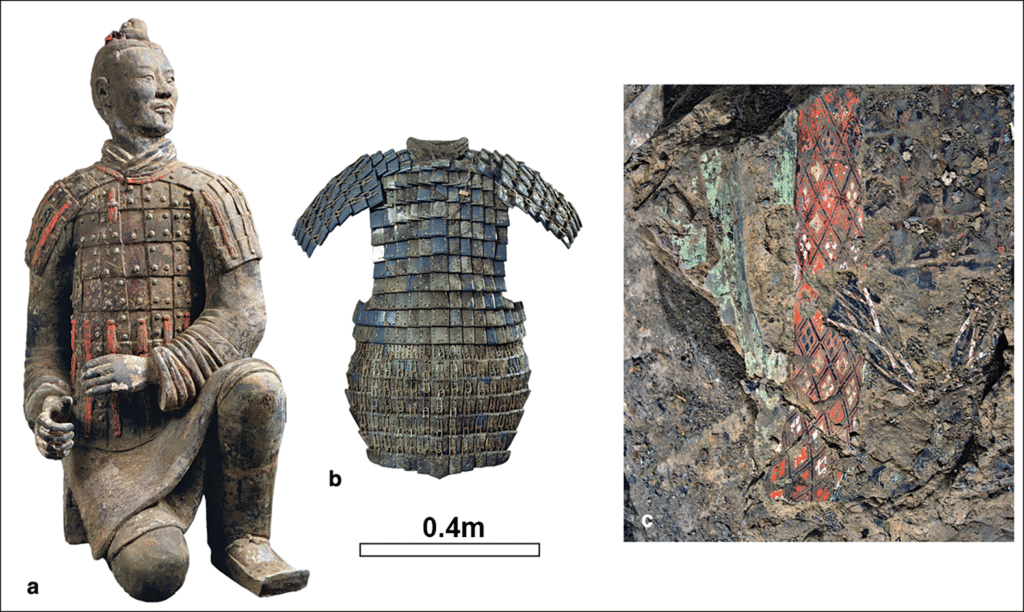
Equally intriguing are the surviving traces of decoration. Researchers identified chemical signatures consistent with cinnabar, a mineral that produces a vivid red pigment. A dark surface layer may also represent remnants of lacquer, although its precise composition remains uncertain.
These findings suggest that the armor originally had a more elaborate appearance than its heavily corroded remains convey today. Its production would have demanded considerable resources and skilled labor, making it an exceptionally valuable possession.
The relationship between military equipment and elite status continued throughout Chinese history. Centuries later, craftspeople produced increasingly elaborate examples, including the Tang dynasty golden armor recovered from a royal tomb on the Tibetan Plateau.
The Terracotta Army May Not Tell the Whole Story
Perhaps the most significant aspect of the discovery lies in what it reveals about the limitations of the Terracotta Army as a representation of ancient Chinese warfare.
The ceramic soldiers guarding the emperor’s mausoleum predominantly wear sculpted armor resembling leather garments. Bronze also dominates the enormous collection of weapons associated with the funerary complex.
However, the Qin state had already developed a sophisticated ironworking industry before the unification of China. The presence of iron armor and swords in Tomb M1 highlights the disparity between the empire’s technological capabilities and the military equipment represented elsewhere in the mausoleum.
One explanation is that expensive iron equipment remained exclusive to high-ranking individuals. Alternatively, the bronze weapons accompanying the Terracotta Army may reflect symbolic funerary choices or older military inventories.
An ongoing research project at University College London aims to investigate the broader role of iron production in the Qin Empire and its significance for understanding the emperor’s monumental burial complex.
A Landmark in the History of Chinese Armor
The history of iron armor in China predates Qin Shi Huang’s empire. Earlier archaeological discoveries, including an iron scale helmet from Yanxiadu, demonstrate that Chinese craftspeople employed this technology during the Warring States period (475–221 BCE).
However, the researchers consider the M1 armor the earliest likely example of a complete iron scale garment intended to protect the torso in China. Although extensive corrosion prevents a definitive reconstruction, the archaeological evidence supports this interpretation.
For decades, the Terracotta Army has shaped the world’s understanding of the military forces that established China’s first empire. The iron armor from Tomb M1 now offers a different perspective, bringing researchers closer to understanding the actual equipment, craftsmanship, and industrial capabilities behind those armies.
Cover Image: A kneeling Terracotta warrior alongside a limestone replica of scale armor from the mausoleum complex of China’s first emperor. Credit: Michael Charlton & Weisha Du / Antiquity (2026), CC BY 4.0, adapted.