
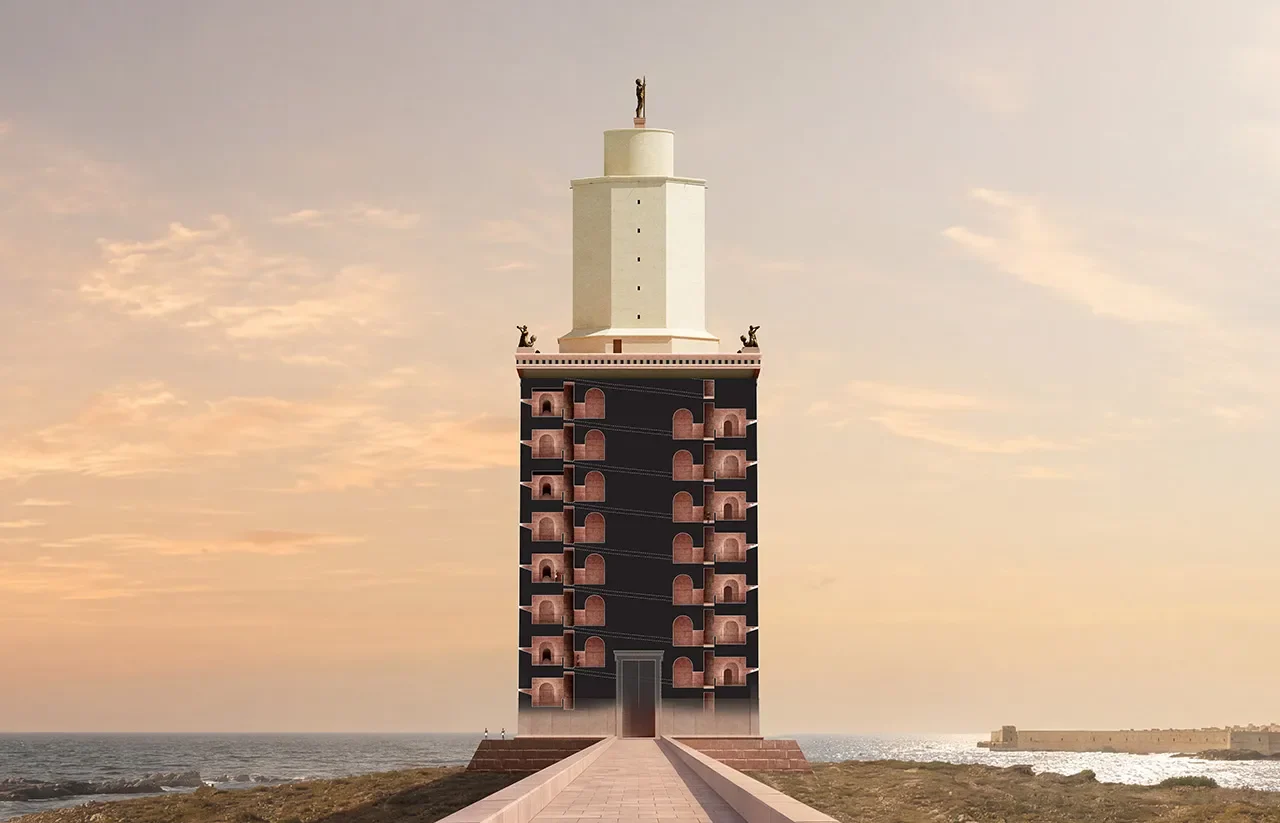
More than 2,200 years after its construction, the Lighthouse of Alexandria is revealing architectural details that remained hidden for centuries. Archaeologists and engineers have digitally reconstructed the ancient monument, identifying an elaborate interior with 67 rooms across nine levels, vast vaulted halls and a ramp wide enough for two horsemen to pass each other.
The reconstruction also offers new insights into one of the greatest engineering achievements of antiquity: how a stone structure approximately 100 meters (328 feet) tall survived repeated earthquakes over nearly 1,600 years.
Led by archaeologist and architect Isabelle Hairy, the research combines three decades of underwater archaeology with historical documentation and modern structural analysis. The French National Centre for Scientific Research (CNRS) presented the results in October 2026, offering a detailed scientific reconstruction of one of the Seven Wonders of the Ancient World.
Reassembling a Wonder from the Seabed
Built in the third century BC on the island of Pharos, the lighthouse guided ships toward Alexandria, one of the most influential cities of the ancient Mediterranean. Its immense scale reflected the architectural ambitions of the Ptolemaic dynasty, which established Alexandria as a major center of commerce, science and scholarship.
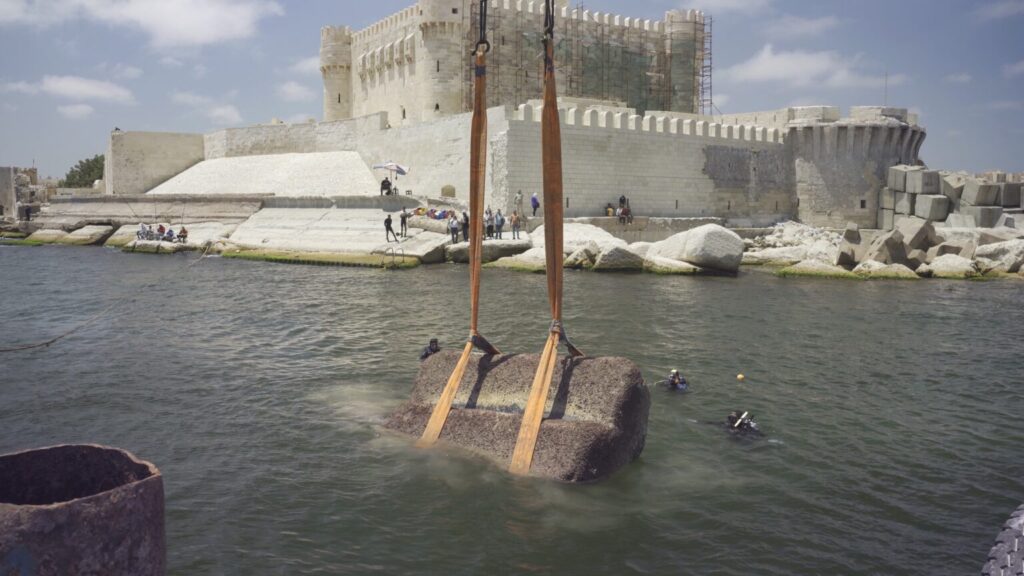
Much of the monument’s surviving architecture now lies beneath the waters surrounding the Citadel of Qaitbay. Underwater excavations have documented 4,896 stone blocks and nearly 3,000 fragments of construction metal across approximately two hectares of seabed.
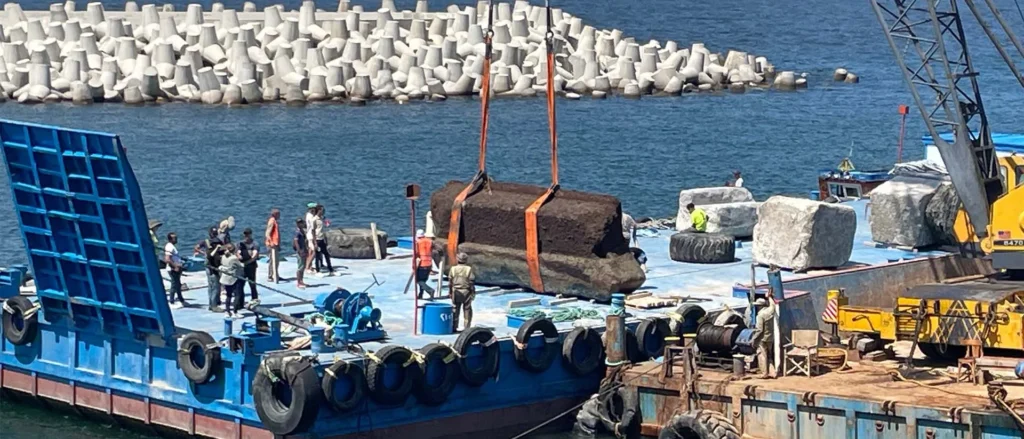
In June 2025, archaeologists recovered some of the site’s largest architectural elements. These included massive doorway components weighing between 64 and 73 metric tons, enormous stone slabs and architectural elements repurposed from Egypt’s Old Kingdom pyramids.
Researchers also identified fragments of a previously unknown Egyptian-style pylon constructed using Greek building techniques. The discovery provides further evidence of the interaction between Egyptian and Greek architectural traditions during the Ptolemaic period.
Yet the submerged remains represent less than 10 percent of the original lighthouse. Recovering its complete architectural layout required evidence from other sources.
Behind the Walls of the Ancient Lighthouse
Researchers examined representations of the monument on coins, terracotta lamps, mosaics and engraved glass. Medieval Arabic accounts provided additional information about its dimensions, architectural features and internal organization.
Recent archaeological discoveries have further enriched this historical record. In October 2026, underwater archaeologists announced the discovery of a bronze signet ring depicting the Lighthouse of Alexandria in the remains of the city’s ancient royal quarter.
Through the Pharos Project, Hairy and engineers from the Dassault Systèmes Foundation combined archaeological and historical evidence to develop and refine a three-dimensional model of the monument.
Their reconstruction suggests that visitors approached the lighthouse along an elevated causeway supported by 16 arches before reaching a monumental entrance approximately 13 meters (43 feet) high.
Beyond that entrance lay an intricate network of chambers, staircases and passageways. A broad ramp provided one route through the building, while interconnected rooms and separate staircases offered an alternative. This architectural arrangement helps explain why historical visitors described the lighthouse as a labyrinth.
The Engineering Behind Centuries of Survival
According to the CNRS, the Lighthouse of Alexandria endured 18 earthquakes during its long history. Its survival raises important questions about how ancient engineers managed the weight and structural stability of such an enormous building.
The reconstruction identifies three principal architectural sections arranged according to proportional relationships and resting on a substantial foundation. Superimposed arcades and extensive vaulted halls formed essential components of its internal structure.
Using digital simulations, engineers assessed the monument’s mechanical strength under earthquake conditions. The research team also explored a full-scale virtual model, examining architectural details from within the building and evaluating alternative reconstruction hypotheses.
The lighthouse eventually suffered catastrophic damage during the earthquake and tsunami of 1303. According to the Pharos Project, the disaster ended its operation, and people subsequently used its ruins as a source of building stone. Many of its architectural components eventually ended up beneath the Mediterranean.
The digital reconstruction now allows researchers to examine the lighthouse not merely as a lost monument, but as an engineering achievement. By studying the relationship between its geometry, materials and internal architecture, archaeologists can investigate how Hellenistic builders approached structural challenges that remain relevant to engineers today.