
A Chinese research team has completed the restoration of the only known physical example of Tang dynasty golden armour, recovered from a royal tomb on the Tibetan Plateau and identified as belonging to a Tuyuhun king.
The armour was restored by specialists from the Chinese Academy of Social Sciences, following a multi-year conservation project carried out between 2022 and 2025 by its Key Laboratory of Archaeological Sciences and Cultural Heritage.
Severely Damaged Armour Recovered from Looted Tomb
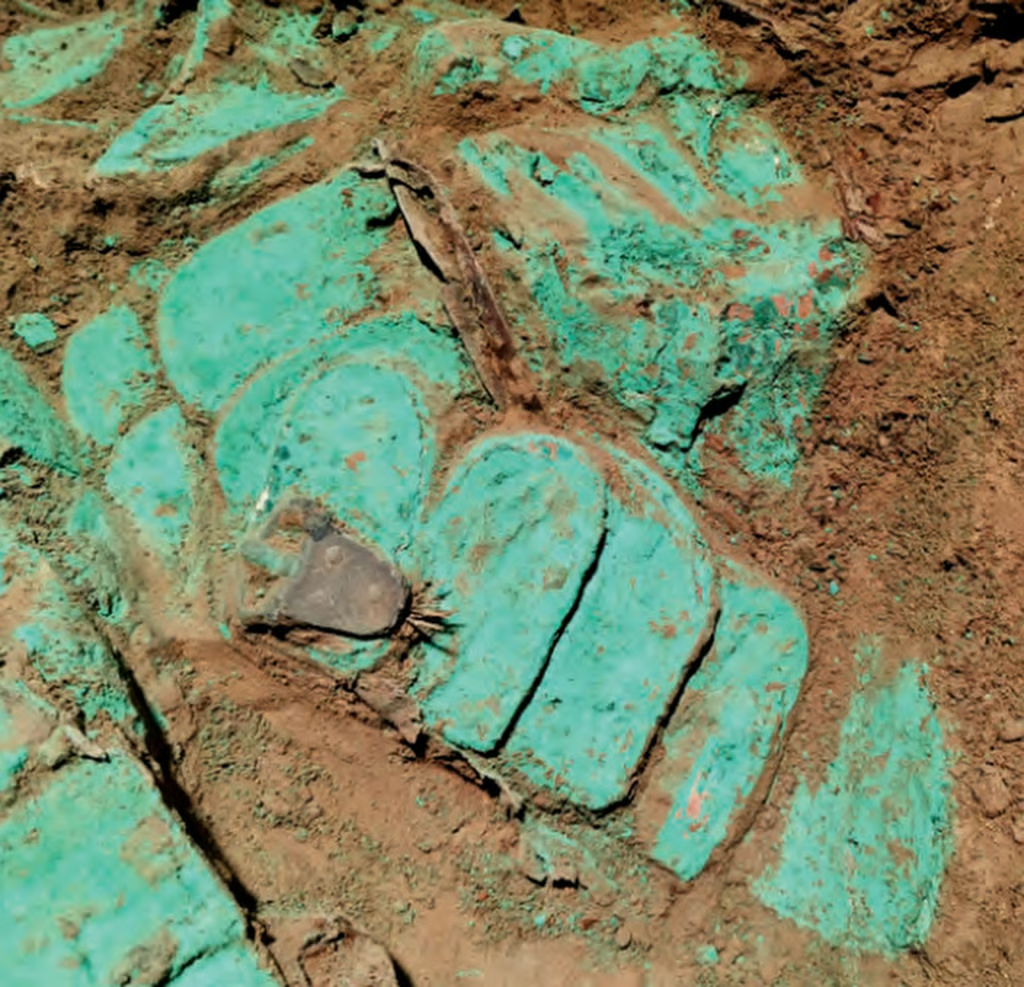
The armour was excavated from the Tuyuhun royal tombs in Dulan County, an area that had previously been affected by looting and early salvage excavations. As a result, the armour plates were found heavily fragmented, degraded, and mixed with lacquered components.
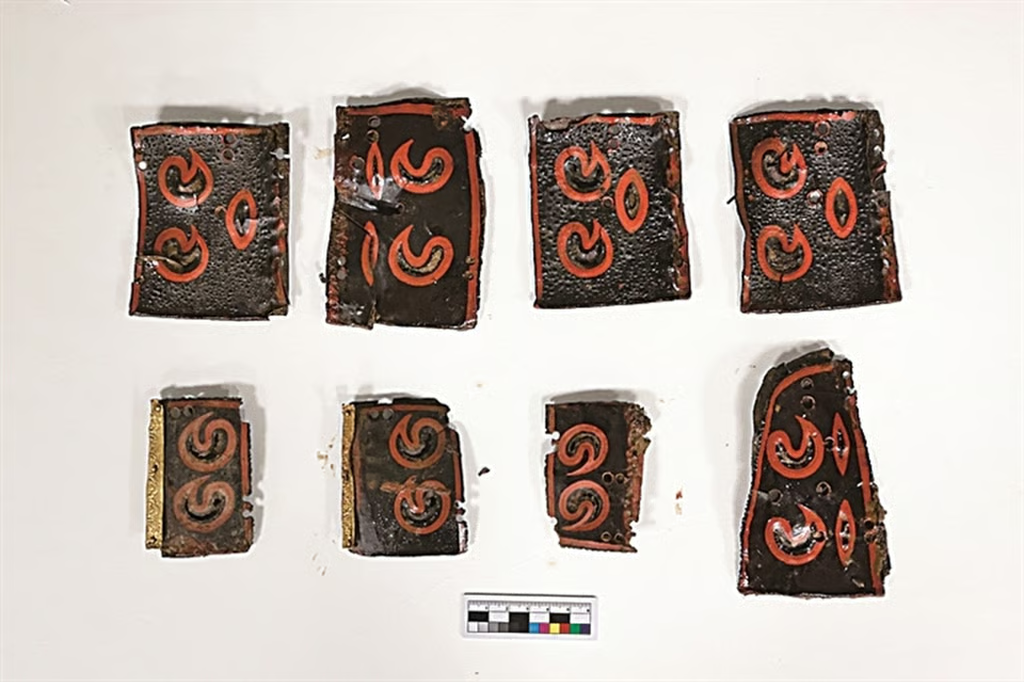
According to the excavation report published in the journal Archaeology in 2024, the bronze plates were nearly rectangular with semicircular lower edges. Numerous lacquered armour fragments were also recovered, but the original structure of the suit was no longer intact.Restoration Process and Scientific Analysis
Conservators adopted a systematic restoration strategy based on separating and reassembling the fragmented components. Each armour plate was cleaned, stabilized, and documented individually before being reassembled.
“We disassembled the damaged armour into individual parts and then reassembled them after layered cleaning and protection,” said conservation expert Guo Zhengchen during a press conference on January 14.
The team recorded the original spatial information of each fragment using 3D scanning. Manufacturing techniques and material composition were analyzed through scanning electron microscopy and ultra-depth microscopy.
Gilding Confirms ‘Golden Armour’
Scientific analysis revealed that the armour was not standard bronze equipment. Traces of deliberate gold gilding were identified on multiple plates, confirming that the suit was originally produced as golden armour.
Based on associated gold artefacts, silk textiles, and dendrochronological analysis of the tomb’s wooden structure, researchers dated the burial to the mid-8th century, during the Tang dynasty.
Identification of the Tomb’s Occupant
The tomb was identified as belonging to a king of the Tuyuhun, a polity that once controlled large parts of China’s northwestern frontier. The golden armour is believed to have been among the ruler’s most valuable possessions.
Other grave goods recovered from the tomb include equestrian equipment, iron armour, and lacquered military items, indicating a strong martial tradition.
Historical and Regional Context
The Tuyuhun kingdom was gradually subdued by the Sui and Tang dynasties before becoming a vassal of the Tubo Empire, which dominated the Tibetan Plateau during the early medieval period.
The tomb’s location in Qinghai places it along an important section of the Silk Road, linking the Tang capital Chang’an with Central Asia. Researchers say the restored armour provides new material evidence for elite military equipment used in frontier regions during the Tang era.