Scientists have identified a deadly prehistoric plague strain in an animal for the first time – a 4,000-year-old domesticated sheep from the Eurasian Steppe – offering new clues about how one of history’s most feared diseases spread across continents.
A team of international researchers has uncovered a crucial missing link in the history of the plague: its presence in livestock. The breakthrough came from DNA extracted from the tooth of a domesticated sheep unearthed at Arkaim, a Bronze Age pastoralist site in Russia’s Western Eurasian Steppe. The animal, which lived around 4,000 years ago, carried the same ancient plague strain – known as the Late Neolithic Bronze Age (LNBA) lineage – that infected humans across Eurasia at the time.
A Mysterious Plague Without Fleas
The LNBA plague circulated for nearly 3,000 years, starting about 5,000 years ago, before disappearing entirely. Unlike the medieval Black Death strain, which spread via flea-infested rats, this prehistoric variant lacked the genetic adaptations for flea transmission. How it spread remained a mystery — until now.
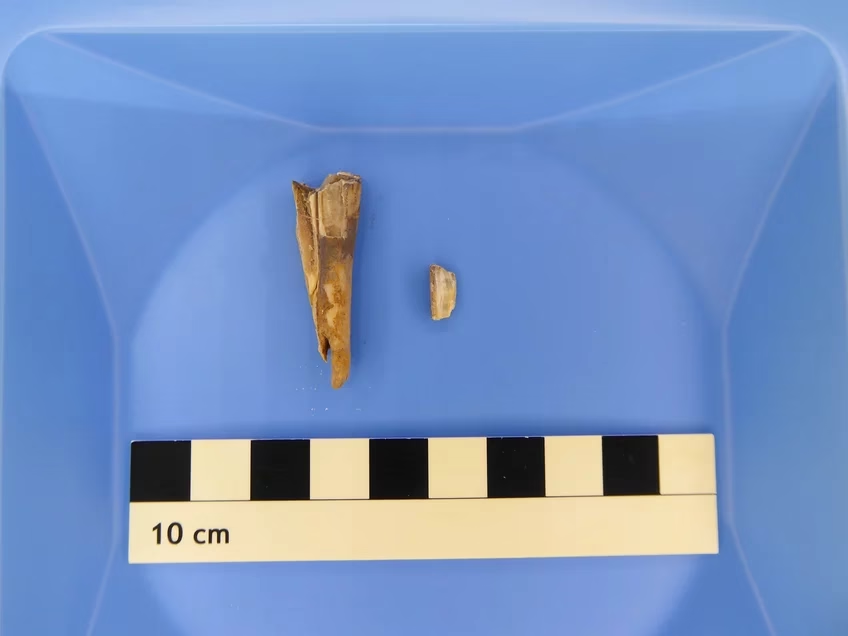
Genetic analysis showed that the sheep’s plague genome was almost identical to one found in a human from a nearby site dating to the same period. This suggests that humans and their livestock were infected by the same pathogen, possibly through contact with wild animals carrying the bacteria.
“If we didn’t know it came from a sheep, we would have assumed it was another human case,” said Dr. Christina Warinner of Harvard University.
Sheep Herding and the Spread of Disease
The find points to sheep herding as a potential bridge between humans and the still-unknown natural reservoir of the disease. In modern plague-endemic regions, sheep can contract the bacteria from infected wildlife and pass it to humans during slaughter or food preparation. In the vast grasslands of the Bronze Age, steppe herders’ livestock likely came into frequent contact with infected wild animals.
The Sintashta-Petrovka culture, to which Arkaim belonged, was known for large-scale animal husbandry and advanced horse technology — factors that could have increased such contact.

A Reservoir Still at Large
Despite the discovery, the ultimate source of the prehistoric plague remains unidentified. The study found signs of strong evolutionary pressure on the LNBA strain, suggesting repeated “spillover” events from an animal host rather than continuous human-to-human transmission.
“Finding that reservoir would be the next step,” said Dr. Felix M. Key of the Max Planck Institute for Infection Biology.
With tens of thousands of ancient animal bones stored in archaeological collections worldwide, scientists believe many more answers are waiting to be uncovered.
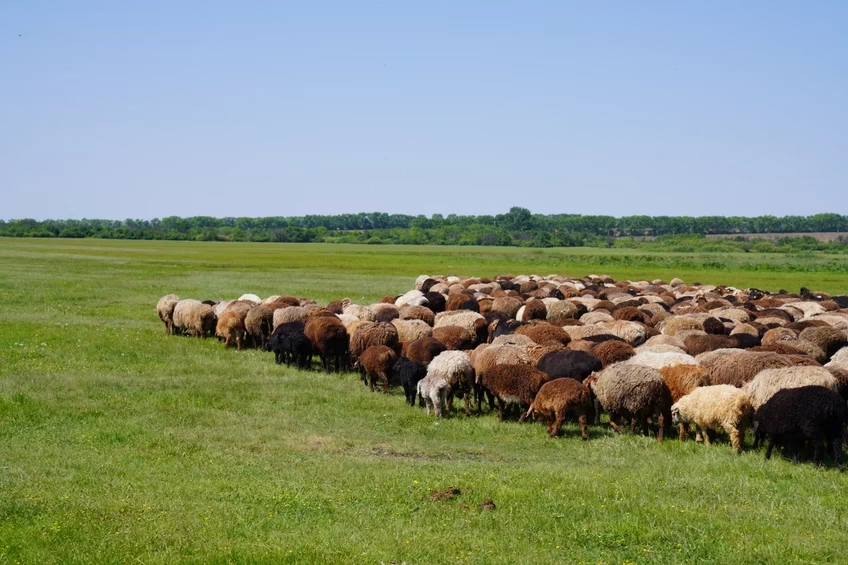
Cover Image Credit: A herd of sheep grazes in a steppe landscape of the Southern Urals near Arkaim, where herders would have managed similar flocks 4,000 years ago. © Taylor Hermes