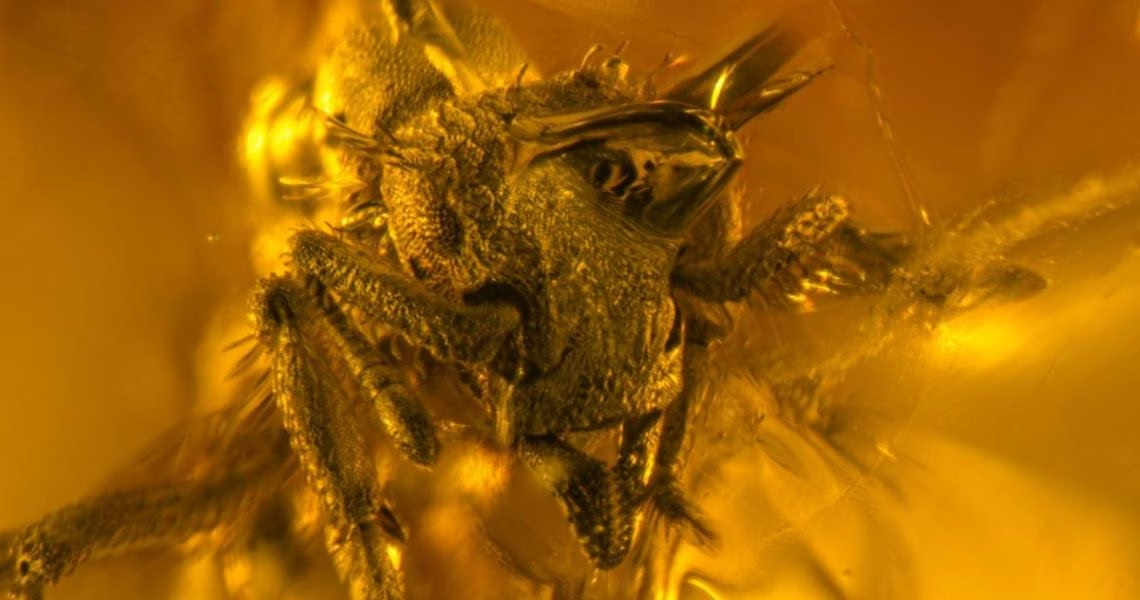
New Jersey Institute of Technology biologists uncover a tiny but groundbreaking dirt ant fossil, reshaping the evolutionary history of one of the planet’s most cryptic insects.
A team of researchers from the New Jersey Institute of Technology (NJIT) has made a remarkable discovery: the first-ever fossil of a “dirt ant” (Basiceros) from the Caribbean, perfectly preserved in 16-million-year-old Dominican amber. The finding, published in the Proceedings of the Royal Society B, sheds new light on the mysterious evolutionary journey of these highly camouflaged insects.
An Ancient Caribbean Resident Revealed
Dirt ants are masters of disguise, blending seamlessly with the soil and leaf litter of tropical forests thanks to specialized hairs that trap particles against their bodies. Today, they are found exclusively in the rainforests of Costa Rica to Southern Brazil, making this Caribbean fossil an evolutionary curveball.
The newly identified species, Basiceros enana, is significantly smaller than any modern relative — measuring just 5.13 millimeters compared to the nearly 9 millimeters of present-day species. According to lead author Gianpiero Fiorentino, a Ph.D. candidate at NJIT’s Barden Lab, the fossil offers rare and invaluable insight.
“Dirt ants are rare finds in the wild. Captured in amber, it’s like finding a diamond,” said Fiorentino. “This fossil is singularly distinct from all its modern relatives and reshapes the evolutionary history of Basiceros.”
Changing the Map of Ant Evolution
Until now, scientists believed dirt ants’ range had always been confined to mainland tropical forests. The Caribbean fossil challenges that assumption, suggesting the ants once occupied the islands before disappearing sometime during the Miocene epoch (23–5.3 million years ago).
“If a group of animals is only found in South America and up to Costa Rica today, you wouldn’t expect their early relatives in the Caribbean,” explained senior author Phil Barden, NJIT associate professor of biology. “This fossil underscores how living species distributions can hide a much more complex evolutionary past.”
The team’s findings also raise questions about how these ants reached the islands in the first place. Ancient land bridges may have provided pathways from the mainland to the Caribbean before environmental changes erased those connections.
Peering Into the Past With Modern Technology
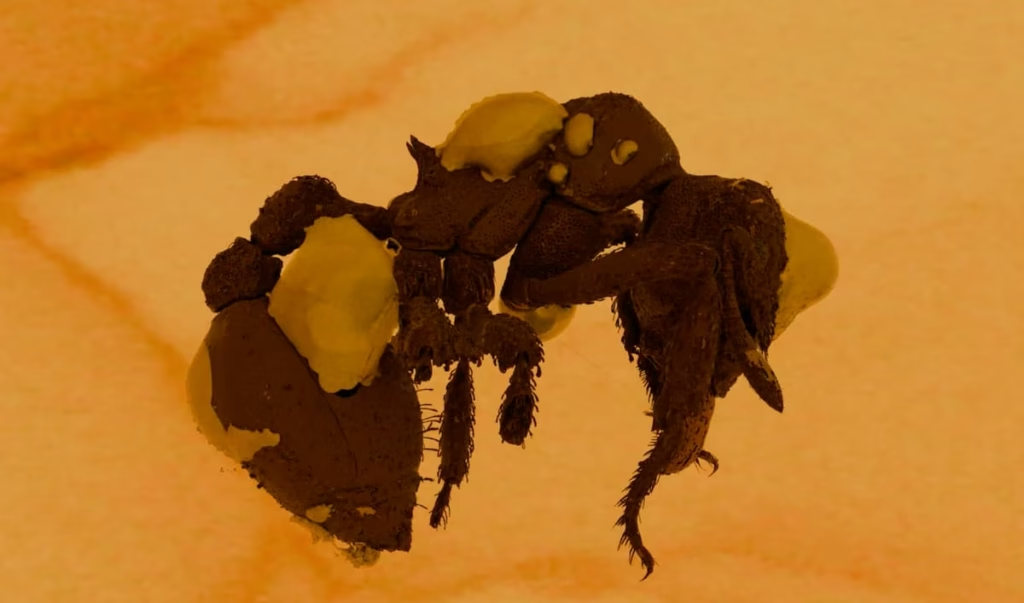
To analyze the fossil, researchers used Micro-CT scanning and 3D reconstruction at NJIT and Japan’s Okinawa Institute of Science and Technology. This allowed scientists to document microscopic anatomical details, including the two layers of specialized hairs — “brush hairs” and “holding hairs” — that dirt ants use for camouflage.
Amber’s ability to preserve entire organisms in three dimensions meant researchers could gather extensive morphological data from the tiny specimen. By comparing these features to all known modern Basiceros species, the team was able to position B. enana within the genus’s evolutionary family tree.
Surprising Size Evolution
One of the most striking revelations is the species’ size. The fossil shows that early Caribbean dirt ants were much smaller than their modern counterparts, contradicting previous hypotheses that dirt ants had originally been large and later shrank.
“They almost doubled in size over the past 20 million years,” said Fiorentino. “This flips earlier assumptions and highlights how crucial fossils are to understanding evolutionary history.”
Despite its size, B. enana already displayed key predatory adaptations seen in modern dirt ants, such as mandibles with 12 triangular teeth and an upturned propodeal spine.
Why They Disappeared
While the exact cause of the Caribbean dirt ants’ extinction remains unknown, researchers suspect ecological shifts during the Miocene played a role. Loss of available habitats, increased competition, or declining prey populations could have driven the ants out.
Fiorentino noted that the Caribbean region has seen significant predator ant losses — over one-third of ant genera that existed when Dominican amber formed are now extinct locally.
“Understanding what drives local extinction is essential for protecting biodiversity today,” he said. “By learning from past extinctions, we can better address modern human-driven biodiversity loss.”
A Small Insect, a Big Story
For scientists, this fossil is more than just an amber curiosity — it’s a crucial puzzle piece in understanding how species adapt, migrate, and disappear over millions of years.
“The discovery of Basiceros enana adds a missing chapter to the story of dirt ants,” Barden concluded. “It’s a reminder that the fossil record can still surprise us, rewriting what we thought we knew about the natural world.”
New Jersey Institute of Technology (NJIT)
Fiorentino Gianpiero, Probst Rodolfo, Richter Adrian, Economo Evan P. and Barden Phillip 2025A fossil-informed pattern of body size increase and local extinction in Basiceros dirt ants (Hymenoptera: Formicidae). Proc. R. Soc. B.29220242171
http://doi.org/10.1098/rspb.2024.2171
Cover Image Credit: Photomicrograph of Basiceros enana, a newly discovered extinct dirt ant species preserved in Dominican amber, formed from tree resin that fossilized millions of years ago. Credit: Gianpiero Fiorentino (NJIT)