
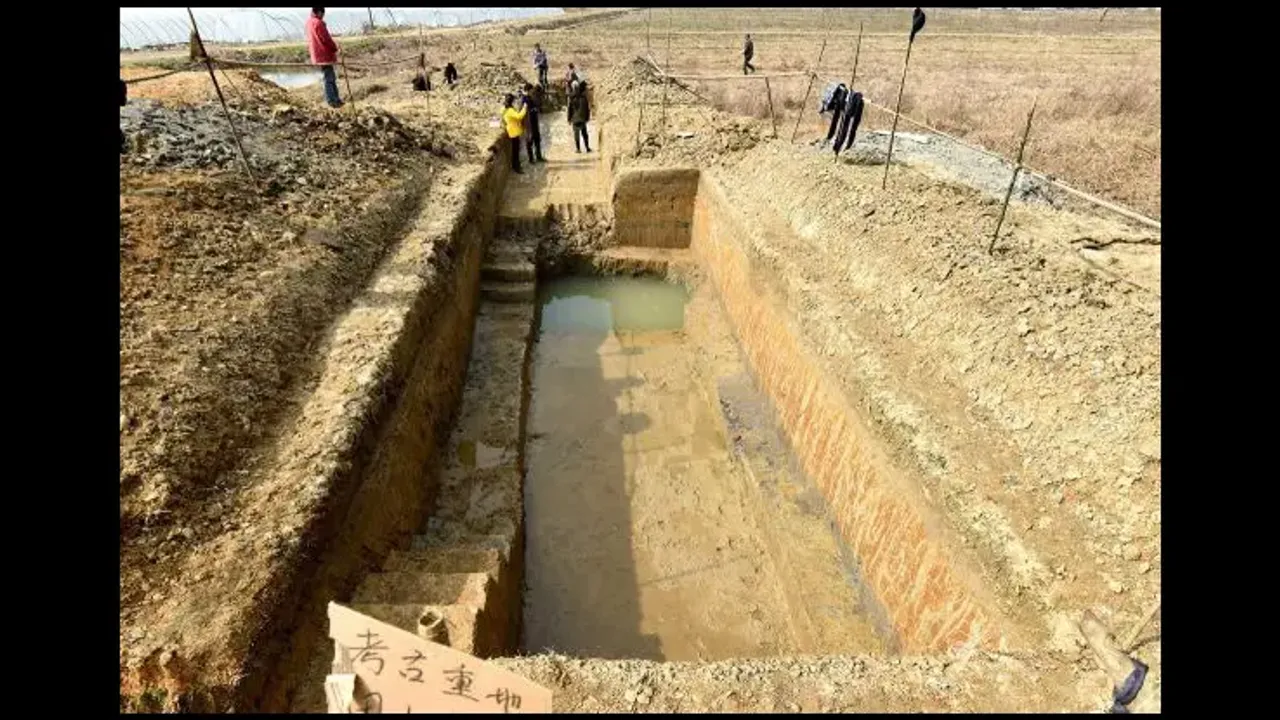
A 4,000-year-old water system discovered in central China is offering one of the clearest pieces of evidence yet that the Xia Dynasty was not a loosely organized early society, but rather a highly coordinated and engineered state with the capacity to design and control its environment on a large scale.
Unearthed at the Wangchenggang site in Henan Province, the system reveals a settlement where water was not simply managed for survival, but deliberately controlled, distributed, and integrated into the broader urban layout in ways that suggest long-term planning.
A Planned System, Not a Primitive Settlement
Archaeologists identified two large artificial ditches, each about three meters wide and extending over 120 meters, running along a strict north–south axis and connecting directly to a moat nearly 10 meters wide, forming a coherent and clearly structured hydraulic network.
According to excavation leader Ma Long, the near-identical form and proportions of the ditches indicate standardized planning and execution, rather than gradual or improvised construction. The sheer scale of the work—requiring the removal of thousands of cubic meters of earth—points to the presence of centralized authority capable of organizing large labor forces and coordinating complex engineering efforts.
This was not a settlement adapting to its environment; it was a settlement actively shaping it.
Engineering That Reached Every Household
The system extended far beyond these main channels, as archaeologists uncovered a network of smaller auxiliary waterways ranging from 0.3 to one meter in width, branching toward buildings and kilns throughout the site and ensuring that water management reached nearly every functional area of the settlement.
These channels enabled the rapid drainage of rainwater and wastewater, helping to maintain stable and dry living conditions while also supporting production areas, suggesting a level of infrastructural integration that connected daily life with broader environmental control.
What emerges is a multi-layered hydraulic system operating simultaneously at both the settlement-wide and individual building levels, reflecting a degree of planning and coordination that is rarely documented for such an early period.
The Signature of Early State Power
For researchers, the importance of the discovery lies not only in its technical sophistication, but in what it reveals about social and political organization.
As noted by Yang Wensheng, a hierarchically structured water system of this scale suggests the presence of a governing authority capable of planning infrastructure, mobilizing labor, and enforcing standardized construction practices across the settlement.
Rather than monumental architecture or written records, it is precisely these kinds of integrated systems that provide the most convincing archaeological evidence for early state formation.
Rewriting the Narrative of the Xia Dynasty
The Xia Dynasty has long occupied an uncertain position between historical tradition and archaeological verification, with debates often centered on the extent to which it represented a fully developed state.
Discoveries such as the Wangchenggang water system are beginning to shift that perspective by providing tangible evidence of organized urban planning, engineered infrastructure, and coordinated labor systems.
Instead of isolated architectural remains, archaeologists are now uncovering interconnected systems that demonstrate how early societies structured space, managed resources, and maintained control over their environments.
A City Defined by Control
Perhaps the most revealing aspect of the discovery is how deeply the water system is embedded within the settlement’s layout, suggesting that it was not added later but conceived as part of the city’s original design.
The channels defined spatial organization, supported economic activity, and protected living conditions, forming a framework that shaped how the settlement functioned on a daily basis.
By 4,000 years ago, communities in central China were already designing settlements with a level of coordination, environmental awareness, and engineering intent that clearly reflects a mature and highly organized society.
And rather than marking the beginning of complexity, this discovery suggests something more striking: by this point in time, complexity was already firmly established.