
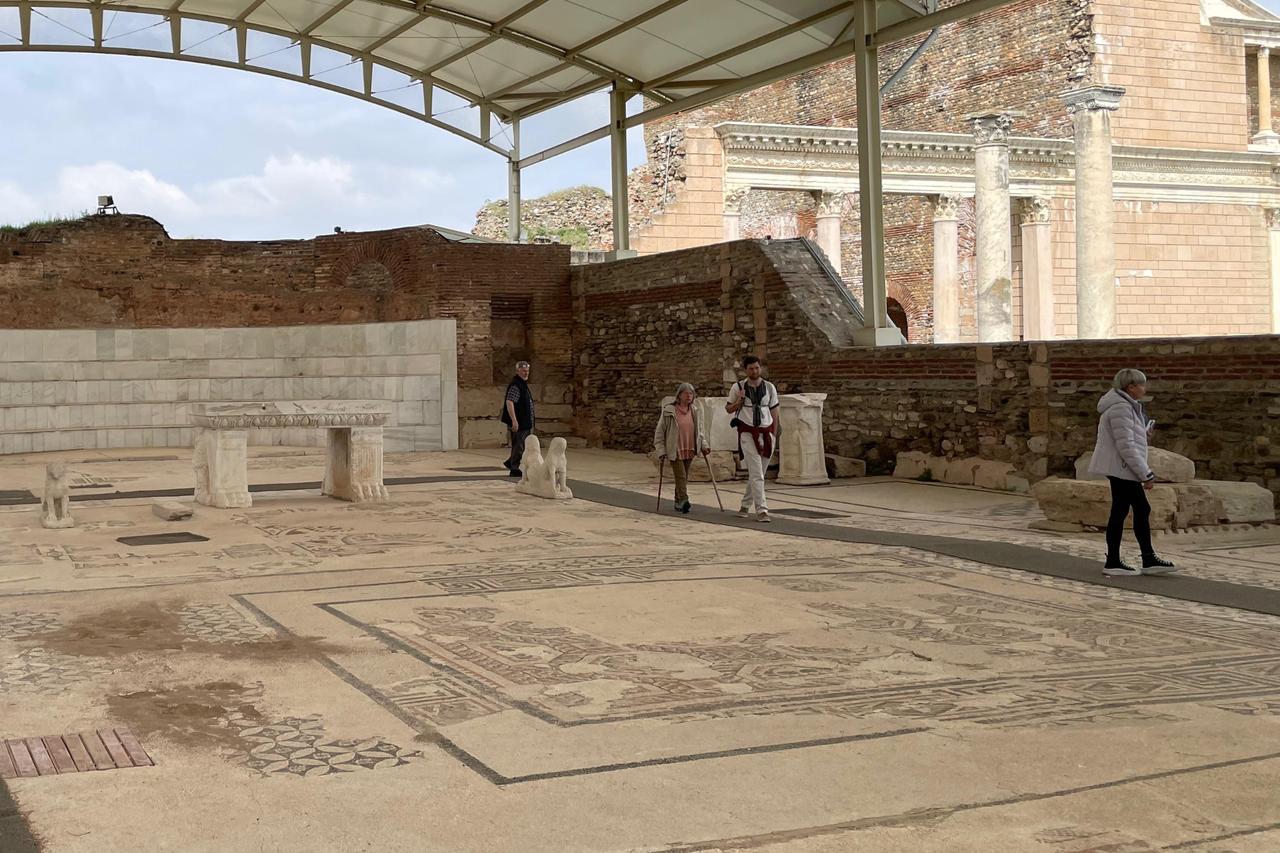
A vast synagogue unearthed in the ancient city of Sardis is offering one of the clearest and most striking insights into Jewish life in the Roman world. Built into a monumental public complex and covered with nearly 1,400 square meters of mosaics, the structure stands among the largest known synagogues of antiquity—and one of the best preserved.
The building, located in western Turkey’s Manisa province, dates primarily to the 4th and 5th centuries A.D. and reflects a community that was not only present, but highly visible within the urban fabric of a major Roman city.
According to archaeologist Bahadır Yıldırım, first assistant director of excavations at Sardis, the synagogue was at the heart of communal life. Speaking from inside the structure in remarks reported by Türkiye Today, he emphasized that the building’s scale, decoration, and layout reveal a well-organized and socially integrated Jewish population during the Late Roman period.
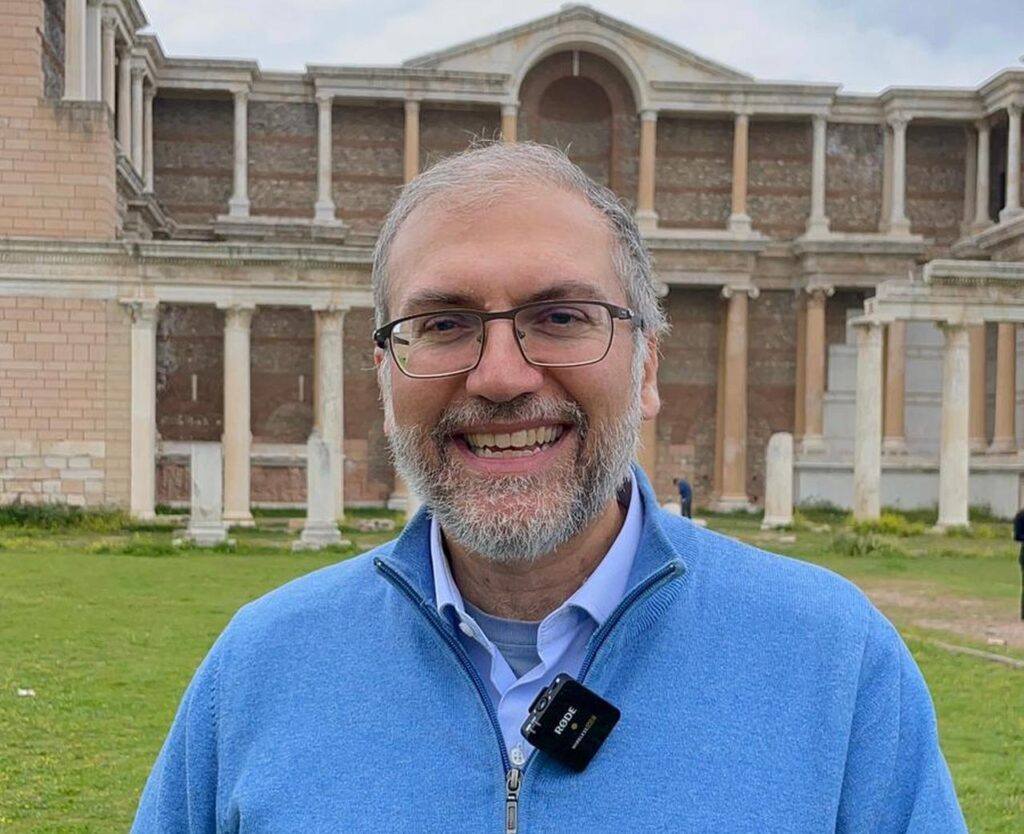
Credit: Koray Erdoğan / Türkiye Today
The Sardis Synagogue Within a Roman Public Complex
Unlike many ancient synagogues, the Sardis example was not built as a standalone structure. Instead, it was integrated directly into the city’s bath-gymnasium complex, one of the most prominent public spaces in Roman Sardis.
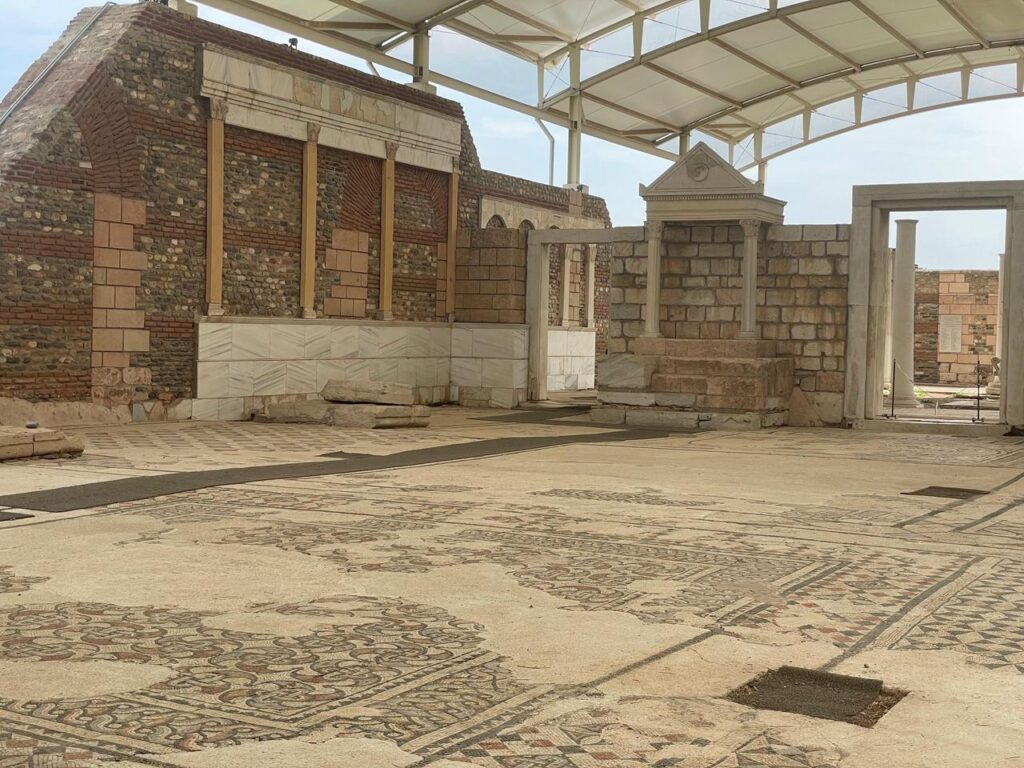
Discovered in 1962, the building quickly drew attention for its unexpected size. Entry was through a colonnaded forecourt, partially roofed but open at its center, before leading into a massive hall stretching more than 50 meters in length. The space could accommodate nearly 1,000 people, pointing to a large and active congregation.
Towering stone piers once supported a roof rising approximately 14 meters above the floor. While that superstructure has not survived, the spatial layout remains clearly legible today. A modern protective covering now shelters the site—not as a reconstruction, but as a safeguard for its most valuable feature: the mosaics.
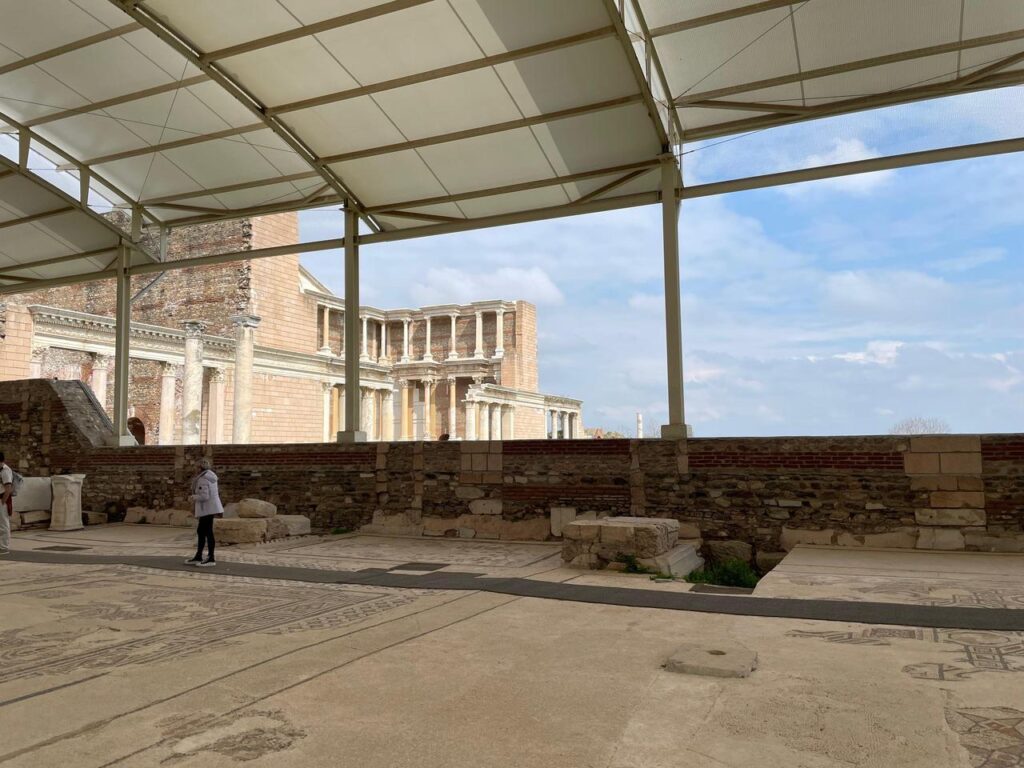
Mosaics and Ritual Features Inside the Ancient Synagogue at Sardis
The synagogue’s interior is dominated by its expansive mosaic floors. Covering roughly 1,400 square meters, they form one of the largest continuous decorative surfaces preserved from any ancient synagogue. Unlike the figural scenes common in Roman art, these mosaics are composed almost entirely of geometric patterns, creating a distinct visual identity.
Near the entrance, archaeologists identified a ritual washing installation, likely used for purification before prayer. At the center of the forecourt stood a large krater-shaped fountain, supplied by clay pipes running beneath the floor—an architectural detail that underscores the building’s ceremonial function.
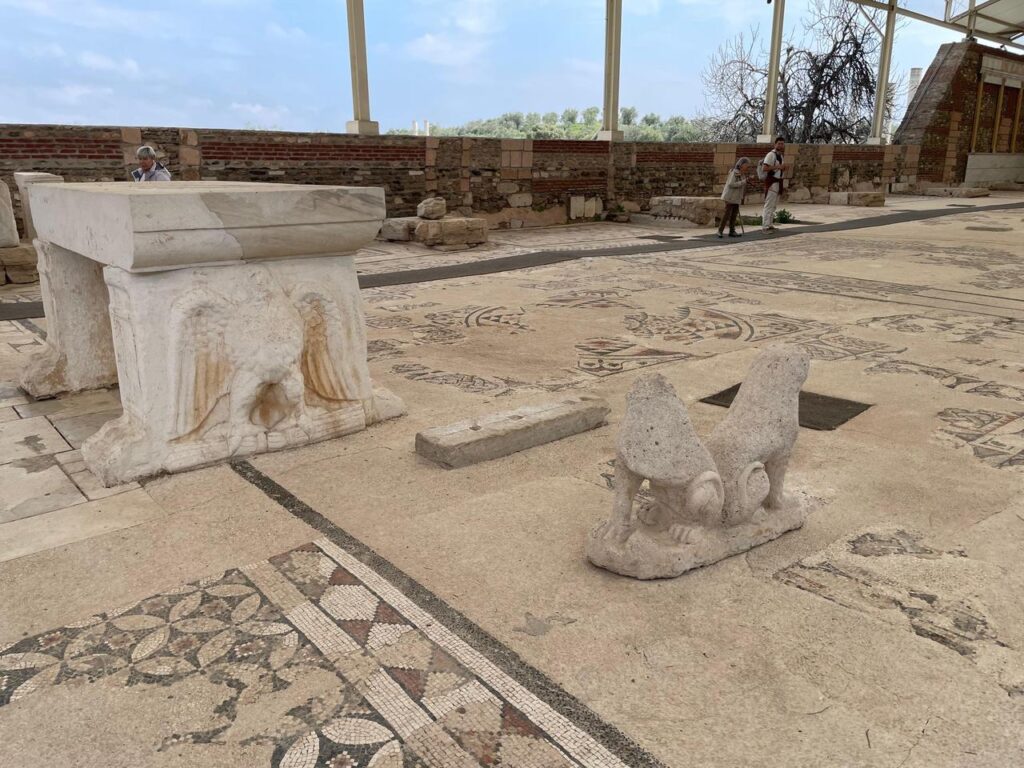
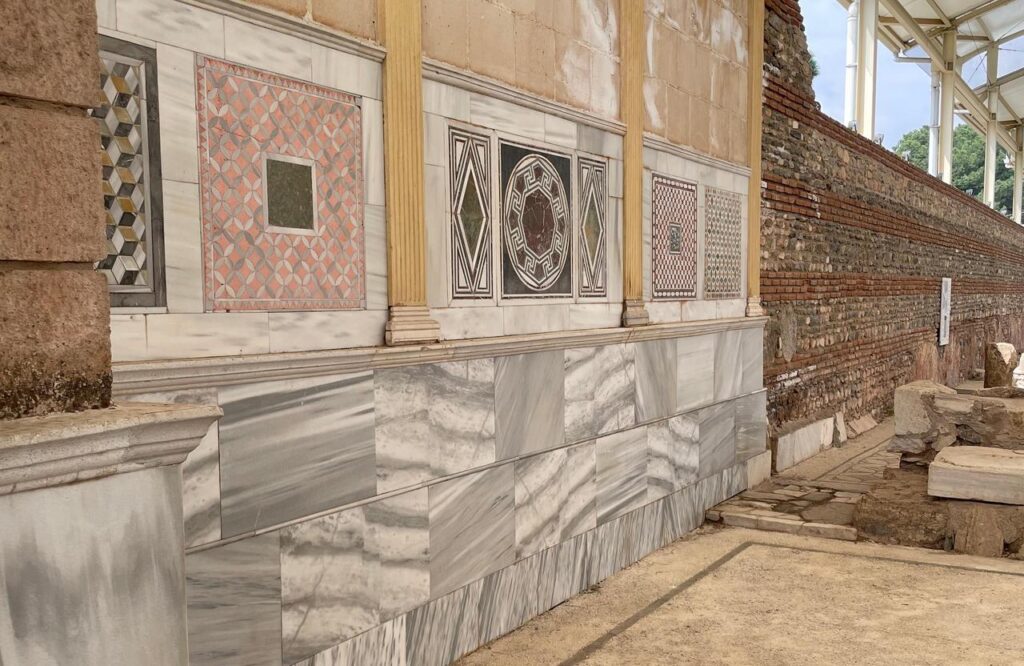
Inside the main hall, marble decoration was added over time, reflecting continued investment across generations. Among the most significant features is a large marble table decorated with lions, believed to have been used during the reading of Torah scrolls brought from shrines positioned at the far end of the hall.
Behind the main space, an apse lined with marble benches may have been reserved for community elders, reinforcing the synagogue’s role not only as a religious center, but as a place of governance and instruction.
Inscriptions reveal status and civic integration
One of the most revealing aspects of the Sardis synagogue is its inscriptions. Written in Greek, they record donations made by members of the local Jewish community—including individuals identified as city councilors and officials.
This detail is crucial. It indicates that the Jewish population of Sardis was not isolated, but actively engaged in the civic life of the city. Their ability to fund such an elaborate building further suggests a level of wealth and influence rarely documented so clearly in the archaeological record.
A mosaic inscription within the hall refers to a figure described as a “priest and teacher of wisdom,” offering a rare glimpse into the intellectual and religious leadership within the community.
Excavation, restoration, and renewed protection
Following its discovery in the 1960s, the synagogue underwent an extensive conservation effort. Mosaics were carefully lifted, reinforced with concrete backing, and then reinstalled. Architectural elements—including walls, columns, and decorative features—were partially reconstructed to help convey the building’s original appearance.
This initial restoration was completed in 1973, but exposure to weather over the following decades led to new deterioration. In response, a lightweight protective shelter was installed in 2021 with official approval, ensuring both preservation and continued research.
Yıldırım noted that conservation work is ongoing, carried out section by section, with the primary goal of protecting the mosaic floors that define the monument.
Sardis and the broader historical context
The synagogue’s story cannot be separated from that of Sardis itself. Once the capital of the Lydian Kingdom, the city remained a major center under Persian, Hellenistic, and Roman rule. It is also known as one of the Seven Churches of Asia, highlighting its importance in early Christianity.
Yet the synagogue adds another layer to this history. It demonstrates that Sardis was also home to a thriving Jewish community whose presence was both architecturally visible and socially embedded within the city.
Abandoned after an earthquake in the early 7th century A.D., the building survives today as a rare space where visitors can still walk across original mosaic floors within an ancient place of worship.
Cover Image: A broad view of the Sardis synagogue’s main hall, sheltered by a modern protective roof, with visitors walking over its ancient mosaic floors in Salihli, Manisa. Credit: Koray Erdoğan / Türkiye Today