
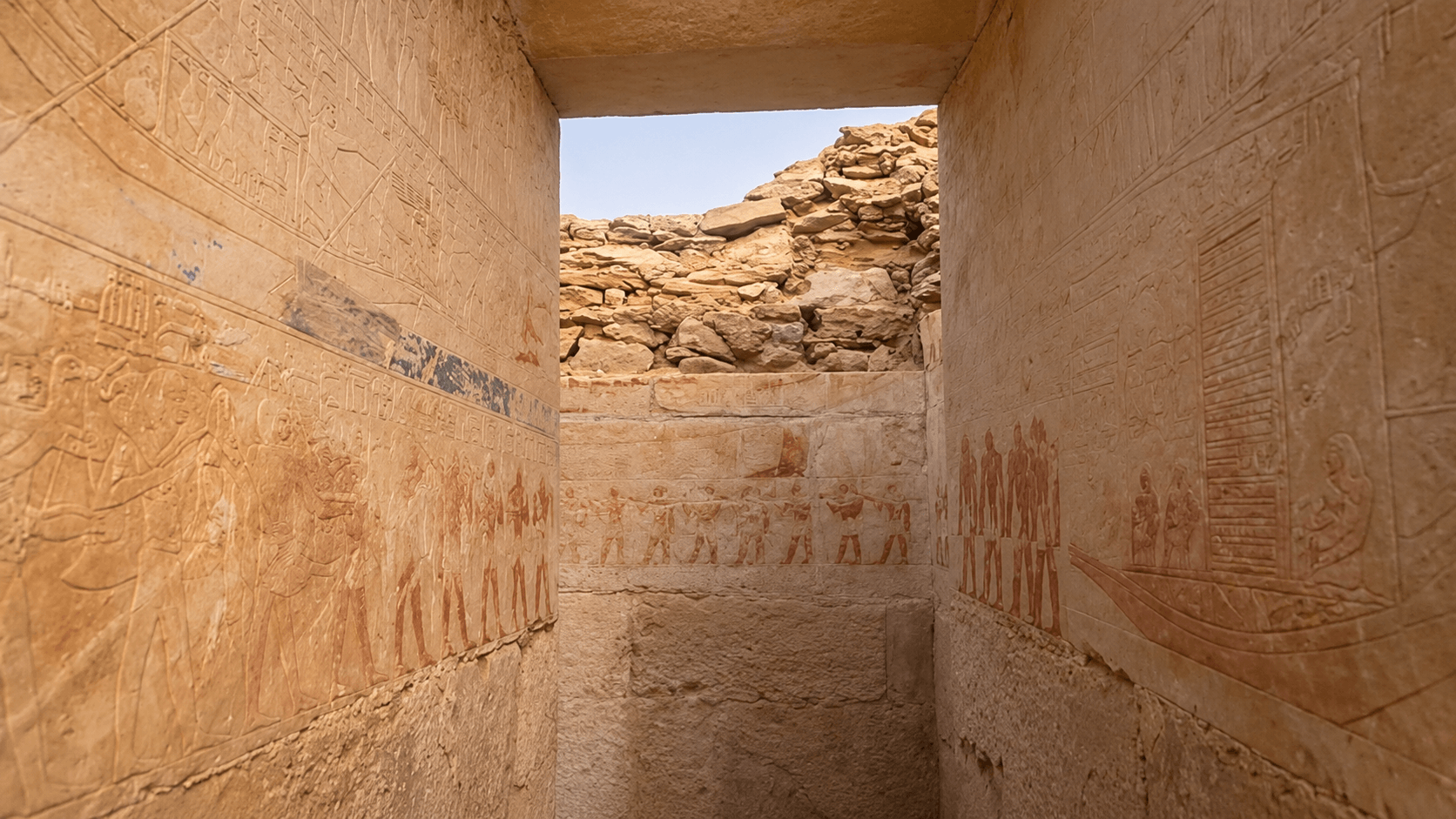
A 4,300-year-old Saqqara tomb has brought the careers of two Egyptian officials back into view. One managed agricultural records and offerings; the other rose to become a judge responsible for courts, petitions and complaints.
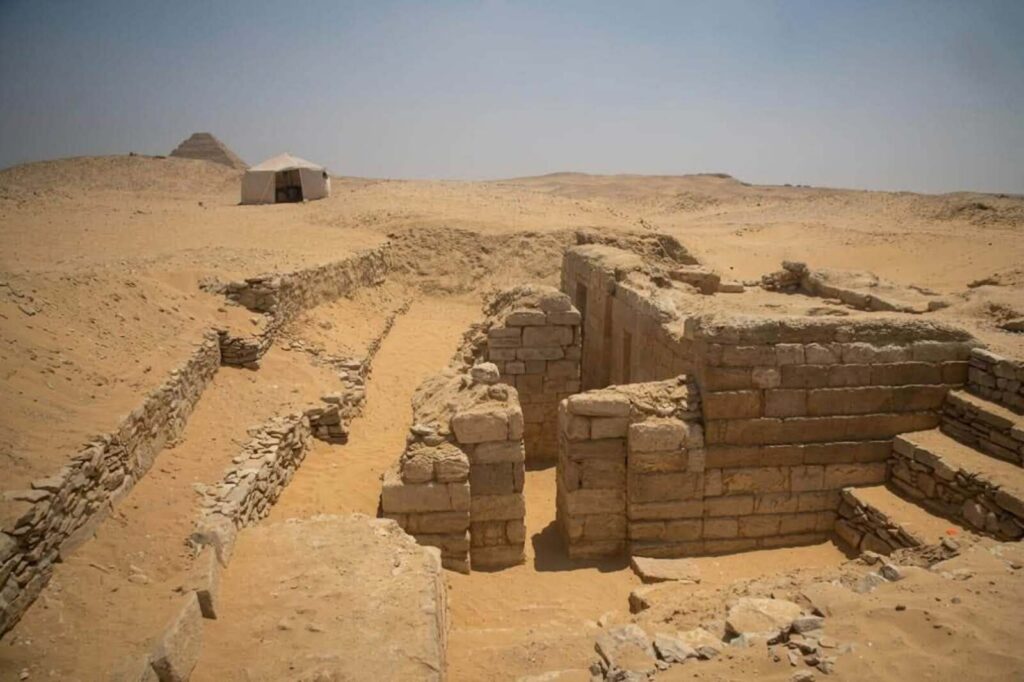
The adjoining funerary chapels belonged to Yunmin and his father, Iti, who served the Egyptian state during the late Fifth Dynasty. Their shared mastaba was excavated by a joint Spanish-Egyptian archaeological mission during its 2026 season in the Mariette Necropolis of northern Saqqara.
The mastaba dates to the reign of Djedkare Isesi. Rather than presenting only the wealth or status of its occupants, its inscriptions and decoration preserve an unusually personal record of how public office connected two generations of the same family.
Two careers preserved inside one mastaba
The mastaba contains two funerary chapels opening from its eastern wall. The larger and more elaborately decorated northern chapel was created for Yunmin, while the southern chapel belonged to his father.
Inscriptions identify Yunmin as a judge, director of the court and head of the scribes who examined petitions and complaints. These titles place him within a system that depended on written records to process disputes, requests and decisions.
His father, Iti, followed a different administrative path. He held scribal positions associated with agricultural land and offerings—two areas essential to the management of estates and the continued operation of funerary and religious institutions.
The contrast between their careers gives the tomb much of its significance. Yunmin’s titles point toward courts and formal petitions, while Iti’s work was connected with land, produce and the movement of offerings. Their chapels show two distinct sides of Old Kingdom administration preserved within a single family monument.
Agricultural scenes still carry their original colors
Yunmin’s chapel contains a carefully constructed architectural façade inscribed with funerary texts and an offering formula. A formal representation of the official was also placed within the decorated space, ensuring that his name, appearance and titles remained connected.
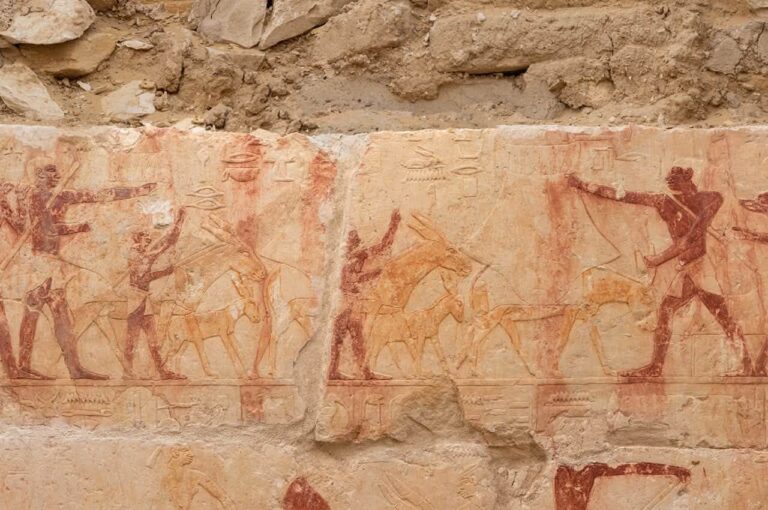
High-quality reliefs cover the walls with scenes of agricultural activity and processions carrying provisions toward the tomb. Many still retain traces of their original colors, allowing details of clothing, produce and movement to survive alongside the carved outlines.
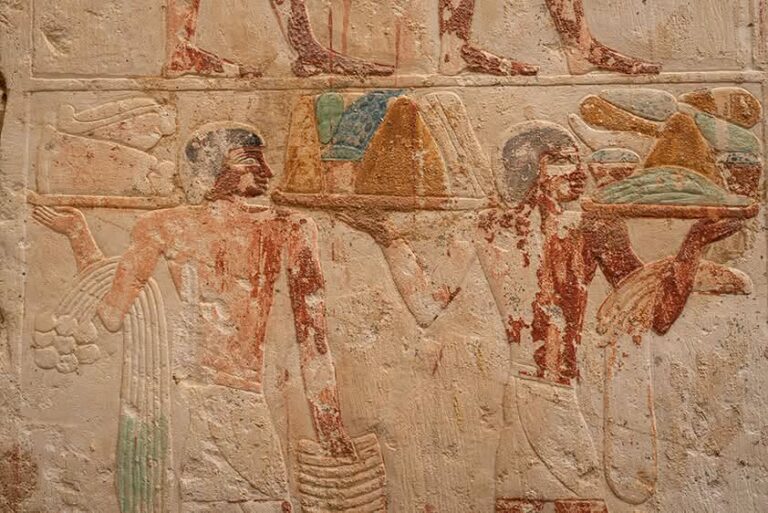
These images were not included simply to illustrate rural life. Agricultural abundance was central to Egyptian funerary belief, and depictions of food production and offering bearers were intended to provide lasting sustenance for the deceased.
The scenes also reflected the economic foundations of the society in which Yunmin and Iti worked. Courts, scribes, estates and funerary cults all depended on agricultural production, making the decoration closely connected with the professional world recorded in their titles.
A symbolic doorway in Iti’s chapel
The southern chapel is less completely preserved, but its surviving decoration includes colored offering scenes and a false door. Much of the original wall ornament has been lost, yet the remaining elements confirm that Iti received a distinct commemorative space beside his son.
False doors were designed as symbolic points of passage rather than functioning entrances. Ancient Egyptians believed that the spirit of the deceased could approach this threshold to receive food, drink and ritual offerings presented by the living. A similar feature was recently found in the Old Kingdom tomb of Sekhentiu-Ptah at Saqqara, where the false door remained in its original position.
Its presence in Iti’s chapel reinforces the close relationship between the architecture and the offering scenes around it. The space was constructed not merely as a memorial but as a place where contact between the living and the dead could continue through repeated ritual acts.
Known to Mariette but never fully investigated
The mastaba’s location was not entirely unknown before the 2026 excavation. French archaeologist Auguste Mariette, whose work helped define the archaeology of Saqqara during the 19th century, had already recorded its presence.
However, the monument had not previously been subjected to comprehensive excavation and scientific documentation. The new investigation allowed archaeologists to establish its layout, examine the inscriptions and record the surviving decoration systematically.
That distinction makes the project more than the announcement of another ancient structure at Saqqara. It demonstrates how monuments noted during early archaeological exploration can still preserve substantial evidence when they are revisited using modern methods.
One family within the Old Kingdom administration
The excavation forms part of a joint research project between the Autonomous University of Barcelona and Egypt’s Supreme Council of Antiquities. The mission is directed by Egyptologist Josep Cervelló Autuori.
Scientific documentation of both chapels has been completed, accompanied by conservation and restoration work intended to protect the architecture, inscriptions and colored reliefs exposed during excavation.
What survives inside the mastaba is more than a list of official titles. Yunmin and Iti emerge as members of the same family whose working lives touched different parts of the Egyptian state: judicial administration, written petitions, agricultural land and the supply of offerings.
Their shared tomb transformed those careers into a permanent family record. More than 4,300 years later, its adjoining chapels reveal how authority, professional identity and remembrance were carried from one generation to the next in Old Kingdom Egypt.
Cover Image: The newly excavated mastaba of Yunmin and Iti at northern Saqqara contains two funerary chapels decorated with inscriptions and colored reliefs. Credit: Egyptian Ministry of Tourism and Antiquities