
An exceptionally preserved Early Bronze Age pithos burial has been uncovered in eastern Attica, revealing complex funerary architecture and long-lived ritual activity along the coast of the Aegean. The discovery was made during rescue excavations carried out since 2024 in the town of Rafina, ahead of riverbank stabilization works.
Dated to the Early Bronze Age (ca. 3200–2000 BC), the burial belongs to a formative era when social identities and mortuary traditions across the Aegean were becoming increasingly diverse. According to an official announcement by the Ministry of Culture, the pithos was deliberately placed in a pit cut into the clay soil on the southern bank of a stream—an intentional and carefully planned act rather than a simple deposition.
A monumental pithos transformed into funerary architecture
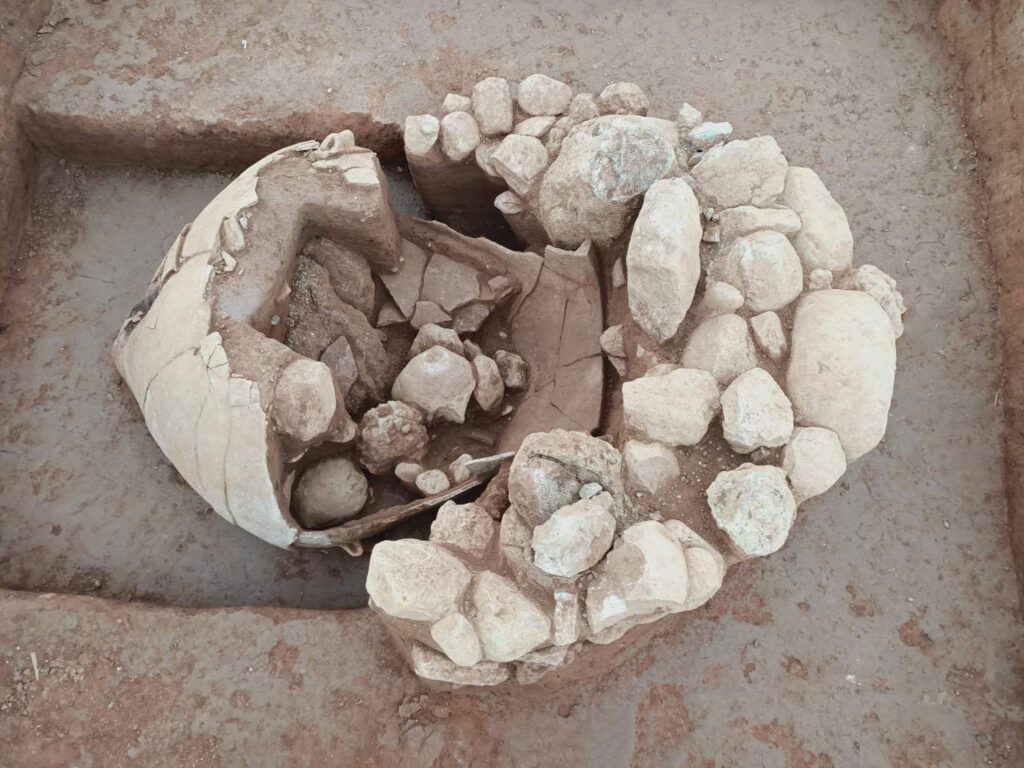
The ceramic vessel itself is striking in scale and execution. Standing 1.74 meters high, the pithos features horizontal handles at its widest point and a rope-like relief decoration encircling the neck and handles, a characteristic motif of Early Bronze Age pottery in Attica. The mouth of the vessel was sealed by a robust semicircular wall built of river pebbles, while two large stones, reinforced with slab-like elements, created a pseudo-doorway complete with jambs and a threshold, transforming the burial into a small architectural monument.
Two individuals and a carefully selected assemblage of grave goods
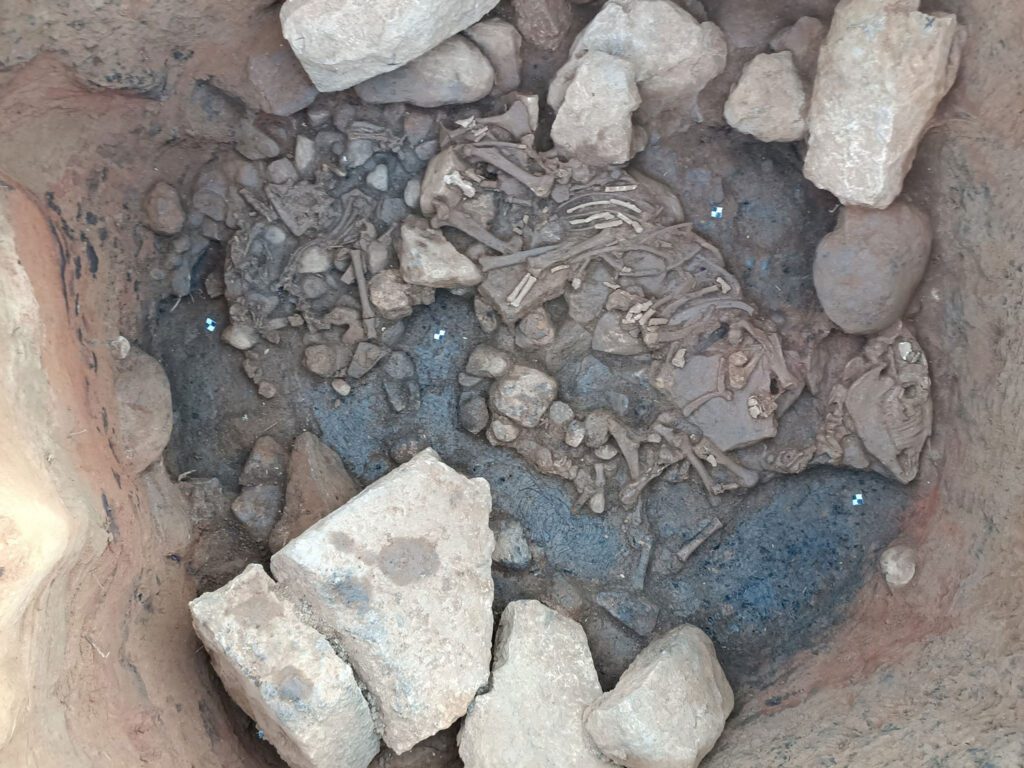
Inside, archaeologists uncovered the skeletal remains of two individuals, laid on a prepared layer of sand and pebbles. Large stones covered the bones and filled nearly the entire interior space. The grave goods—a bronze tweezer, obsidian points, pottery vessels, and an oval slab-like stone interpreted as a small “table”—underscore the care invested in the burial and the social value attributed to the deceased.
An isolated burial within a diverse funerary landscape
What makes the Rafina find particularly notable is its isolated character. While organized Early Bronze Age cemeteries are known from nearby locations such as Tsepi and Mati in Marathon, Agios Kosmas in Elliniko, and Asteria in Glyfada, this solitary pithos burial points to alternative funerary choices within the same cultural landscape. Its form and ritual treatment also suggest Cycladic and eastern Aegean influences, highlighting Attica’s role as a crossroads rather than a peripheral zone during the third millennium BC.
The funerary context is further enriched by a second archaeological feature discovered approximately two meters southeast of the pithos. There, a large circular pit showed evidence of long-term use and repeated burning. In its upper layers, archaeologists identified a bucranium—an architectural element shaped like an ox skull—alongside pottery and bronze coins dating to historical periods. Near the bottom, within a thick burnt layer, lay the skeleton of an equid accompanied by the bones of smaller animals.
Revisiting Rafina’s prehistoric communities
This layered sequence suggests that the area retained ritual significance over an extended span of time, long after the Early Bronze Age burial had been sealed. Ongoing archaeological, zooarchaeological, and natural science analyses are expected to clarify whether animal sacrifice was practiced at the site and how its symbolic meaning evolved through successive periods.
The discovery also revisits a landscape explored decades earlier. More than seventy-five years ago, Greek archaeologist Dimitrios Theocharis documented Early Bronze Age settlements near Rafina’s ancient harbor and on the Asketario peninsula. The newly uncovered burial and ritual pit now add a crucial mortuary and symbolic dimension to that picture, offering fresh insight into social organization, memory, and beliefs about death among prehistoric communities along the Attic coast.
Cover Image Credit: Greek Ministry of Culture and Sports