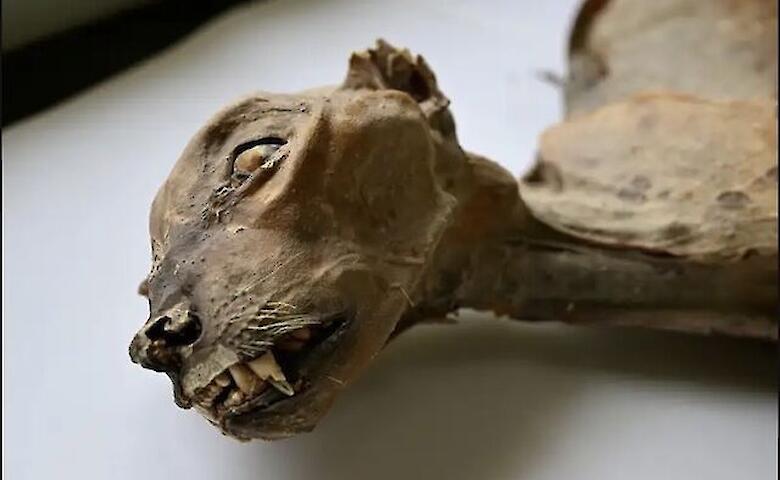
Deep beneath the desert plateaus of northern Saudi Arabia, scientists have uncovered a discovery that feels almost implausible at first glance: naturally mummified cheetahs, preserved for millennia inside dry limestone caves. The find offers a rare, almost intimate glimpse into a vanished ecosystem—one in which apex predators once thrived where today only silence remains.
The discovery, recently published in Communications Earth & Environment, represents one of the most extraordinary records of large carnivores ever recovered from an arid environment. It also opens an unexpected window into the deep genetic history of cheetahs in the Arabian Peninsula.
A hidden archive beneath the desert
The mummified remains were identified inside a cave system near Arar, close to the country’s northern frontier. Within these chambers, researchers documented the mummified bodies of seven cheetahs, alongside skeletal remains belonging to at least 54 additional individuals.
Radiocarbon dating revealed an astonishing time depth. Some of the animals lived as recently as the late 19th century, while others died more than 4,000 years ago. Taken together, the remains span thousands of years—suggesting that cheetahs used these caves repeatedly across generations.
Such preservation is almost unheard of for large carnivores. The caves’ microclimate—extreme dryness, stable temperatures, and consistently low humidity—slowed decomposition to a near standstill. In effect, the caves acted as natural vaults, protecting not only bones but also skin, soft tissue, and even facial features.
Not victims, but residents
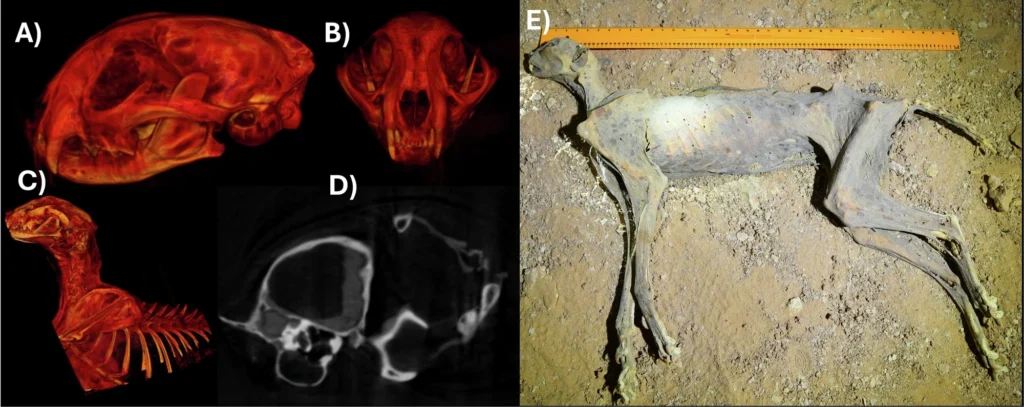
The cheetahs’ appearance is striking. Clouded eyes, desiccated skin, and shrunken limbs give the bodies an almost sculptural quality, as if time itself paused around them. Crucially, the remains show little evidence of scavenging, a key factor in their survival.
Radiographic analysis of skulls revealed a mix of cubs, juveniles, and adults. This age distribution, combined with the sheer number of cheetahs relative to prey species, strongly suggests that the caves were not hunting traps or accidental death sites. Instead, researchers argue they functioned as dens—likely used by females to give birth and raise cubs over long periods.
If correct, the caves were not merely shelters, but integral parts of cheetah life cycles in Arabia.
Ancient DNA rewrites cheetah history
Perhaps the most consequential breakthrough came from genetics. For the first time, scientists successfully extracted and sequenced DNA from naturally mummified big cats—a feat long thought to be nearly impossible.
The results were unexpected. The youngest cheetah mummy showed its closest genetic affinity to the Asiatic cheetah, now reduced to a critically endangered population in Iran. Older remains, however, were genetically closer to the Northwest African cheetah—one of the rarest and most threatened cheetah lineages on Earth.
This pattern overturns a long-standing assumption that Arabia was once inhabited exclusively by Asiatic cheetahs. Instead, the peninsula appears to have been a genetic crossroads, where multiple cheetah lineages overlapped across millennia.
From extinction to possibility
Cheetahs once ranged across Africa, the Middle East, and much of Asia. Today, they occupy roughly nine percent of their historic range. In Saudi Arabia, they disappeared decades ago—victims of habitat loss, declining prey, hunting, and escalating human-wildlife conflict.
Yet the timing of this discovery is significant. In recent years, Saudi Arabia has launched large-scale ecological restoration efforts, reintroducing native species such as the Arabian oryx, gazelles, and Nubian ibex. As prey populations recover and protected landscapes expand, conservationists have begun cautiously discussing the return of apex predators.
Here, the cave cheetahs become more than a scientific curiosity. Their DNA provides a concrete, evidence-based framework for deciding which modern cheetah populations might be ecologically and genetically appropriate for any future reintroduction.
Caves as forgotten libraries of life
Beyond cheetahs, the study points to a broader implication. Caves in arid regions may preserve entire chapters of lost biodiversity—silent records of ecosystems that vanished long before written history. In landscapes where traditional archaeological or ecological data are scarce, such natural archives can redefine conservation baselines.
Frozen beneath the desert, the mummified cheetahs tell a story of endurance, disappearance, and potential return. They remind us that restoration is not an abstract idea, but a dialogue between past and future—one in which ancient evidence can still shape modern choices.
In that sense, Saudi Arabia’s cave cheetahs are not only remnants of extinction. They are messengers, carrying genetic and ecological memory forward, at a moment when the question is no longer what once lived here—but what might again.
Boug, A.A., Mir, Z.R., Jbour, S. et al. Mummified cave cheetahs inform rewilding actions in Saudi Arabia. Commun Earth Environ 7, 24 (2026). https://doi.org/10.1038/s43247-025-03021-6
Cover Image Credit: Boug, A.A (2026), Commun Earth Environ