
An Anglo-Saxon church hidden beneath the floor of St Cuthbert’s in Darlington has come to light during restoration work, revealing a previously unknown phase of early medieval worship in England.
Restoration Work Uncovers Earlier Structure
The discovery emerged during a £2.5 million renovation project aimed at improving accessibility داخل the historic church. As workers removed the Victorian flooring, archaeologists identified wall remains that did not correspond to the layout of the current building.
Excavations were carried out by The Archaeological Practice of Newcastle (APN), working closely with the church authorities and construction teams. From the outset, the focus remained on careful documentation and preservation, ensuring that the newly uncovered remains were not disturbed.
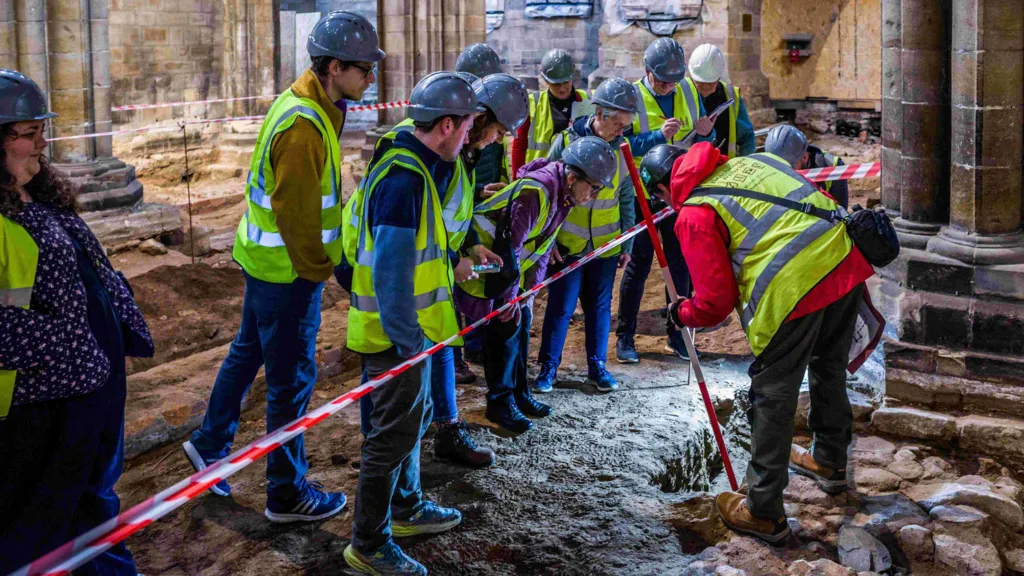
A Church Built After the Norman Conquest
Initial findings suggest that the structure belongs to an Anglo-Saxon church dating to the late 11th century, likely constructed shortly after the Norman Conquest of 1066. The walls are thought to date to around 1080, placing them within a critical period of transition in English history.
This was a time when religious institutions were being reorganized, and the Darlington site may reflect how local communities adapted to the shifting political and cultural landscape.
At the same time, earlier activity cannot be ruled out. Previously discovered sculptural fragments from the 10th and 11th centuries indicate that religious use of the site may extend even further back into the Anglo-Saxon period.
Structural Details Reveal Reuse and Adaptation
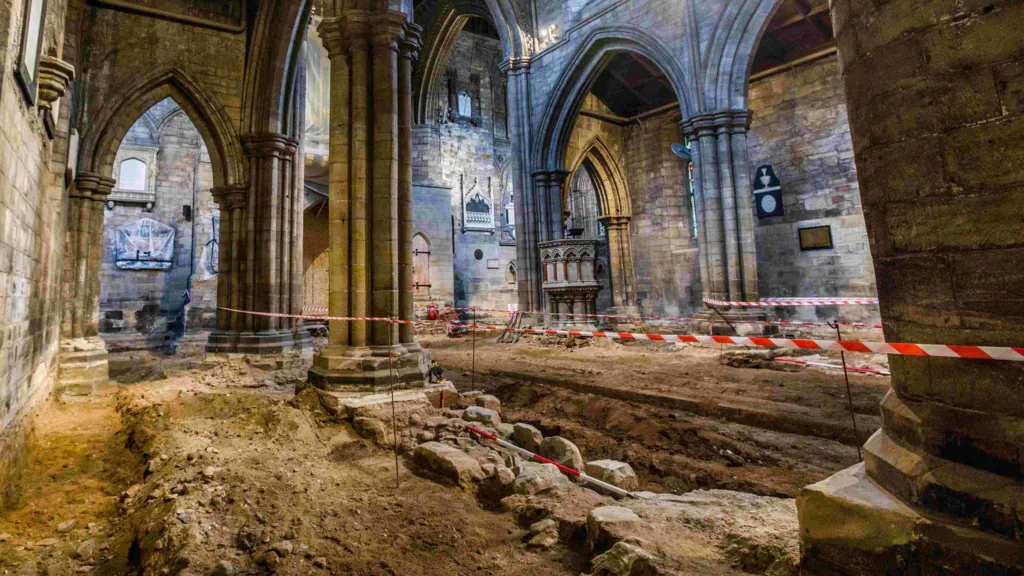
The uncovered walls measure approximately 1.2 meters in width and are constructed using roughly worked facing stones with a rubble core—typical of early medieval building techniques. The foundations are primarily composed of cobbles, providing a stable base.
One of the most striking observations is that these walls are slightly misaligned with the later Norman columns above. This detail suggests that the existing church was not built independently, but instead incorporated the earlier structure, reusing its walls as foundational elements.
While no clear traces of the eastern end have been identified, there are indications of western wall remains that may point to a tower structure associated with the earlier church.
Digital Preservation and Public Access
The excavation area has been recorded using advanced 3D imaging techniques, allowing researchers to document the site in detail and revise architectural plans accordingly.
When restoration is complete, these digital models and visual reconstructions will be made available داخل the church, offering visitors a direct view into its earlier architectural phases.
Cover Image Credit: Stuart Boulton Photography