
Nearly two millennia after the eruption of Mount Vesuvius, Pompeii continues to reveal intimate details of Roman life. This time, the evidence comes not from grand buildings or frescoes, but from something far more subtle: the ash preserved inside household incense burners.
A new scientific study has identified what Romans actually burned in their homes, uncovering a surprising mix of local materials and imported luxury substances.
Ash That Preserved a Ritual World
At the center of the research are two small ceramic incense burners recovered from Pompeii and a nearby rural villa. When Vesuvius erupted in AD 79, the ash and heat sealed their contents, preserving them with unusual precision.
What remained inside was not simple residue, but a chemical record of ritual activity.
Using advanced biomolecular methods, researchers examined microscopic plant remains and organic compounds trapped within the ash. For the first time, it became possible to reconstruct the substances used in everyday religious practices.
Local Plants Meet Global Trade
The results reveal a layered pattern of ritual behavior.
Pompeian households burned locally available materials such as wood, grasses, and possibly laurel or fruit tree remains. These substances likely formed the base of daily offerings.
More striking, however, was the presence of aromatic resins from the Burseraceae family, chemically similar to frankincense and elemi. These materials do not originate in Italy and were most likely imported from tropical regions of Africa or Asia.
This finding provides the first direct archaeological evidence that imported incense was used in Pompeian domestic cult practices.
A City Connected Far Beyond Italy
The implications go beyond ritual.
The presence of these resins shows that Pompeii was deeply integrated into long-distance trade networks. Goods such as incense and spices moved across routes linking India, Arabia, sub-Saharan Africa, and the Mediterranean before reaching Italy.
What makes this evidence particularly compelling is its context. These materials were not limited to elite environments. They appear within a household shrine, suggesting that global trade shaped even the most personal aspects of daily life.
Wine, Smoke, and Daily Devotion
In one of the censers, researchers identified chemical traces consistent with grape-derived substances, likely wine.
This supports historical accounts describing rituals in which incense burning was combined with liquid offerings. Until now, such practices were primarily known from texts. Here, they are directly confirmed through material evidence.
Within Roman homes, these rituals took place at shrines known as lararia, where families honored protective deities such as the Lares and Penates. The combination of smoke and liquid offerings formed a recurring part of domestic religious life.

Reconstructing the Senses of the Past
The study also highlights the growing importance of sensory archaeology.
By using techniques such as gas chromatography and microscopic analysis, researchers were able to detect molecular traces invisible to the naked eye. These methods reveal not only what was burned, but how ritual may have been experienced.
The smell of resin, the presence of smoke, and the use of wine all contributed to a sensory environment that shaped daily religious practice.
More Than Objects: A Glimpse Into Roman Life
The censers themselves add further context.
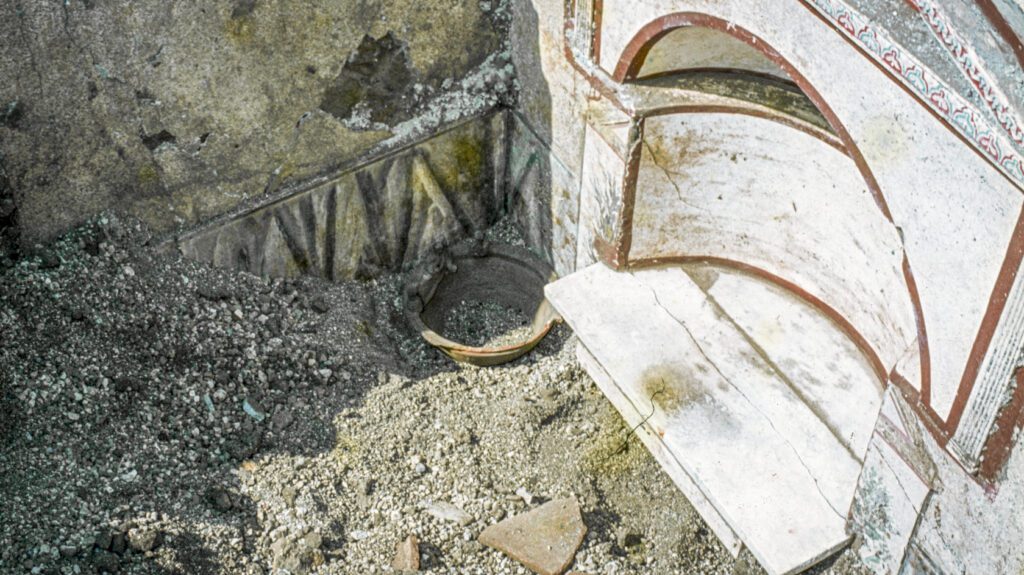
One was discovered in a rural villa alongside objects associated with ancestor veneration. The other came from a building undergoing renovation at the time of the eruption, suggesting that ritual practices continued even during periods of change.
These findings point to a consistent reality. Roman religion was not confined to temples or public ceremonies. It was embedded in everyday life, repeated through small but meaningful acts within the household.
Eber J, Gur-Arieh S, Power RC, Rageot M, Stockhammer PW. Ashes from Pompeii: incense burners, residue analyses, and domestic cult practices. Antiquity. Published online 2026:1-20. doi:10.15184/aqy.2026.10320
Cover Image Credit: Terracotta incense burner with the investigated ash residues. The rim is adorned with three female figures, probably depicting deceased persons who were venerated after their death. (Image: Parco Archeologico di Pompeii. Fotograf: Johannes Eber). Credit: Eber J, 2026, Antiquity