
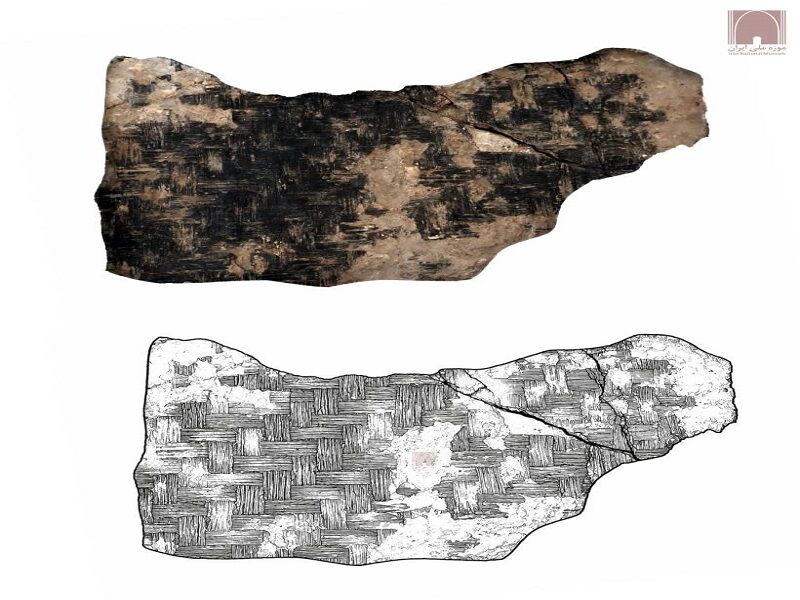
A 9,000-year-old reed mat from Ali Kosh in western Iran preserves direct evidence of how one of the region’s earliest village communities prepared the floors of its mudbrick homes.
The fragment, now held by the National Museum of Iran, measures only 13.5 by 22 centimeters. Its surface retains a regular woven pattern, while traces beneath it show that the mat was laid over natural bitumen, a material used to protect interior spaces from ground moisture.
The object was excavated during archaeological campaigns carried out at Ali Kosh in 1961 and 1963. Although it is not a new discovery, the fragment remains an unusually rare survival from a period when organic materials such as reeds, fibres and woven floor coverings usually decayed without leaving a visible trace.
Neolithic families used reeds and bitumen
Ali Kosh lies on the Deh Luran Plain near the foothills of the Zagros Mountains. The surrounding rivers and wetlands supplied reeds that could be gathered and woven, while natural bitumen was available in the wider region.
Before placing the mat, the inhabitants levelled the floors of their houses with compacted earth and covered them with a thin layer of greenish clay. Bitumen was then spread beneath the woven reeds, helping to limit moisture entering the living space from below.
The surviving fragment was made using a “two over, two under” weaving technique. Its regular structure shows that mat production followed a practiced method rather than a simple arrangement of loose reeds.
These floor coverings would have formed part of ordinary domestic life. People sat, slept, prepared food and carried out daily tasks on surfaces made from materials collected close to the settlement.
The combination of clay, bitumen and woven reeds also demonstrates that Ali Kosh’s inhabitants understood the properties of the materials around them. Their houses were built from mudbrick and carefully plastered, while their floors were prepared in several stages.
Similar mats were used in burials
Archaeological evidence from Ali Kosh shows that reed matting was not limited to house floors.
Some individuals were placed in a contracted position, wrapped in similar woven mats and buried beneath the floors of residential buildings. The practice is known from several early farming communities in Southwest Asia, where the dead were often interred within or close to domestic spaces.
The surviving floor fragment does not itself prove the burial custom. Instead, it belongs to the same wider tradition of reed working documented elsewhere at the site.
This distinction is important. The object directly records how floors were covered, while the burials show that similar woven materials also played a role in funerary practices.
Ali Kosh and the rise of settled village life
Ali Kosh was first investigated by archaeologists Frank Hole and Kent Flannery. Excavations identified three principal occupation phases known as Boz Mordeh, Ali Kosh and Mohammad Jaffar.
Recent reassessments place activity at the settlement at approximately 7500 to 6500 BC. During this period, communities on the Deh Luran Plain were becoming increasingly settled and more dependent on herding.
The inhabitants kept sheep and fully domesticated goats, while continuing to use wild plants and other local resources. Obsidian marine shells and stone beads found at the settlement also show that Ali Kosh was connected to exchange networks extending well beyond the plain.
The reed mat belongs to this transition. Unlike stone tools, pottery or mudbrick walls, woven plant materials rarely survive. The fragment therefore preserves a part of Neolithic life that is usually missing from archaeological sites.
It shows not only how people built their houses, but also how they finished and maintained the spaces inside them.
From reed mats to Safavid carpets
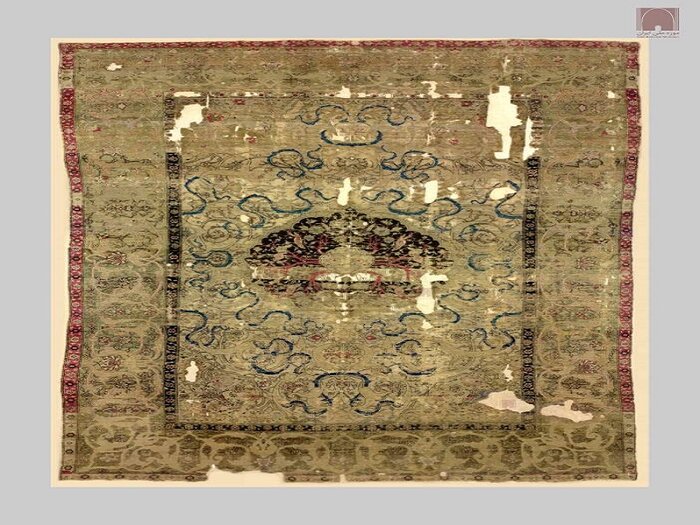
The National Museum of Iran also holds a Safavid-period carpet from Tabriz that offers a much later comparison.
Measuring 213 by 158 centimeters, the carpet was woven with silk warp and weft. Its decoration includes a central medallion, birds, animals, flowers and cloud motifs, while gold and silver brocade threads were incorporated into the pile.
The two objects were produced almost nine millennia apart.
The Ali Kosh mat was made from reeds and laid over bitumen in a Neolithic mudbrick house. The Safavid carpet was woven from silk and precious metal threads for a very different social setting.
Together, they trace the long history of floor coverings in Iran, from practical woven mats made by early village communities to the highly specialized carpets produced in the workshops of the Safavid period.
Cover Image: The 9,000-year-old reed mat fragment from Ali Kosh, shown above with a detailed reconstruction of its woven pattern below. Credit: National Museum of Iran.
IRNA