
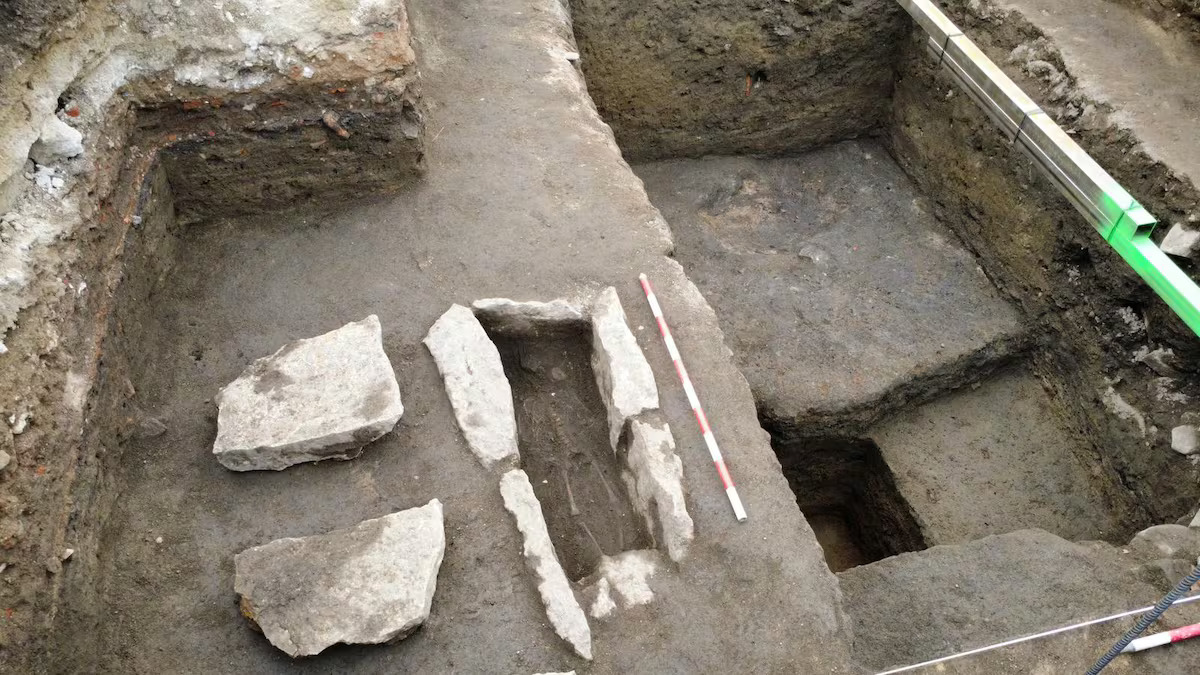
An intact grave containing the remains of a very young child has been uncovered directly outside one of the principal entrances to the historic city of Ávila in central Spain.
The child, believed to have been approximately 18 months old, was buried alone and carefully aligned with the entrance now marked by the monumental San Vicente Gate. The unusual location has prompted archaeologists to consider whether the burial was connected with protective beliefs associated with city gates and boundaries in the Roman world.
Researchers have emphasized, however, that there is currently no evidence that the child was sacrificed or died violently.
A solitary burial on the entrance axis
The grave was discovered during public works around Avenida de Portugal, the San Vicente roundabout and Calle Humilladero, immediately outside Ávila’s famous walled center.
According to the Ávila City Council, the burial was found within an undisturbed archaeological sequence containing remains dating back to the Roman settlement established at the site in the first century AD.
The child’s skeleton was preserved inside an intact grave covered with stone slabs. No other contemporary burials were identified immediately beside it.
Municipal archaeologist Rosa Ruiz noted that the grave’s solitary position and precise alignment with the entrance made it particularly unusual. Rather than being placed within an organized cemetery, the child appears to have been deliberately buried at a highly visible and symbolically important point on the approach to the settlement.
The grave was sealed beneath archaeological layers dating no later than the fifth century AD. This indicates that the burial belongs to late antiquity or an earlier Roman phase, several centuries before Ávila’s surviving medieval walls were constructed.
Was the grave intended to protect the city?
Ruiz has suggested that the burial’s location may be related to protective traditions known from the Roman world.
City gates, roads and boundaries were often regarded as vulnerable transitional spaces. They separated the organized and protected world of the settlement from the potentially dangerous territory beyond it. Rituals performed at such thresholds could be intended to repel misfortune, disease, hostile forces or supernatural threats.
The placement of the child directly on the entrance axis may therefore have carried a protective meaning. Archaeologists are investigating whether the grave represents the continuation of older Roman beliefs during a period when Christianity was becoming dominant.
This interpretation remains a hypothesis based primarily on the grave’s position and archaeological context. The available evidence does not show that the child was deliberately killed, nor does it establish that the burial formed part of a formal sacrificial ceremony.
The child may have died naturally and then been given an unusual burial because the community attributed special significance to the city entrance.
Further analysis may reveal how the child died
Anthropological examination will attempt to determine the child’s biological sex, health and possible cause of death.
Researchers will look for signs of disease, nutritional stress, congenital conditions or physical trauma. A more precise date may also be obtained through radiocarbon analysis or the study of materials recovered from the surrounding layers.
Until those investigations are completed, the circumstances of the burial remain uncertain.
The grave nevertheless provides rare evidence of how communities in late Roman or early Christian Ávila may have understood death, protection and the symbolic importance of urban boundaries.
Separate medieval cemetery found nearby
The child’s grave should not be confused with a medieval Christian cemetery uncovered in the nearby San Vicente garden.
Archaeologists working in the area identified several funerary structures and fragments of paved surfaces associated with a later phase of occupation, possibly connected with the Basilica of San Vicente.
The medieval cemetery and the solitary child burial belong to different periods. Some early reports appear to have combined the two discoveries, leading to claims that the child’s grave dated to the 12th century.
Stratigraphic evidence released by the Ávila City Council instead places the child burial no later than the fifth century AD.
An entrance used for nearly two millennia
San Vicente Gate is one of the principal entrances in Ávila’s medieval fortifications. The walls visible today were largely constructed during the 12th century, although the area had already been occupied and crossed by roads for many centuries.
Roman funerary stones reused in later structures suggest that burial grounds once extended beyond the earlier settlement. The newly uncovered child grave adds another layer to this long history.
Its exact purpose may never be established with certainty. Yet its isolated position directly in front of the ancient entrance suggests that the location was not accidental.
Further study may determine whether the burial represents a personal family decision, an unusual Christian practice or the survival of a much older belief that the dead could guard the boundary between the city and the outside world.