

Archaeologists excavating the Neolithic settlement of Pashatepe in southeastern Azerbaijan have uncovered a polished stone sphere that does not match any known direct parallel from the South Caucasus.
The object was found in the Jalilabad district during excavations led by Vafa Mahmudova, a senior researcher at the Institute of Archaeology and Anthropology of the Azerbaijan National Academy of Sciences. According to Azerbaijan’s Report news agency, the artifact weighs 1.87 kilograms and measures about 10 centimeters in diameter.
At first glance, it is a simple object: a carefully shaped stone ball small enough to hold in two hands. Its importance lies in the details. The surface has no visible perforation, no clear impact scars, and no obvious wear pattern that would immediately identify it as a hammerstone, grinding tool, weapon, or suspended object.
That makes the sphere difficult to place within the familiar toolkit of Neolithic daily life.
Mahmudova has suggested that the object may have served a ritual purpose or may have been used as a weight. For now, both remain working possibilities rather than conclusions. Further specialist analysis will be needed to study its surface, raw material, manufacturing traces, and archaeological context.
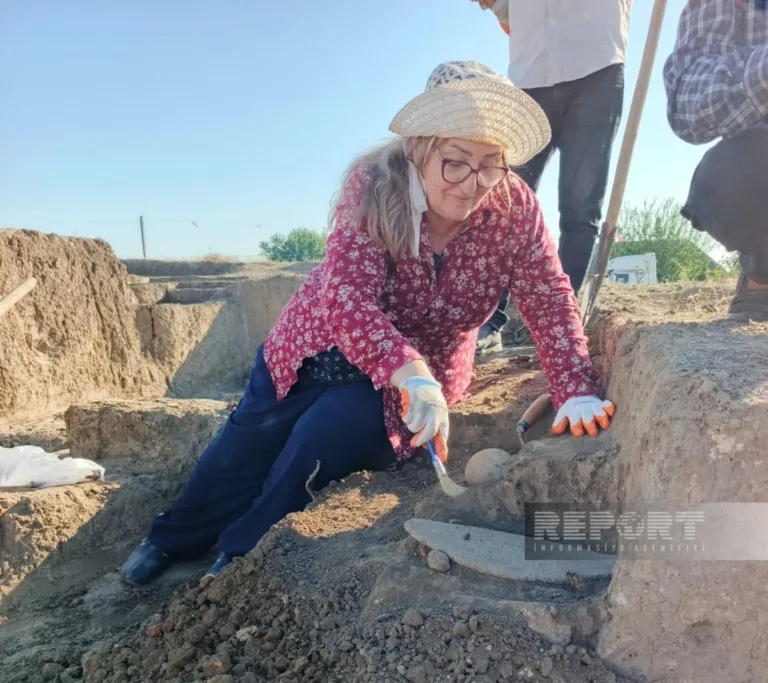
A rare find from Azerbaijan’s Neolithic landscape
Pashatepe is not an isolated findspot. It is part of the Mughan region, a lowland zone in southeastern Azerbaijan that has become increasingly important for understanding early farming communities in the South Caucasus.
The settlement belongs to the Neolithic world of the 6th millennium BC, a period when communities in this region were building mudbrick houses, raising animals, cultivating crops, making pottery, and developing new forms of settled life.
Recent research by Mahmudova has argued that the Mughan Plain was one of the centers where a local Neolithic culture formed in the South Caucasus during the 6th millennium BC. The same work places Pashatepe within a broader system of sites that included Alikomektepe and Polutepe, settlements linked by geography, material culture, and early agricultural traditions.
That background matters for the stone sphere. It was not found in a random landscape, but in a region where Neolithic communities were already producing distinct architecture, ceramics, stone objects, and ritual practices.
Why archaeologists are cautious
Stone artifacts are common at Neolithic sites. Grinding stones, pounders, axes, polishers, blades, and other worked objects were part of ordinary life in early farming settlements. They helped people process grain, prepare food, shape materials, and carry out household or craft tasks.
The Pashatepe sphere is harder to explain.
If it had been used for pounding, archaeologists might expect clearer traces of repeated impact. If it had been attached to something, a hole or groove might be expected. If it functioned as a weight, researchers will need to understand whether its mass fits any known measuring system. If it was ritual, its meaning may depend on the space in which it was found and whether related objects appear nearby.
This uncertainty is part of the object’s value. The stone sphere does not provide an easy answer. Instead, it opens a more interesting question: what kinds of objects were Neolithic communities in the Mughan Plain making beyond the tools needed for basic survival?
According to the researchers, no direct morphological analogue has yet been recorded in published material from the South Caucasus. That does not mean the object is impossible to compare globally. It means that, within the known regional record, it currently stands apart.
Pashatepe and the movement of ideas
The Neolithic of Azerbaijan sits within a larger story of contact between the South Caucasus, Anatolia, northern Mesopotamia, the Iranian plateau, and the Levant. Farming and herding did not spread into a blank landscape. Local communities adopted, adapted, and transformed new ways of living.
Pashatepe appears to reflect that process. Research on the site has connected the Mughan region with wider cultural movements while also emphasizing local development. The settlement has produced mudbrick architecture, pottery, stone objects, burials, and evidence of ritual behavior.
One of the more striking details recorded in previous research from Pashatepe is a child burial accompanied by the remains of a large horned animal placed behind the body. Mahmudova’s study interprets this as an unusual burial practice within the site’s Neolithic ritual world.
The newly reported stone sphere should be understood against that wider background. Its form may be practical, symbolic, or somewhere between the two. In early farming societies, those categories were not always separate. Objects could measure, mark status, serve in ritual, or carry meanings that are difficult to recover from shape alone.
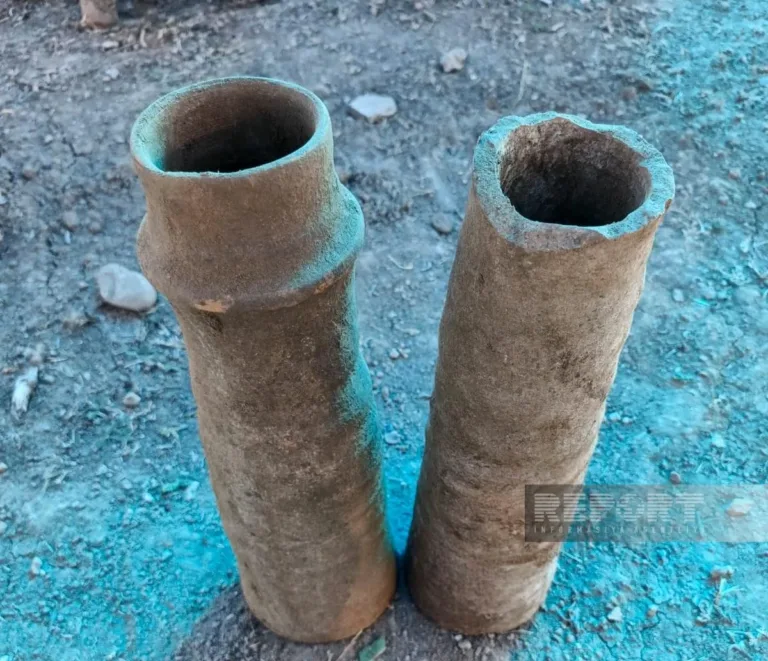
Later traces at the same site
The latest excavation also produced evidence from later periods. Archaeologists expanded the excavation area and continued work at a depth of about 45–50 centimeters. In the newly opened area, they recorded ceramic pipe-like elements interpreted as part of a drainage or water system, possibly dating to the medieval period.
These pipes are not directly linked to the Neolithic sphere. They show that the area continued to be used or revisited long after the prehistoric settlement phase. Their exact date has not yet been established.
Researchers also inspected the nearby Alikomektepe monument, another important site in the Jalilabad region. Working with regional heritage officials, they clarified the site’s earlier coordinates and protection-zone boundaries and identified areas that are now reportedly under illegal use.
A small object, still unexplained
For now, the polished stone sphere from Pashatepe remains an unusual object from a formative period in the prehistory of Azerbaijan.
Its size is modest. Its implications are not. A 10-centimeter stone ball from a Neolithic settlement may point to measurement, ritual practice, craft skill, or an object category that has not yet been clearly recognized in the South Caucasus.
The next stage will be technical rather than dramatic: microscopic use-wear analysis, raw material identification, comparison with other Neolithic stone objects, and careful publication of the find context.
Until then, the sphere is best described not as a solved mystery, but as a rare object from a region where early farming communities were shaping their own version of Neolithic life.