
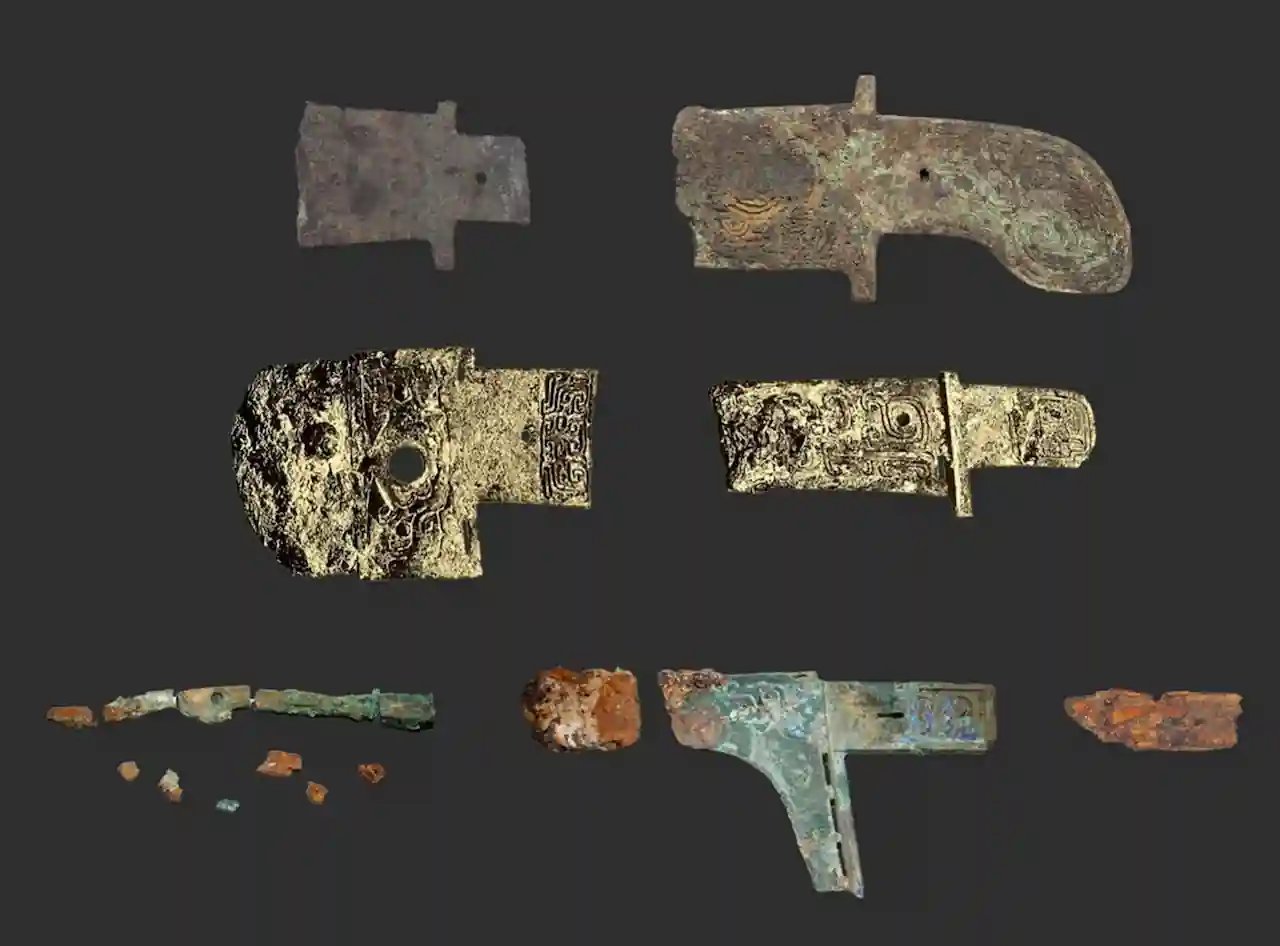
A dark, corroded meteorite iron object lay buried for thousands of years inside a ritual pit in southwestern China. At first, it looked unremarkable. Then scientists analyzed it—and what they found may change how we understand early technology: the Sanxingdui artifact appears to be made from meteorite iron, a material that did not originate on Earth.
A Discovery That Should Not Exist
The object, labeled K7QW-TIE-1, was unearthed from Pit No. 7 at the Sanxingdui archaeological site—an already enigmatic Bronze Age civilization known for its surreal masks and monumental bronze sculptures.
Measuring about 20 centimeters, the artifact resembles a narrow axe or tool. At first glance, its form seems simple. Its composition, however, tells a very different story.
Laboratory tests revealed a material made of more than 90% iron and around 7.4% nickel.
That combination is the problem.
During the Bronze Age (3000–1200 BCE), iron smelting technology had not yet developed in China. Objects like this should not exist in that context.
And yet, here it was—carefully placed inside a sacrificial pit.
The Nickel Signature No One Expected
The real breakthrough came with microscopic analysis.
Using scanning electron microscopy, researchers discovered that nickel within the artifact was not randomly distributed. Instead, it appeared remarkably uniform, in some areas reaching concentrations close to 20%.
That detail is critical.
Even much later civilizations struggled to produce iron–nickel alloys with such consistency. The two elements behave differently under heat, separating rather than blending evenly without advanced control.
But this object shows none of that instability.
It is chemically balanced in a way that ancient metallurgy cannot easily explain.
Which leaves a far more unusual possibility:
the metal may not have been produced on Earth at all.
A Material That Formed in Space
Further evidence comes from the artifact’s internal structure.
Scientists identified equiaxed ferrite grains—a crystalline pattern that forms only when metal cools extremely slowly over long periods. On Earth, such conditions are rare and difficult to sustain.
In space, however, they are normal.
Metallic meteorites cool gradually over millions of years in a vacuum, producing exactly this kind of structure.
Taken together—the nickel content, the uniform distribution, and the crystalline pattern—the evidence points in the same direction.
This object was likely not smelted, but instead crafted from a fragment of a meteorite.
In other words, ancient artisans may have taken material that fell from the sky and turned it into a functional object.

More Than Just a Tool
The artifact’s purpose is still debated.
Its hardness suggests it could have been used as a cutting or carving tool, perhaps even in the production of Sanxingdui’s famous bronze works. But its archaeological context tells a different story.
It was found inside a sacrificial pit, among objects believed to hold ritual meaning.
That matters.
Across many ancient cultures, materials from the sky were not ordinary resources. They were symbols of power, divinity, and cosmic connection.
This raises a possibility that cannot be ignored:
the object may have been both practical and symbolic—valued not only for what it could do, but for where it came from.
A Rare Find—Even Globally
Artifacts made from meteoritic iron are known, but they are exceptionally rare.
Examples have been discovered in ancient Egypt and parts of Europe, including Spain’s Villena Treasure. In China, however, only about a dozen similar objects have been identified—and most come from northern regions.
The Sanxingdui artifact stands apart.
It is the largest meteoritic iron object ever found in China, and the first of its kind in the southwest. Unlike northern examples, which often combine iron with bronze, this piece is entirely iron.
That difference is not minor.
It suggests that the Sanxingdui culture may have followed a distinct technological or cultural path, separate from other regions.
Fragile Evidence, Ongoing Questions
Time has not been kind to the artifact.
After centuries of corrosion, it is now extremely fragile. Archaeologists removed it together with surrounding soil and transferred it to a conservation laboratory at the Sanxingdui Museum, where it is being preserved under controlled conditions.
Further analysis may help identify the exact type of meteorite used. But there is a limit—each new test risks damaging the object.
For now, the research continues carefully, step by step.
A Discovery That Changes the Question
This find does more than add another artifact to the archaeological record.
It changes the question itself.
Instead of asking when ancient societies learned to produce iron, we may need to ask something else:
how did they recognize—and decide to use—materials that came from beyond Earth?
Sanxingdui has long challenged conventional narratives with its unusual art and cultural practices. This discovery pushes that challenge even further.
Because if confirmed, it suggests that one of humanity’s earliest metal objects was not just crafted by human hands—
but born in space, and shaped on Earth.
Haichao Li, Zishu Yang, Yuniu Li, Jiahui Liu, Yu Lei, Honglin Ran, The earliest meteoritic iron artefact of the Chinese Bronze Age discovered at Sanxingdui, Southwest China. Archaeological Research in Asia, Volume 46, June 2026, 100692. doi.org/10.1016/j.ara.2026.100692
Cover Image Credit: H. Li et al. 2026, Archaeological Research in Asia