Iron trade, long assumed to revolve around finished weapons and refined metal, is now being reconsidered after a striking discovery off the Carmel coast. Beneath the shallow waters near Dor Lagoon, archaeologists uncovered a 2,600-year-old shipwreck carrying raw, unworked iron—evidence that challenges established views of how this critical resource moved across the ancient Mediterranean.
An Ordinary Wreck That Wasn’t
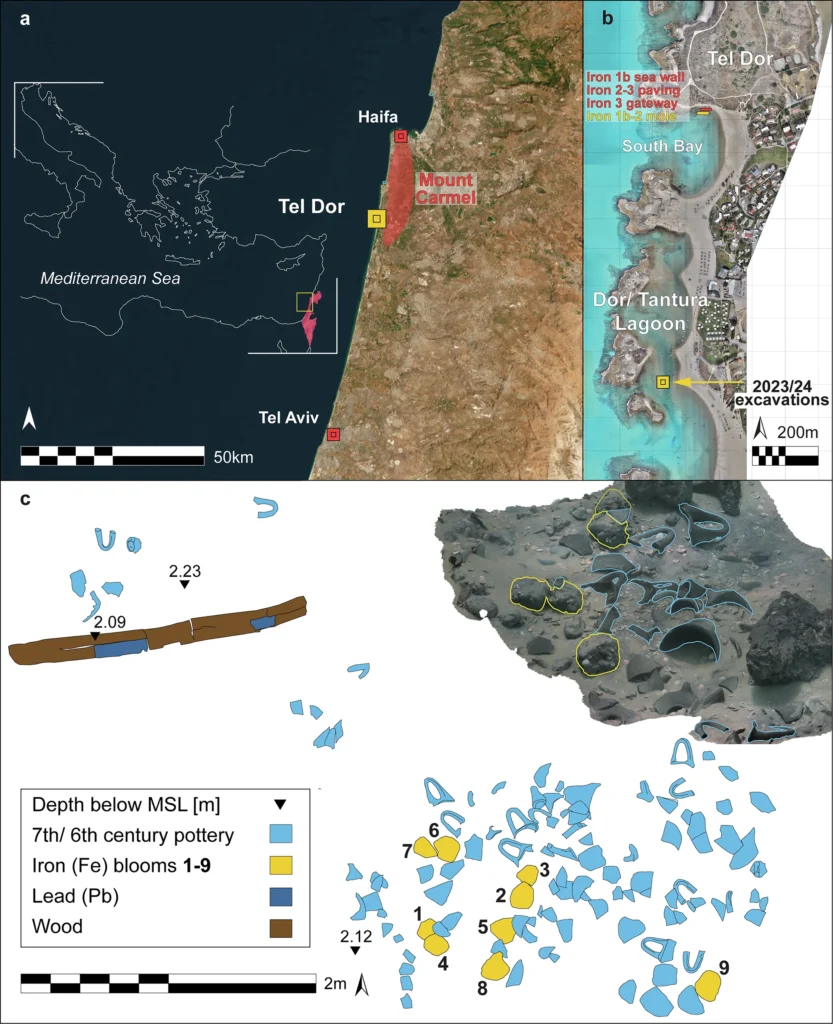
At first, the site appeared routine. Amphora fragments, an anchor, ballast stones, and organic remains such as grape seeds—nothing unusual for an Iron Age vessel.
Then came the real surprise.
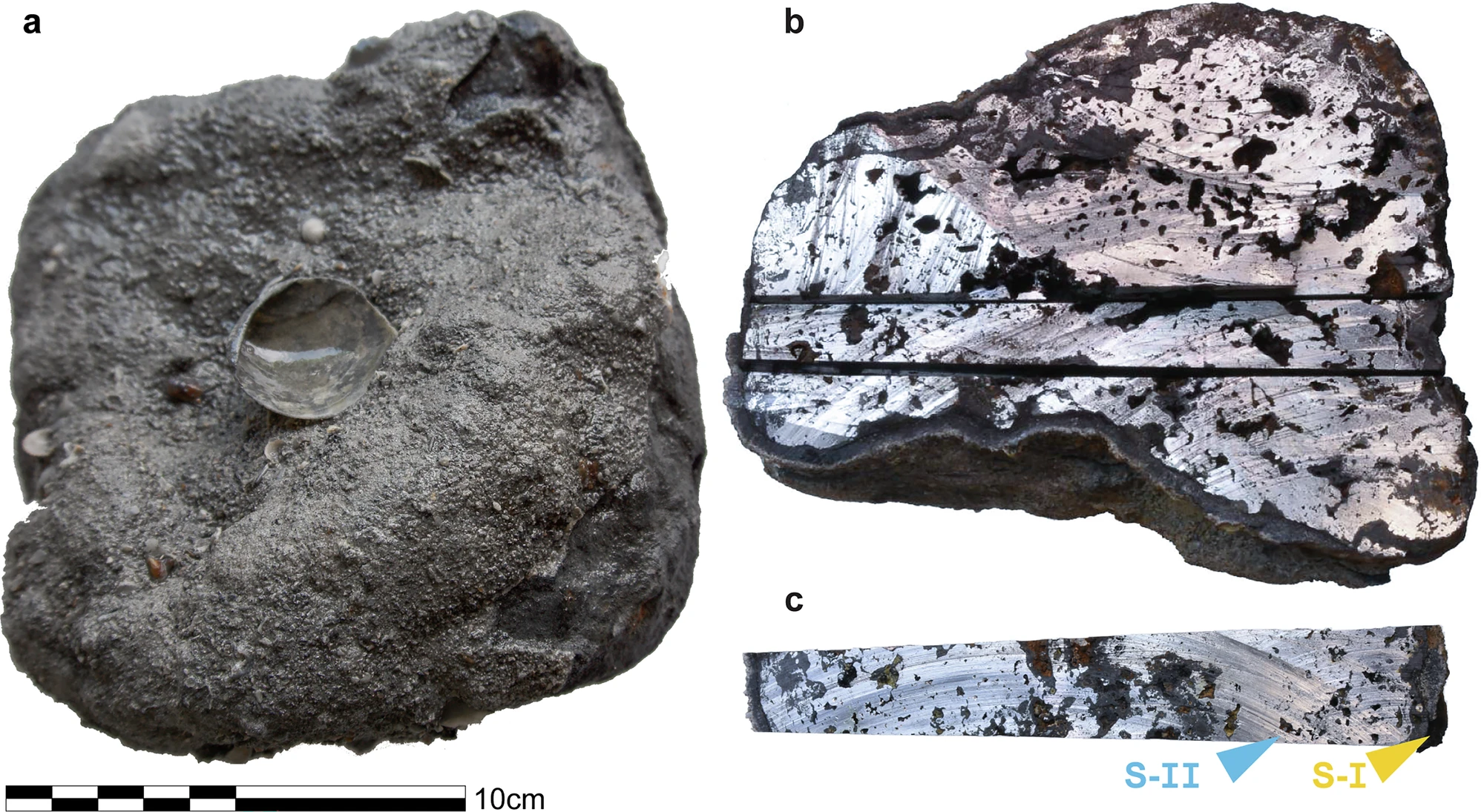
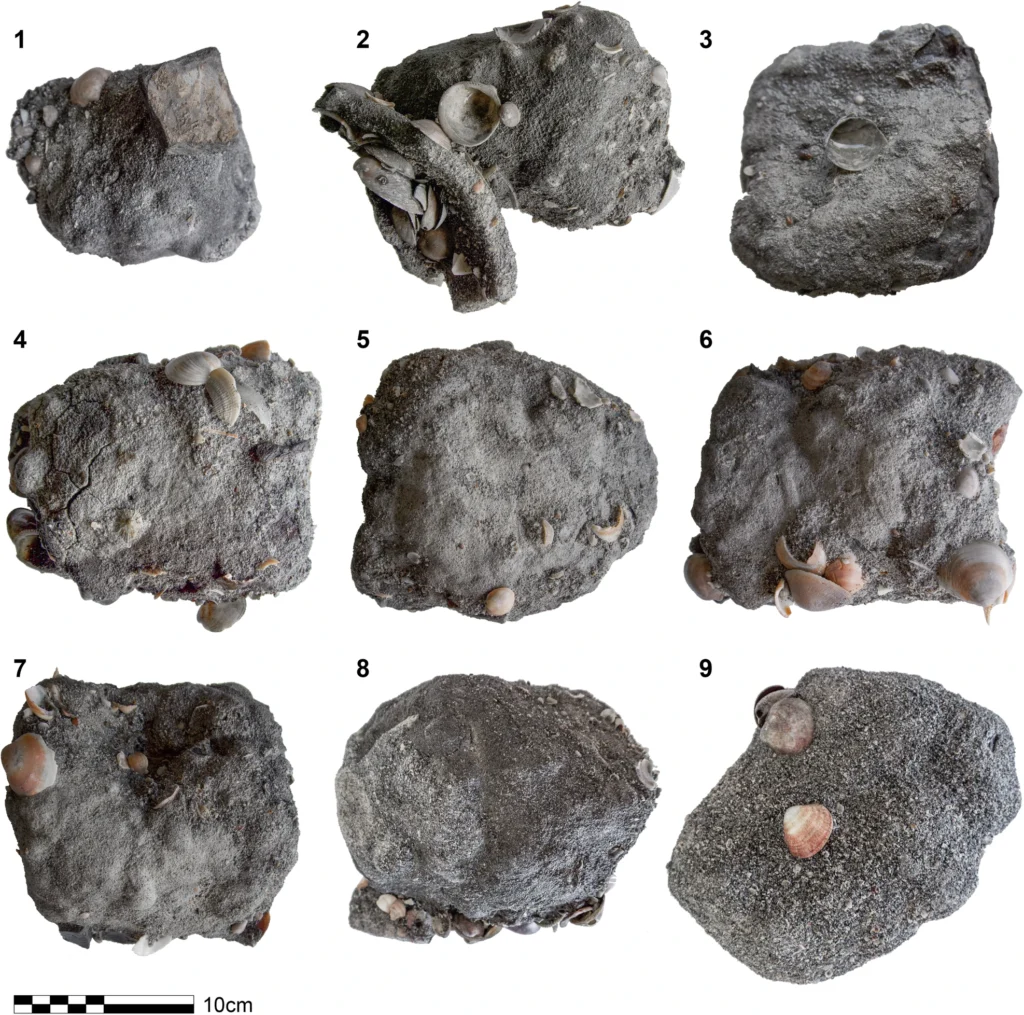
Nine heavy iron masses were recovered from the seabed, each weighing between 5 and 10 kilograms. These were not tools or weapons, but iron blooms—spongy, semi-processed lumps produced during the earliest stage of smelting.
That distinction changes everything.
A Detail That Breaks the Model
In traditional metallurgy, blooms were never meant to travel. They were unstable, full of slag, and had to be forged quickly while still hot to become usable metal.
But the Dor blooms tell a different story.
Scientific analysis shows they were never refined. Their internal structure still contains pores, slag inclusions, and uneven carbon distribution—clear signs of iron in its rawest state. This was not unfinished work left behind.
It was cargo. Deliberately transported.
A Precise Moment in a Turbulent World
Dating evidence makes the discovery even more significant. A charred oak fragment embedded inside one bloom, combined with organic remains from the wreck, places the ship’s final voyage around 639–631 BCE.
This was not a stable period.
The Neo-Assyrian Empire was collapsing, Babylon was rising, and Egypt was reasserting control across the Levant. In such a landscape, access to iron meant access to power.
And that power depended on supply.
Not Weapons—A Supply Chain
What the Dor shipwreck reveals is not just a cargo, but a system.
Until now, iron was thought to circulate mainly as finished or semi-finished material. The presence of raw blooms challenges that assumption and suggests a more complex production network.
Smelting likely took place near ore sources, raw blooms were transported across long distances, and final forging happened at their destination. This points to a distributed system of production, where different regions specialized in different stages rather than relying on a single centralized process.
Why Ship Raw Iron?
At first glance, transporting unfinished metal seems inefficient. Blooms require additional work, fuel, and expertise before they can be used.
But the Dor evidence points to a practical advantage.
Each bloom was covered in slag—a byproduct of smelting that formed a natural protective layer. This coating likely shielded the iron from corrosion during long sea voyages. In contrast, finished iron would have been far more vulnerable.
Shipping iron in its raw state may have been the smarter choice.
A Mediterranean Network in Motion
The rest of the cargo reinforces this picture. Amphorae linked to Cyprus and the Aegean suggest that the vessel was part of a wider trade system connecting the Levant, Egypt, Cyprus, and the broader Mediterranean.
Such networks are often associated with Phoenician traders, but the evidence also points to something more flexible than a strictly controlled imperial system.
Iron appears to have circulated through dynamic commercial routes, involving traders, workshops, and regional powers rather than a single authority.
Rethinking Ancient Industry
The implications reach deep into archaeology itself.
For decades, researchers have debated whether ironworking remains in ancient cities reflect local smelting or secondary processing. The Dor blooms strongly support the second scenario.
Many urban centers may not have produced iron from ore at all. Instead, they likely imported raw material and refined it locally, reshaping how we interpret furnaces, slag deposits, and workshop remains across the region.
Warfare Was Built on Trade
This discovery also reframes how ancient armies were supplied.
If weapons were produced locally from imported raw iron, then military strength depended not only on access to mines, but on access to trade networks.
Control the routes, and you control the material.
Control the material, and you control the army.
A Quiet Discovery with Big Consequences
The Dor shipwreck does not look spectacular. There is no gold, no monumental sculpture, no royal inscription.
Just rough, dark masses of iron.
Yet these unworked blooms reveal something far more important: a hidden system of movement, specialization, and strategy that underpinned the ancient world.
By demonstrating that raw iron itself was a traded commodity, the discovery reshapes how we understand both industry and warfare in the Iron Age. It suggests that the foundations of ancient power were not only forged in workshops, but also transported across the sea in a form that was, until now, largely overlooked.
Eshel, T., Ioffe, A., Langgut, D. et al. Earliest iron blooms discovered off the Carmel coast revise Mediterranean trade in raw metal ca. 600 BCE. npj Herit. Sci. 14, 155 (2026). https://doi.org/10.1038/s40494-026-02409-7
Cover Image Credit: Eshel, T.,et al., 2026, npj Heritage Science