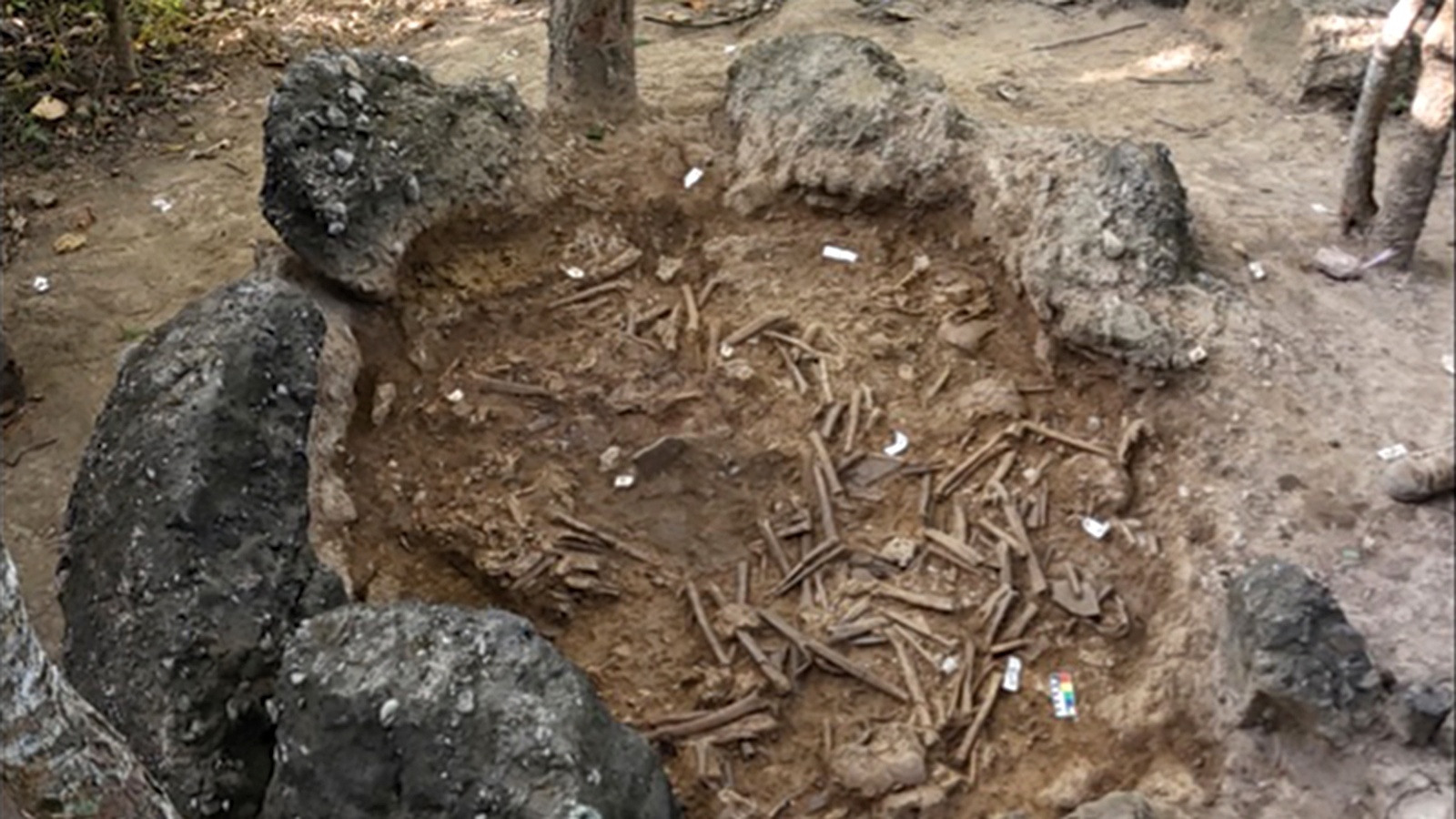
A Laos death jar has revealed something archaeologists had long suspected but rarely seen so clearly: at least one of the great stone vessels of the Plain of Jars was used to hold the dead.
Inside a massive stone jar at Site 75 in northern Laos, researchers found the disarticulated remains of at least 37 people. The bones and teeth were not placed there in a single event. Radiocarbon dating suggests the jar was used between about AD 890 and 1160, possibly over several generations, as part of a complex mortuary tradition in the highlands of Southeast Asia.
The discovery, published in Antiquity, gives rare direct evidence for how some of the region’s mysterious megalithic jars may have been used. For decades, scholars have debated whether the great stone vessels scattered across the Xieng Khouang Plateau served as burial containers, ritual monuments, storage vessels, or something else entirely. This find does not solve every question. But it brings one answer into sharper focus. Some jars were clearly involved in the treatment of the dead.
A stone jar filled with human remains
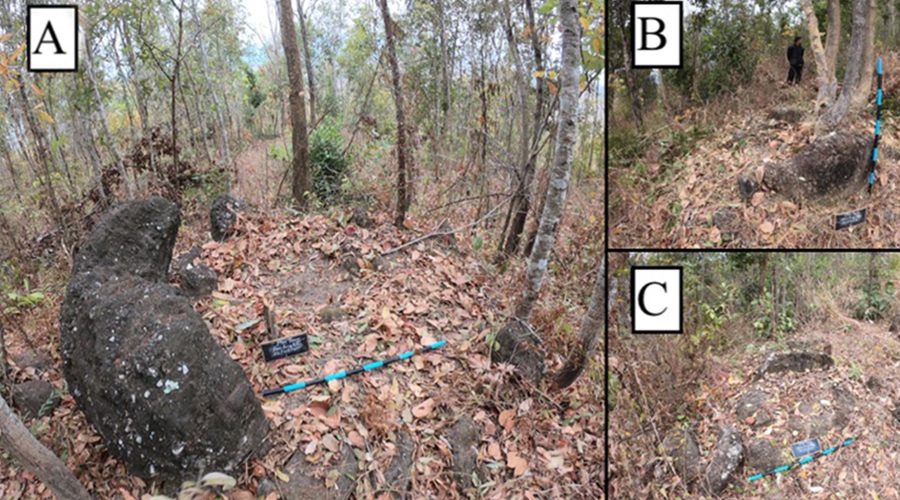
The excavated vessel, known as Jar 1, stands at Site 75, about 70 kilometers northeast of Phonsavan. It is among the largest known jars in Laos, with a base diameter of 2.05 meters and a preserved height of 1.30 meters. Though damaged, it retained enough of its base and sides to preserve deposits inside.
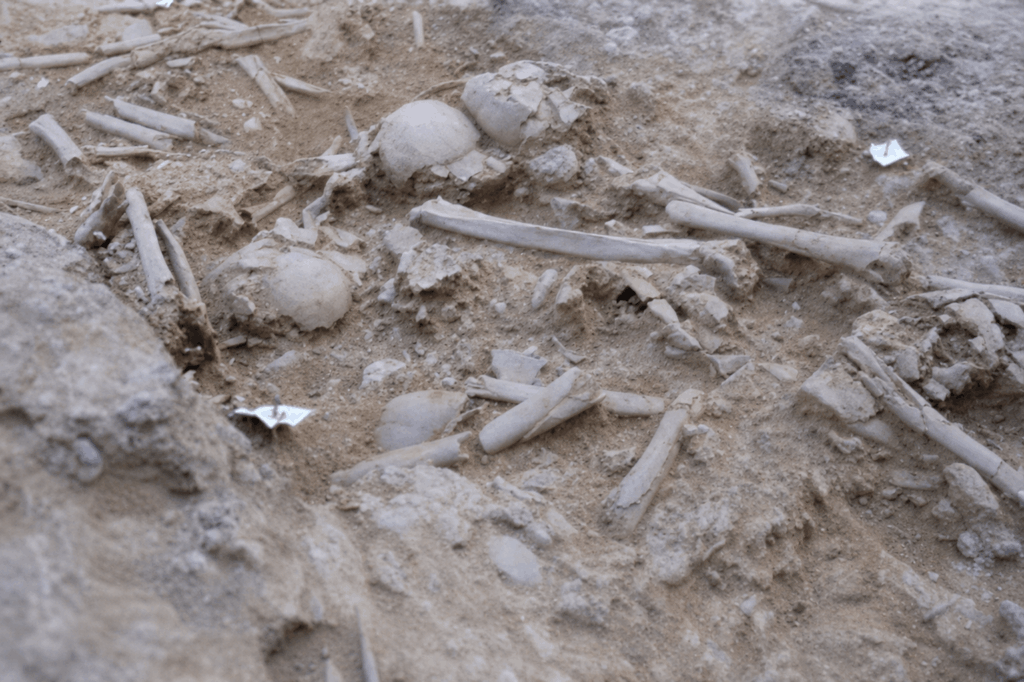
When archaeologists excavated the jar, they uncovered a dense concentration of human bone. The remains were partly scattered, partly grouped. Skull and facial bones were found close to the jar edges, while long bones appeared in deliberate bundles. Teeth provided the highest minimum count, showing that at least 37 individuals were represented.
The dead included young children and adults. Preliminary study found individuals from around 1.5 years old upward, although detailed osteological analysis is still underway. The researchers also noted signs of tooth ablation, a ritual modification involving the removal of certain teeth, a practice known from other parts of mainland Southeast Asia.
This was not the pattern of a normal grave. The lack of complete skeletons, the mixed bones, and the careful grouping of selected body parts point instead to secondary burial. In this practice, bodies were likely allowed to decompose elsewhere before selected remains were gathered and placed inside the jar.
Not one burial, but a long ritual process
The most important point is that Jar 1 was probably not a final resting place in the simple sense. It may have been one stage in a longer funerary sequence.
The radiocarbon dates from human bones and teeth fall between approximately AD 890 and 1160. That range suggests repeated use over time, perhaps for as long as 270 years. The jar may have served a family, an extended community, or a social group that returned to the same vessel across generations.
That idea changes the emotional weight of the discovery. This was not just a container for bones. It may have been a place of return, memory, and ancestral ritual.
Some skulls and jawbones were found in close association, which could mean that certain individuals were deposited before the soft tissues had completely disappeared. But the broader pattern still favors a secondary process. Complete articulated skeletons were absent, including at joints that usually remain connected longest after death.
The researchers therefore suggest that Jar 1 may have functioned as an ossuary, a place where human remains were collected after earlier stages of mortuary treatment.
Glass beads point to wider Asian connections
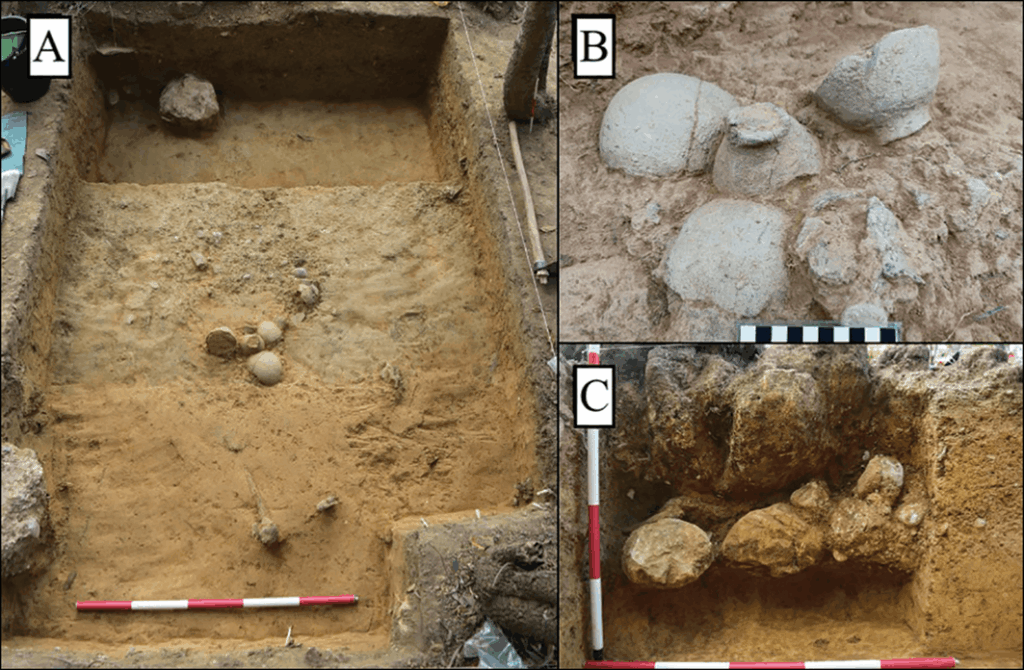
The jar also contained more than human remains. Archaeologists recovered earthenware sherds, an iron knife, a small copper-based bell, 20 glass beads, and five stone slabs. Some of the pottery resembles vessel types previously linked to mortuary activity at other Plain of Jars sites.
The glass beads add another layer to the story. Twelve beads were chemically analyzed, and most were consistent with South Asian glass-making traditions, especially eastern South India. Two others appear closer to plant-ash glass traditions associated with West Asia, including Mesopotamia. One potash-rich bead may have come from southeastern China or northern Vietnam.
These small objects show that the people who used Jar 1 were not isolated highland communities cut off from the wider world. Their burial rituals included objects that moved through long-distance exchange networks across South Asia, West Asia, and Southeast Asia.
The dates also matter. The jar’s use overlaps with a period of expanding regional interaction, when the Song Dynasty, the Dali Kingdom, Đại Việt, Champa, Pagan, Dvaravati, and the Khmer Empire all formed part of a dynamic Asian world of trade, movement, and cultural exchange.
A new clue in the Plain of Jars mystery
The Plain of Jars has long been one of Southeast Asia’s most compelling archaeological landscapes. Hundreds of large hollowed stone jars are spread across more than 120 known sites in northern Laos. Their makers remain poorly understood, and the chronology of the megalithic tradition is still being refined.
Previous excavations had found burials around jars, along with pottery, beads, metal objects, and fragments of burnt bone. But Jar 1 at Site 75 is exceptional because it preserved a large, in-situ assemblage of human remains inside the vessel itself.
That makes the discovery powerful, but also easy to overstate. The find does not prove that every jar at every site was used in exactly the same way. The Plain of Jars covers a broad landscape, and mortuary practices may have varied from place to place and across time.
Still, Jar 1 offers one of the clearest windows yet into the role these stone vessels played in death rituals. Smaller jars may have been used during earlier stages of decomposition, while larger jars like Jar 1 could have received selected bones afterward. Some remains may later have been removed again for reburial elsewhere. The empty state of many other jars may not mean they were unused. It may mean they were part of a moving ritual process.
Generations remembered in stone
The discovery turns a monumental landscape into something more intimate. The Plain of Jars is often described through its mystery and scale. Jar 1 brings that mystery down to the level of individual bodies, teeth, bones, offerings, and repeated acts of care.
The people placed inside the jar lived and died in a region connected to wider Asian exchange routes. They were children and adults, possibly relatives or members of the same community. Their remains were gathered, arranged, and revisited in a ritual tradition that lasted for generations.
Future DNA and bioarchaeological studies may reveal whether the individuals were biologically related, where they came from, what they ate, and how they lived. For now, Jar 1 shows that the stone vessels of Laos were not only monuments of an unknown past. At least in this case, they were places where the dead remained present.
Cover Image: Human remains uncovered inside Jar 1 at Site 75 in Laos, where archaeologists identified at least 37 individuals in a multigenerational mortuary deposit. Credit: Skopal et al., Antiquity 2026 / CC BY 4.0